


Augmenting progress on the elimination of vertical transmissions of HIV in India: Insights from Spectrum-based HIV burden estimations
- PMID: 37556441
- PMCID: PMC10411776
- DOI: 10.1371/journal.pgph.0002270
Augmenting progress on the elimination of vertical transmissions of HIV in India: Insights from Spectrum-based HIV burden estimations
Abstract
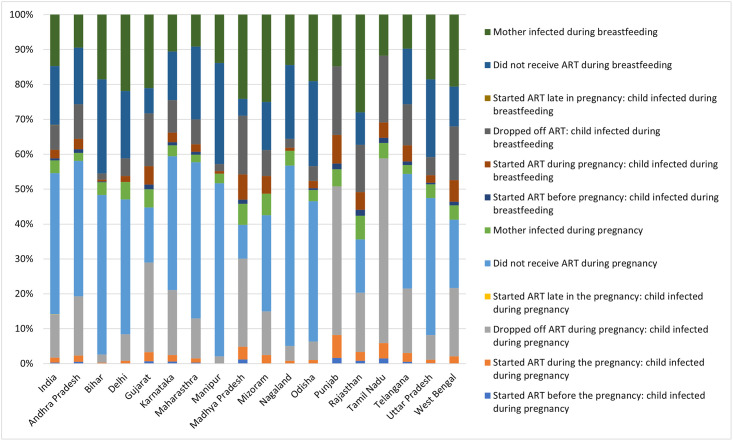
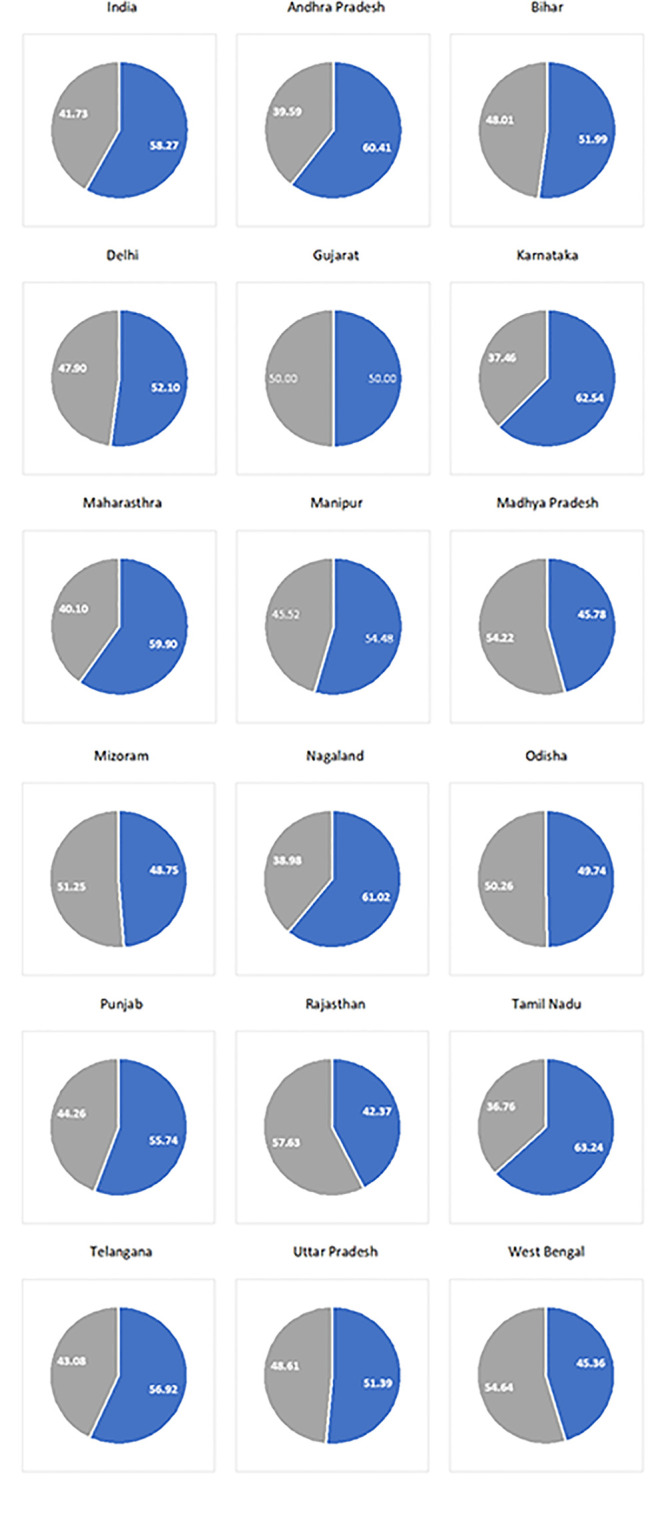
The government of India has adopted the elimination of vertical transmission of HIV as one of the five high-level goals under phase V of the National AIDS and STD Control Programme (NACP). In this paper, we present the data from HIV estimations 2021 for India and select States detailing the progress as well as the attributable causes for vertical transmissions. The NACP spearheads work on mathematical modelling to estimate HIV burden based on the periodically conducted sentinel surveillance for guiding program implementation and policymaking. Using the results of the latest round of HIV Estimations in 2021, we analysed the mother-to-child transmission (MTCT) during the perinatal and postnatal (breastfeeding) period. In 2021, overall, around 5,000 [3,000-7,800] vertical transmissions were estimated nationally with 58% being perinatal infections and remaining during breastfeeding. MTCT at 6 weeks was around 12.95% [9.45-16.02] with the final transmission rate at 24.25% [18.50-29.50]. Overall, 57% of vertical transmissions were among HIV-positive mothers who did not receive ART during pregnancy or breastfeeding, 19% among mothers who dropped off ART during pregnancy or delivery, and 18% among mothers who were infected during pregnancy or breastfeeding. There were significant variations between States. Depending upon the States, the programme needs to focus on the intervention domains of timely engagement in antenatal care-HIV testing-ART initiation as well as programme retention and adherence support. Equally important would be strengthening the strategic information to generate related evidence for inputting India and State-specific parameters improving the MTCT-related modelled estimates.
Copyright: © 2023 Kumar et al. This is an open access article distributed under the terms of the Creative Commons Attribution License, which permits unrestricted use, distribution, and reproduction in any medium, provided the original author and source are credited.
Conflict of interest statement
The authors have declared that no competing interests exist.
Figures
References
-
- United Nations General Assembly. Political Declaration On HIV And AIDS: On The Fast-Track To Accelerate The Fight Against HIV And To End The AIDS Epidemic By 2030. United Nations; 2016. https://www.unaids.org/en/resources/documents/2016/2016-political-declar....
-
- Joint United Nations Programme on HIV/AIDS. Global AIDS Strategy 2021–2026. End Inequalities. End AIDS. UNAIDS, Geneva, Switzerland; 2021. https://www.unaids.org/sites/default/files/media_asset/global-AIDS-strat....
-
- Joint United Nations Programme on HIV/AIDS. New global pledge to end all inequalities faced by communities and people affected by HIV towards ending AIDS. UNAIDS, Geneva, Switzerland; 2021. https://www.unaids.org/en/resources/presscentre/pressreleaseandstatement....
-
- World Health Organization. Global guidance on criteria and processes for validation: elimination of mother-to-child transmission of HIV, syphilis and hepatitis B virus. Geneva: WHO; 2021. Licence: CC BY-NC-SA 3.0 IGO.
-
- Joint United Nations Programme on HIV/AIDS. UNAIDS 2022 epidemiological estimates. UNAIDS, Geneva, Switzerland; 2022. https://aidsinfo.unaids.org/.
LinkOut - more resources
Full Text Sources
Research Materials