


Associations Between Monthly Cannabis Use and Myocardial Infarction in Middle-Aged Adults: NHANES 2009 to 2018
- PMID: 37556891
- PMCID: PMC10998689
- DOI: 10.1016/j.amjcard.2023.07.065
Associations Between Monthly Cannabis Use and Myocardial Infarction in Middle-Aged Adults: NHANES 2009 to 2018
Abstract
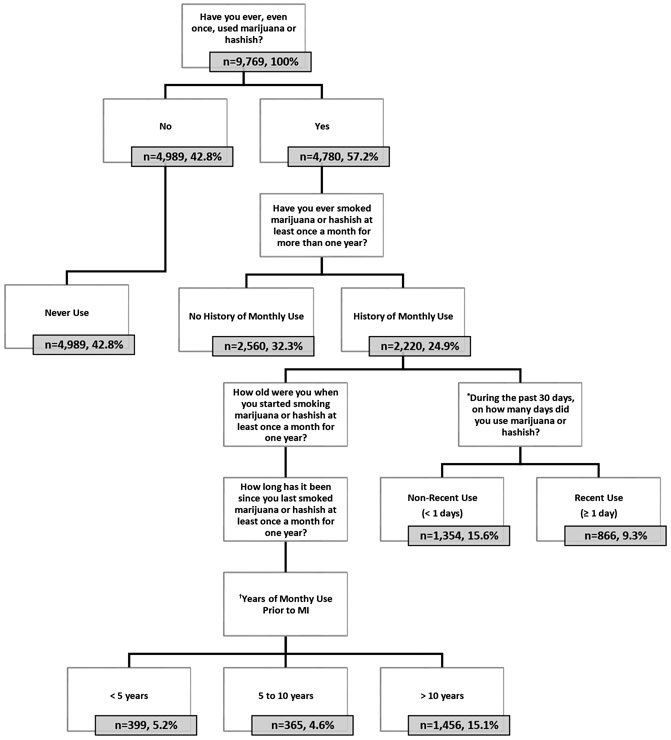
Mechanistic research suggests using Cannabis sativa L. (cannabis or marijuana) may increase the risk of cardiometabolic disease, but observational studies investigating associations between cannabis use and myocardial infarction (MI) have reported inconsistent results. Cross-sectional National Health and Nutrition Examination Survey data from five 2-year cycles between 2009 and 2018 and representing 9,769 middle-aged adults (35 to 59 years old) were analyzed. Multivariable logistic regression models accounting for sampling weights and adjusting for cardiovascular risk factors were used to assess associations between a history of monthly cannabis use before MI and a subsequent MI. A quarter of respondents (n = 2,220) reported a history of monthly use >1 year before an MI. A history of MI was reported by 2.1% of all respondents and 3.2.% of those who reported a history of monthly use. In fully adjusted multivariable models, and compared with never use, a history of monthly cannabis use preceding an MI was not associated with an MI (odds ratio [OR] 0.78, 95% confidence interval [CI] 0.35 to 1.71). However, when stratified by recent use, the odds of MI were threefold greater (OR 2.98, 95% CI 1.08 to 8.60) when no use was reported within the past month than when use was reported within the past month. Duration of monthly use was also not significantly associated with MI, including monthly use >10 years (OR 0.78, 95% CI 0.30 to 2.01). In conclusion, in a representative sample of middle-aged US adults, a history of monthly cannabis use >1 year before an MI was not associated with a subsequent physician-diagnosed MI, except for threefold greater odds when cannabis was not used within the past month.
Keywords: cannabis; cardiovascular disease; marijuana; myocardial infarction.
Copyright © 2023 The Authors. Published by Elsevier Inc. All rights reserved.
Conflict of interest statement
Declaration of Competing Interest Dr. Corroon is a member of the Board of Directors of CV Sciences Inc., a manufacturer of hemp-derived cannabidiol products. The remaining authors have no competing interests to declare.
Figures
References
-
- The Health Effects of Cannabis and Cannabinoids: The Current State of Evidence and Recommendations for Research. Washington: National Academies of sciences Engineering, and Medicine. The National Academies Press; 2017. - PubMed
-
- Page RL 2nd, Allen LA, Kloner RA, Carriker CR, Martel C, Morris AA, Piano MR, Rana JS, Saucedo JF, American Heart Association Clinical Pharmacology Committee and Heart Failure and Transplantation Committee of the Council on Clinical Cardiology; Council on Basic Cardiovascular Sciences; Council on Cardiovascular and Stroke Nursing; Council on Epidemiology and Prevention; Council on Lifestyle and Cardiometabolic Health; and Council on Quality of Care and Outcomes Research. Medical marijuana, recreational cannabis, and cardiovascular health: a scientific statement from the American Heart Association. Circulation 2020;142:e131–e152. - PubMed
-
- Pacher P, Steffens S, Haskó G, Schindler TH, Kunos G. Cardiovascular effects of marijuana and synthetic cannabinoids: the good, the bad, and the ugly. Nat Rev Cardiol 2018;15:151–166. - PubMed
Publication types
MeSH terms
Grants and funding
LinkOut - more resources
Full Text Sources
Medical
Miscellaneous
