


A 36,200-year-old carving from Grotte des Gorges, Amange, Jura, France
- PMID: 37558802
- PMCID: PMC10412625
- DOI: 10.1038/s41598-023-39897-7
A 36,200-year-old carving from Grotte des Gorges, Amange, Jura, France
Abstract
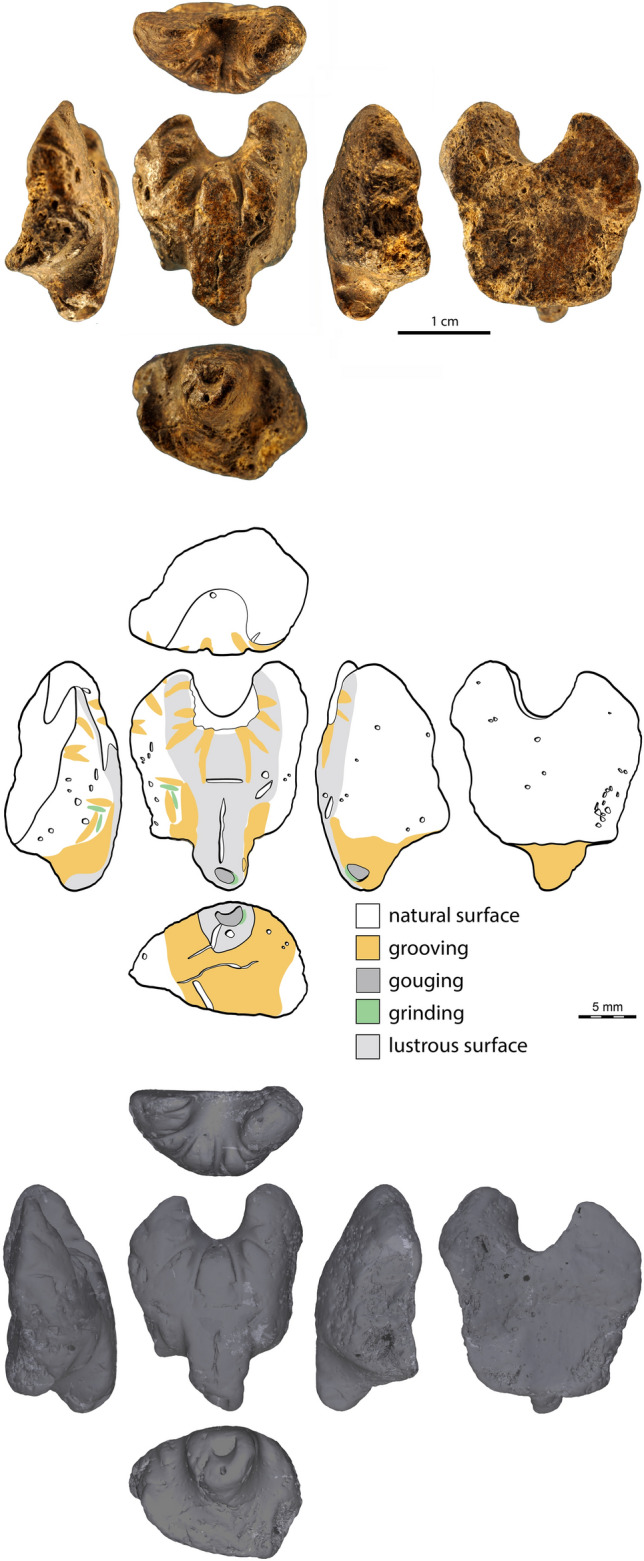
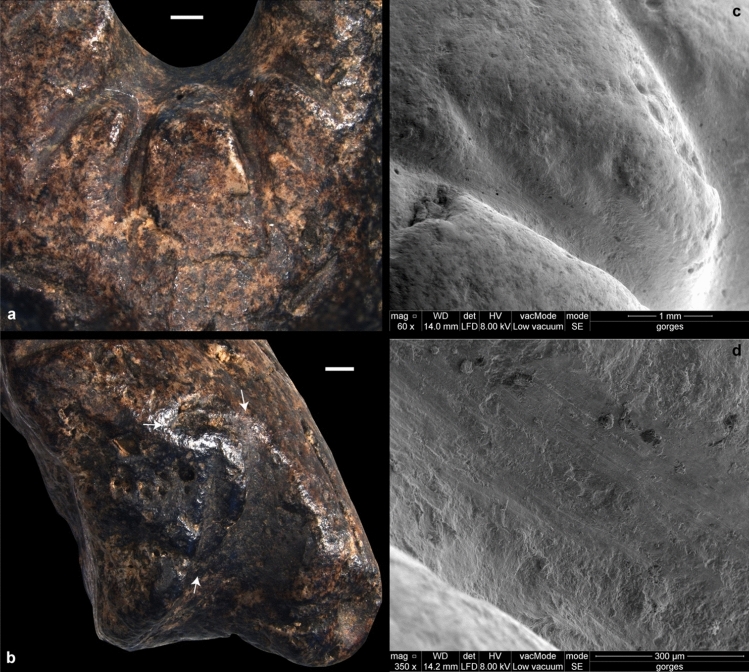
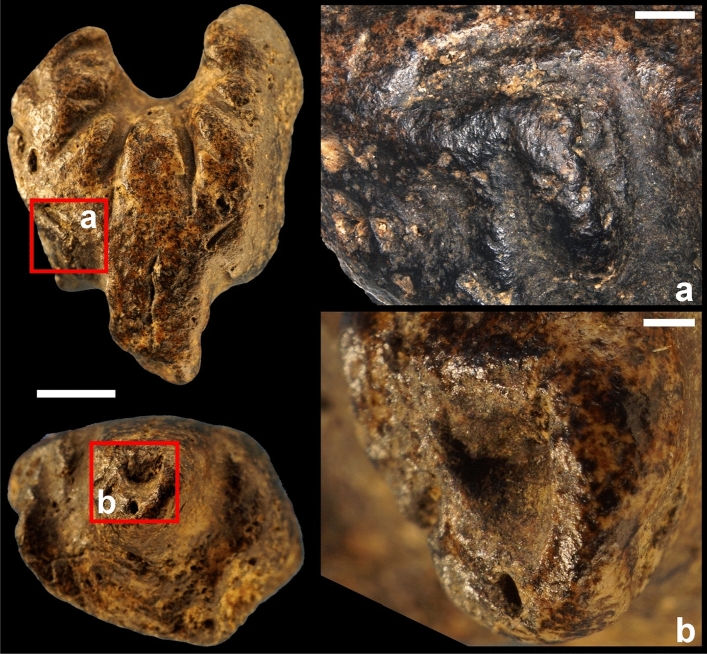
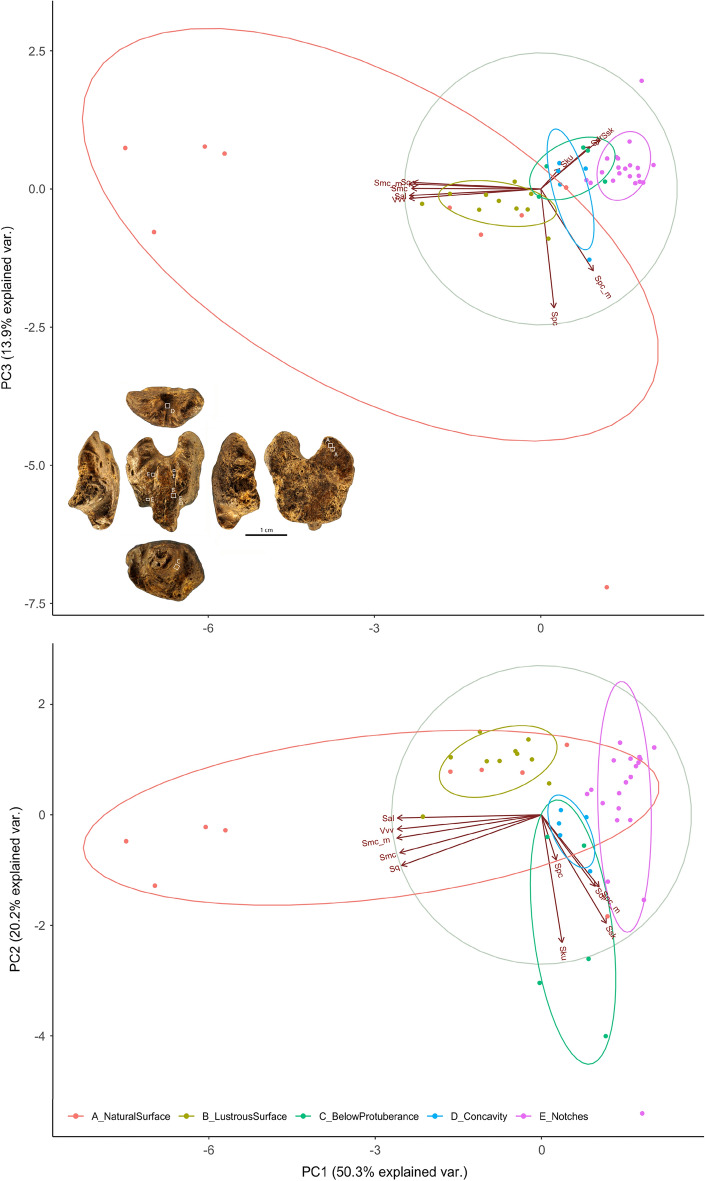
The earliest European carvings, made of mammoth ivory, depict animals, humans, and anthropomorphs. They are found at Early Aurignacian sites of the Swabian Jura in Germany. Despite the wide geographical spread of the Aurignacian across Europe, these carvings have no contemporaneous counterparts. Here, we document a small, intriguing object, that sheds light on this uniqueness. Found at the Grotte des Gorges (Jura, France), in a layer sandwiched between Aurignacian contexts and dated to c. 36.2 ka, the object bears traces of anthropogenic modifications indicating intentional carving. Microtomographic, microscopic, three-dimensional roughness and residues analyses reveal the carving is a fragment of a large ammonite, which was modified to represent a caniformia head decorated with notches and probably transported for long time in a container stained with ochre. While achieving Swabian Jura-like miniaturization, the Grotte des Gorges specimen displays original features, indicating the craftsman emulated ivory carvings while introducing significant technical, thematic, and stylistic innovations. This finding suggests a low degree of cultural connectivity between Early Aurignacian hunter-gatherer groups in the production of their symbolic material culture. The pattern conforms to the existence of cultural boundaries limiting the transmission of symbolic practices while leaving space for the emergence of original regional expressions.
© 2023. Springer Nature Limited.
Conflict of interest statement
The authors declare no competing interests.
Figures




References
-
- Klein, R. G. The human career (3rd ed.). (University of Chicago Press, 2009).
-
- Mellars, P. A. The character of the Middle-Upper Paleolithic transition on south-west France. in The explanation of culture change: Models in prehistory (ed. Renfrew, C.) 255–276 (Duckworth, 1973).
-
- Mania, D. & Mania, U. Bilzingsleben - Homo erectus, his culture and his environment. The most important results of research. in Lower Palaeolithic small tools in Europe and the Levant (eds. Burdukiewicz, J. M. & Ronen, A.) 29–48 (British Archaeological Reports, 2003).
Publication types
MeSH terms
LinkOut - more resources
Full Text Sources
