


A social network analysis model approach to understand tuberculosis transmission in remote rural Madagascar
- PMID: 37558982
- PMCID: PMC10410943
- DOI: 10.1186/s12889-023-16425-w
A social network analysis model approach to understand tuberculosis transmission in remote rural Madagascar
Abstract
Background: Quality surveillance data used to build tuberculosis (TB) transmission models are frequently unavailable and may overlook community intrinsic dynamics that impact TB transmission. Social network analysis (SNA) generates data on hyperlocal social-demographic structures that contribute to disease transmission.
Methods: We collected social contact data in five villages and built SNA-informed village-specific stochastic TB transmission models in remote Madagascar. A name-generator approach was used to elicit individual contact networks. Recruitment included confirmed TB patients, followed by snowball sampling of named contacts. Egocentric network data were aggregated into village-level networks. Network- and individual-level characteristics determining contact formation and structure were identified by fitting an exponential random graph model (ERGM), which formed the basis of the contact structure and model dynamics. Models were calibrated and used to evaluate WHO-recommended interventions and community resiliency to foreign TB introduction.
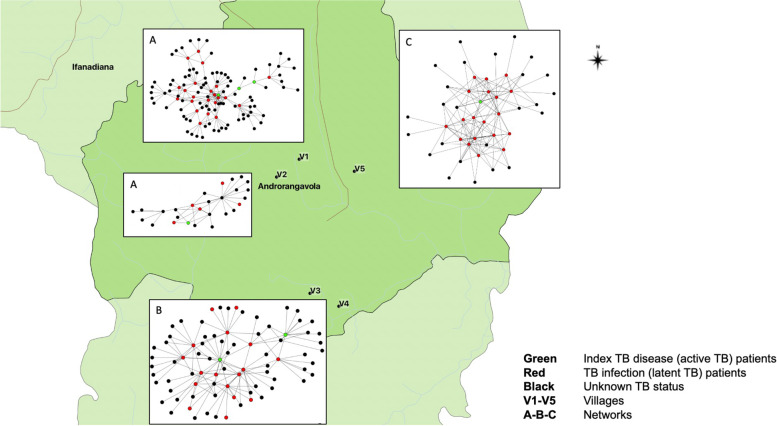
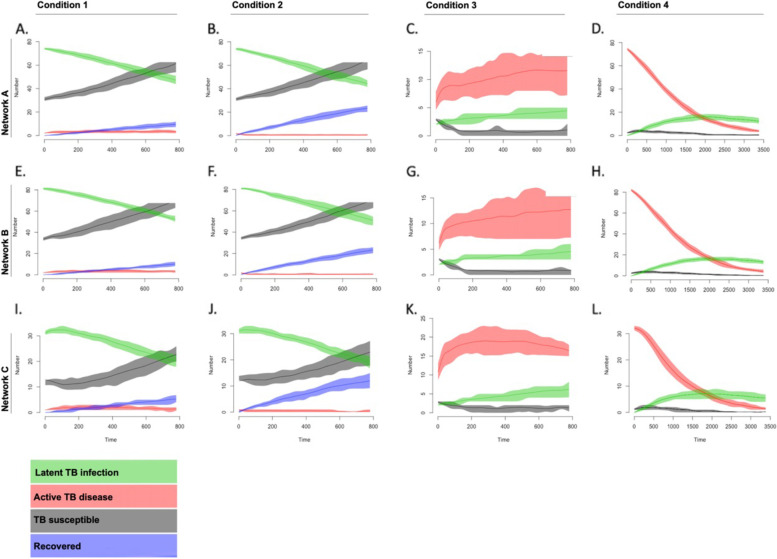
Results: Inter- and intra-village SNA showed variable degrees of interconnectivity, with transitivity (individual clustering) values of 0.16, 0.29, and 0.43. Active case finding and treatment yielded 67%-79% reduction in active TB disease prevalence and a 75% reduction in TB mortality in all village networks. Following hypothetical TB elimination and without specific interventions, networks A and B showed resilience to both active and latent TB reintroduction, while Network C, the village network with the highest transitivity, lacked resiliency to reintroduction and generated a TB prevalence of 2% and a TB mortality rate of 7.3% after introduction of one new contagious infection post hypothetical elimination.
Conclusion: In remote Madagascar, SNA-informed models suggest that WHO-recommended interventions reduce TB disease (active TB) prevalence and mortality while TB infection (latent TB) burden remains high. Communities' resiliency to TB introduction decreases as their interconnectivity increases. "Top down" population level TB models would most likely miss this difference between small communities. SNA bridges large-scale population-based and hyper focused community-level TB modeling.
Keywords: Modeling; Public Health; Social network analysis; Tuberculosis.
© 2023. BioMed Central Ltd., part of Springer Nature.
Conflict of interest statement
The authors declare that they have no competing interests.
Figures

References
-
- WHO. The End TB Strategy. Geneva: World Health Organization; 2015.
-
- Houben R, Menzies NA, Sumner T, Huynh GH, Arinaminpathy N, Goldhaber-Fiebert JD, et al. Feasibility of achieving the 2025 WHO global tuberculosis targets in South Africa, China, and India: a combined analysis of 11 mathematical models. Lancet Glob Health. 2016;4(11):e806–e815. doi: 10.1016/S2214-109X(16)30199-1. - DOI - PMC - PubMed
Publication types
MeSH terms
Grants and funding
LinkOut - more resources
Full Text Sources
Medical
Research Materials
