


Regional Hypertrophy: The Effect of Exercises at Long and Short Muscle Lengths in Recreationally Trained Women
- PMID: 37559762
- PMCID: PMC10407320
- DOI: 10.5114/jhk/163561
Regional Hypertrophy: The Effect of Exercises at Long and Short Muscle Lengths in Recreationally Trained Women
Abstract
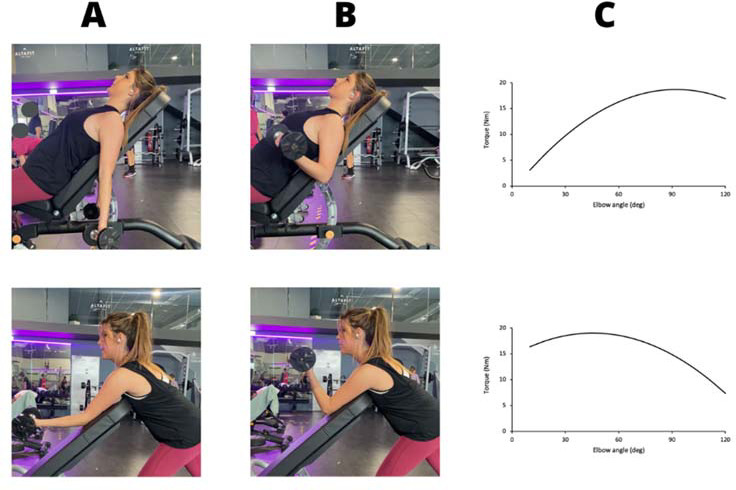
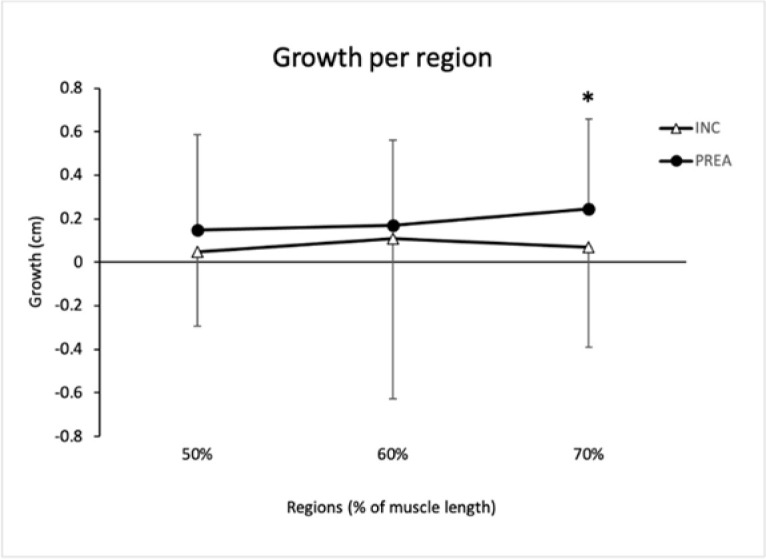
The aim of the present study was to analyse the role of exercises' resistance profile in regional hypertrophy. Thirty-eight healthy women completed a 9-week resistance training program consisting of either 4 sets of 12 repetitions to volitional failure of inclined bicep curls (INC group) or preacher curls (PREA group), three times per week. Pre- and post-intervention muscle thickness was measured using B-mode ultrasound imaging with a linear-array transducer. Scan acquisition sites were determined by measuring 50%, 60% and 70% of the distance between the posterior crest of the acromion and the olecranon. Statistical significance was set at p < 0.05. No region of the INC group grew when comparing pre- to post-intervention. The 70% region of the PREA group grew significantly (muscle thickness increased from 2.7 ± 0.43 cm to 2.94 ± 0.44 cm). We found no growth differences between regions when analysing per group (p = 0.274), region (p = 0.571) or group*region (p = 0.367). Our results show that the distal region of the arm grows in response to the preacher curl that places the highest amount of strain in the range of motion in which the arm muscles are more elongated.
Keywords: muscle architecture; muscle growth; selective hypertrophy; strength; variable resistance.
Copyright: © Academy of Physical Education in Katowice.
Conflict of interest statement
The authors declare no conflict of interest.
Figures
References
-
- Avrillon, S., Del Vecchio, A., Farina, D., Pons, J. L., Vogel, C., Umehara, J., & Hug, F. (2021). Individual differences in the neural strategies to control the lateral and medial head of the quadriceps during a mechanically constrained task. Journal of Applied Physiology, 130(1), 269–281. 10.1152/JAPPLPHYSIOL.00653.2020 - DOI - PubMed
LinkOut - more resources
Full Text Sources