


Pushing the limits of detectability: mixed dark matter from strong gravitational lenses
- PMID: 37559879
- PMCID: PMC10408735
- DOI: 10.1093/mnras/stad2251
Pushing the limits of detectability: mixed dark matter from strong gravitational lenses
Abstract
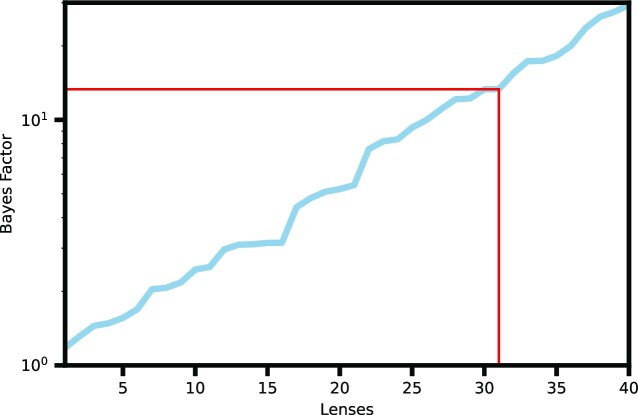
One of the frontiers for advancing what is known about dark matter lies in using strong gravitational lenses to characterize the population of the smallest dark matter haloes. There is a large volume of information in strong gravitational lens images - the question we seek to answer is to what extent we can refine this information. To this end, we forecast the detectability of a mixed warm and cold dark matter scenario using the anomalous flux ratio method from strong gravitational lensed images. The halo mass function of the mixed dark matter scenario is suppressed relative to cold dark matter but still predicts numerous low-mass dark matter haloes relative to warm dark matter. Since the strong lensing signal receives a contribution from a range of dark matter halo masses and since the signal is sensitive to the specific configuration of dark matter haloes, not just the halo mass function, degeneracies between different forms of suppression in the halo mass function, relative to cold dark matter, can arise. We find that, with a set of lenses with different configurations of the main deflector and hence different sensitivities to different mass ranges of the halo mass function, the different forms of suppression of the halo mass function between the warm dark matter model and the mixed dark matter model can be distinguished with 40 lenses with Bayesian odds of 30:1.
Keywords: dark matter; galaxies: structure; gravitational lensing: strong; methods: statistical.
© 2023 The Author(s) Published by Oxford University Press on behalf of Royal Astronomical Society.
Figures



References
-
- Abazajian K. N., 2017, Phys. Rep., 711, 1. 10.1016/j.physrep.2017.10.003 - DOI
-
- Abazajian K. N., Kusenko A., 2019, Phys. Rev. D, 100, 103513. 10.1103/PhysRevD.100.103513 - DOI
-
- Abazajian K., Fuller G. M., Patel M., 2001, Phys. Rev. D, 64, 023501. 10.1103/PhysRevD.64.023501 - DOI
-
- Abazajian K. N., Horiuchi S., Kaplinghat M., Keeley R. E., Macias O., 2020, Phys. Rev. D, 102, 043012. 10.1103/PhysRevD.102.043012 - DOI
-
- Akeret J., Refregier A., Amara A., Seehars S., Hasner C., 2015, JCAP, 08, 043. 10.1088/1475-7516/2015/08/043 - DOI