Review
. 2023 Aug 10;14(1):4838.
doi: 10.1038/s41467-023-40459-8.

Applied machine learning as a driver for polymeric biomaterials design

Affiliations
Review

Applied machine learning as a driver for polymeric biomaterials design

Samantha M McDonald et al. Nat Commun. .

Abstract

Polymers are ubiquitous to almost every aspect of modern society and their use in medical products is similarly pervasive. Despite this, the diversity in commercial polymers used in medicine is stunningly low. Considerable time and resources have been extended over the years towards the development of new polymeric biomaterials which address unmet needs left by the current generation of medical-grade polymers. Machine learning (ML) presents an unprecedented opportunity in this field to bypass the need for trial-and-error synthesis, thus reducing the time and resources invested into new discoveries critical for advancing medical treatments. Current efforts pioneering applied ML in polymer design have employed combinatorial and high throughput experimental design to address data availability concerns. However, the lack of available and standardized characterization of parameters relevant to medicine, including degradation time and biocompatibility, represents a nearly insurmountable obstacle to ML-aided design of biomaterials. Herein, we identify a gap at the intersection of applied ML and biomedical polymer design, highlight current works at this junction more broadly and provide an outlook on challenges and future directions.


Conflict of interest statement

The authors declare no competing interests.

Figures
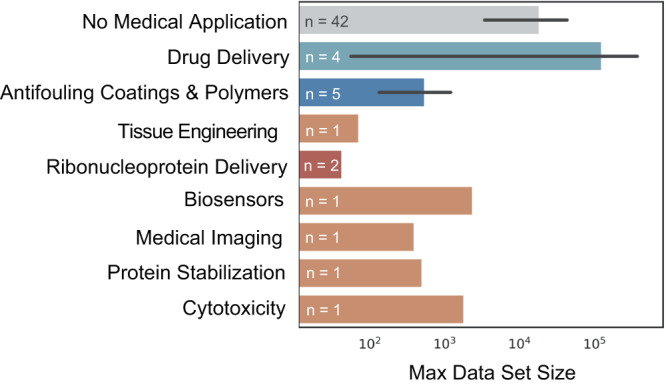
Fig. 1
Fig. 1. Data set sizes documented for applications within polymer chemistry.
There are only a few examples of ML applied to biomedical polymer questions (n = the number of papers for each application). Data availability is a considerable concern for ML approaches within many biomedical applications as demonstrated by the relatively few number of papers which have been published on this topic as well as the small size of the data sets used in these existing approaches.
Fig. 2
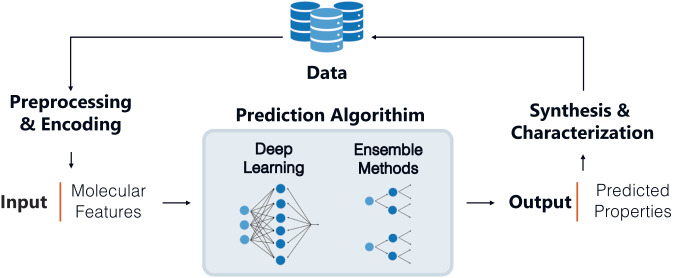
Fig. 2. General ML workflow for property prediction tasks.
Data (i.e., polymers with known properties) must be preprocessed and encoded before passing desired input (e.g., encoded chemical structure, molecular descriptors) into a prediction algorithm. Irrespective of algorithm choice, training proceeds by tuning the model hyperparameters to minimize prediction error. The trained algorithm can then be used to screen polymer candidates prior to experimental synthesis & characterization. While deep learning and ensemble methods are the most widely used, other supervised methods have been employed (see Table 3) and may be preferred based on the application.
Fig. 3
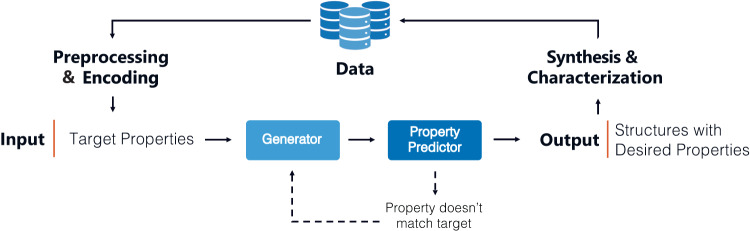
Fig. 3. General ML workflow for inverse design approaches.
Inverse design of polymers target algorithms which generate new, valid polymer structures with desired properties from property inputs. As seen in property prediction, data must be preprocessed & encoded prior to inverse design. Training involves the generation of a new structure through sequence perturbations or interpolations within existing latent spaces (represented here as ‘generator’). The properties of the new structure are predicted and compared to the target properties (shown as ‘property predictor’). The algorithms then iterate between these stages until structures with desired properties are achieved. While training of the ‘generator’ and ‘property predictor’ are approach-dependent, their hyperparameters may be tuned by minimizing the prediction error.
Fig. 4
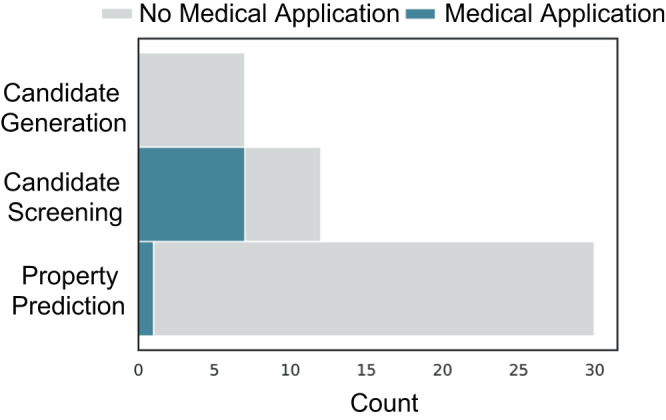
Fig. 4. Uses for ML applied to polymer design.
In each case, biomedical polymers represent a minority of the approaches and are notably missing from candidate generation strategies. The candidate screening methods shown here use property prediction algorithms to choose promising polymers out of a subset of interest. Thus, they differ from the property prediction category only in that their implementation goes a step further.

References

    1. Gomez-Bombarelli R, et al. Automatic chemical design using a data-driven continuous representation of molecules. ACS Cent. Sci. 2018;4:268–276. - PMC - PubMed
    1. Polykovskiy D, et al. Entangled conditional adversarial autoencoder for de novo drug discovery. Mol. Pharm. 2018;15:4398–4405. - PubMed
    1. Nguyen DH, Tsuda K. Generating reaction trees with cascaded variational autoencoders. J. Chem. Phys. 2022;156:044117. - PubMed
    1. Cai C, et al. Transfer learning for drug discovery. J. Med Chem. 2020;63:8683–8694. - PubMed
    1. Panteleev J, Gao H, Jia L. Recent applications of machine learning in medicinal chemistry. Bioorg. Med. Chem. Lett. 2018;28:2807–2815. - PubMed

Publication types