


Fc receptors act as innate immune receptors during infection?
- PMID: 37564652
- PMCID: PMC10410254
- DOI: 10.3389/fimmu.2023.1188497
Fc receptors act as innate immune receptors during infection?
Abstract
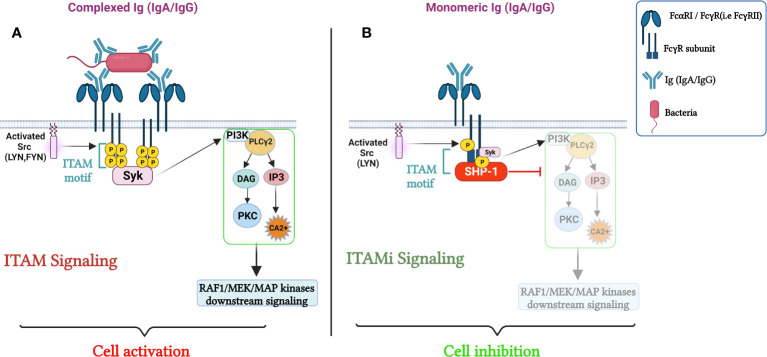
Innate immunity constitutes the first nonspecific immunological line of defense against infection. In this response, a variety of mechanisms are activated: the complement system, phagocytosis, and the inflammatory response. Then, adaptive immunity is activated. Major opsonization mediators during infections are immunoglobulins (Igs), the function of which is mediated through Fc receptors (FcRs). However, in addition to their role in adaptive immunity, FcRs have been shown to play a role in innate immunity by interacting directly with bacteria in the absence of their natural ligands (Igs). Additionally, it has been hypothesized that during the early phase of bacterial infection, FcRs play a protective role via innate immune functions mediated through direct recognition of bacteria, and as the infection progresses to later phases, FcRs exhibit their established function as receptors in adaptive immunity. This review provides detailed insight into the potential role of FcRs as innate immune mediators of the host defense against bacterial infection independent of opsonins.
Keywords: FcR; ITAM bearing receptors; bacterial clearance; infection; innate immunity.
Copyright © 2023 Laassili, Ben El Hend, Benzidane, Oumeslakht, Aziz, El Fatimy, Bensussan and Ben Mkaddem.
Conflict of interest statement
The authors declare that the research was conducted in the absence of any commercial or financial relationships that could be construed as a potential conflict of interest.
Figures

References
Publication types
MeSH terms
Substances
LinkOut - more resources
Full Text Sources
