


Gender differences in the association of individual and contextual socioeconomic status with hypertension in 230 Latin American cities from the SALURBAL study: a multilevel analysis
- PMID: 37568082
- PMCID: PMC10416382
- DOI: 10.1186/s12889-023-16480-3
Gender differences in the association of individual and contextual socioeconomic status with hypertension in 230 Latin American cities from the SALURBAL study: a multilevel analysis
Abstract
Background: Despite global interest in gender disparities and social determinants of hypertension, research in urban areas and regions with a high prevalence of hypertension, such as Latin America, is very limited. The objective of this study was to examine associations of individual- and area-level socioeconomic status with hypertension in adults living in 230 cities in eight Latin America countries.
Methods: In this cross-sectional study, we used harmonized data from 109,184 adults (aged 18-97 years) from the SALURBAL (Salud Urbana en America Latina/Urban Health in Latin America) project. Hypertension was assessed by self-report. Individual-, sub-city- and city-level education were used as proxies of socioeconomic status. All models were stratified by gender.
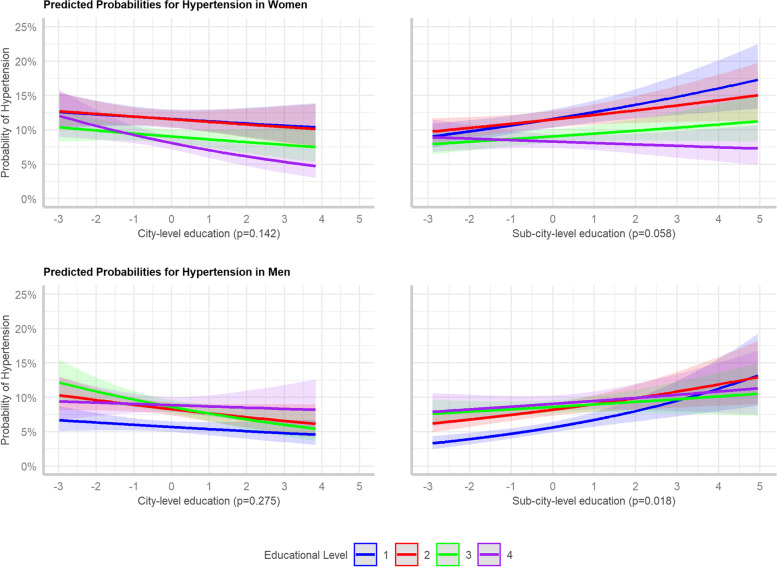
Results: Higher individual-level education was associated with lower odds of hypertension among women (university education or higher versus lower than primary: odds ratio [OR] = 0.67, 95% confidence interval [CI] = 0.61-0.74) but higher odds among men (OR = 1.65; 95%CI 1.47-1.86), although in men an inverse association emerged when measured blood pressure was used (OR = 0.86; 95%CI 0.76-0.97). For both genders, living in sub-city areas with higher educational achievement was associated with higher odds of hypertension (OR per standard deviation [SD] = 1.07, 95%CI = 1.02-1.12; OR = 1.11 per SD, 95%CI = 1.05-1.18, for women and men, respectively). The association of city-level education with hypertension varied across countries. In Peru, there was an inverse association (higher city level education was associated with lower odds of hypertension) in women and men, but in other countries no association was observed. In addition, the inverse association of individual-level education with hypertension became stronger (in women) or emerged (in men) as city or sub-city education increased.
Conclusion: The social patterning of hypertension differs by gender and by the level of analysis highlighting the importance of context- and gender-sensitive approaches and policies to reduce the prevalence of hypertension in Latin America.
Keywords: Education; Hypertension; Latin America; Multilevel analysis; Socioeconomic status; Urban health.
© 2023. BioMed Central Ltd., part of Springer Nature.
Conflict of interest statement
The authors declare no competing interests.
Figures
References
-
- World Health Organization (WHO). A global brief on hypertension: silent killer, global public health crisis: World Health Day 2013. Geneva: World Health Organization; 2013. [cited 2022 Aug 29]. Available from: https://apps.who.int/iris/handle/10665/79059.
-
- NCD Risk Factor Collaboration (NCD-RisC) Worldwide trends in hypertension prevalence and progress in treatment and control from 1990 to 2019: a pooled analysis of 1201 population-representative studies with 104 million participants. Lancet. 2021;398(10304):957–980. doi: 10.1016/S0140-6736(21)01330-1. - DOI - PMC - PubMed
Publication types
MeSH terms
Grants and funding
LinkOut - more resources
Full Text Sources
Medical
Research Materials
