


The Impact of Facial Burns on Short- and Long-Term Quality of Life and Psychological Distress-A Prospective Matched Cohort Study
- PMID: 37568459
- PMCID: PMC10419582
- DOI: 10.3390/jcm12155057
The Impact of Facial Burns on Short- and Long-Term Quality of Life and Psychological Distress-A Prospective Matched Cohort Study
Abstract
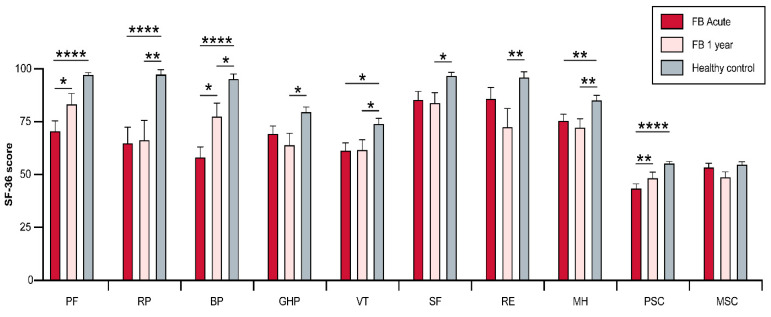
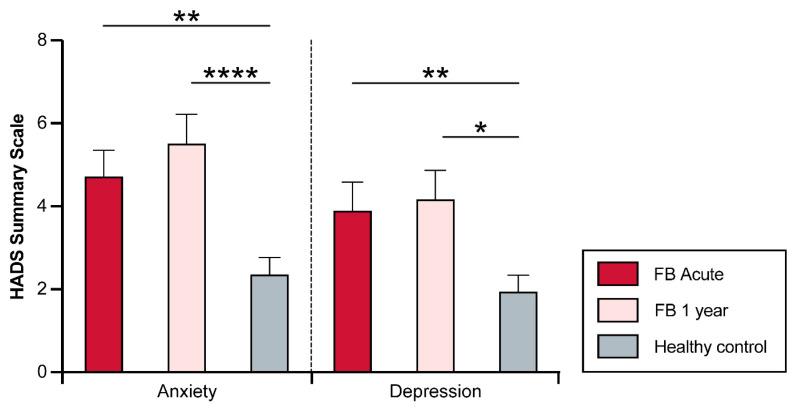
Burn injuries are a major healthcare challenge worldwide, with up to 50% of all minor burns located on the head and neck. With this study, we sought to describe the effect of facial burns (FB) on health-related quality of life through a prospective and matched cohort study design. Patients completed the 36 Item Short Form (SF-36) and the Hospital Anxiety and Depression Scale (HADS). Results were analyzed based on the distribution of datasets. In total, 55 patients with FB and 55 age-and sex-matched candidates were recruited. The most common mechanism of thermal injury was burns from flames. The FB group scored lower in physical and psychological dimensions than the control group, both acutely and one year after injury. An analysis of each domain showed that subjects in the FB group trended toward improvements in their score after one-year post-burn in physical functioning (acute: 71.0 ± 29.2; one-year: 83.7 ± 23.9; p = 0.02) and bodily pain (acute: 58.5 ± 30.3; one-year: 77.9 ± 30.5; p = 0.01) domains. Additionally, the FB group had significanlyt higher scores for anxiety (FB: 4.8 ± 3.2; control: 2.5 ± 2.8; p = <0.002) and depression (FB: 3.9 ± 3.5; control: 2.1 ± 2.7; p = 0.01) compared to the control. In conclusion, facial burns are associated with physical and psychosocial deficits, as well as elevated levels of psychological distress.
Keywords: burn injury; facial burn; quality of life.
Conflict of interest statement
The authors declare no conflict of interest.
Figures
References
-
- James S.L., Lucchesi L.R., Bisignano C., Castle C.D., Dingels Z.V., Fox J.T., Hamilton E.B., Henry N.J., McCracken D., Roberts N.L., et al. Epidemiology of injuries from fire, heat and hot substances: Global, regional and national morbidity and mortality estimates from the Global Burden of Disease 2017 study. Inj. Prev. 2020;26((Suppl. 2)):i36–i45. doi: 10.1136/injuryprev-2019-043299. - DOI - PMC - PubMed
LinkOut - more resources
Full Text Sources
