Review
. 2023 Aug 5;12(15):5138.
doi: 10.3390/jcm12155138.

A Comprehensive Review on Neuroendocrine Neoplasms: Presentation, Pathophysiology and Management

Affiliations
Review

A Comprehensive Review on Neuroendocrine Neoplasms: Presentation, Pathophysiology and Management

Qamar Sultana et al. J Clin Med. .

Abstract

Neuroendocrine neoplasms (NENs) are a group of heterogeneous tumors with neuroendocrine differentiation that can arise from any organ. They account for 2% of all malignancies in the United States. A significant proportion of NEN patients experience endocrine imbalances consequent to increased amine or peptide hormone secretion, impacting their quality of life and prognosis. Over the last decade, pathologic categorization, diagnostic techniques and therapeutic choices for NENs-both well-differentiated neuroendocrine tumors (NETs) and poorly differentiated neuroendocrine carcinomas (NECs)-have appreciably evolved. Diagnosis of NEN mostly follows a suspicion from clinical features or incidental imaging findings. Hormonal or non-hormonal biomarkers (like serum serotonin, urine 5-HIAA, gastrin and VIP) and histology of a suspected NEN is, therefore, critical for both confirmation of the diagnosis and classification as an NET or NEC. Therapy for NENs has progressed recently based on a better molecular understanding, including the involvement of mTOR, VEGF and peptide receptor radionuclide therapy (PRRT), which add to the growing evidence supporting the possibility of treatment beyond complete resection. As the incidence of NENs is on the rise in the United States and several other countries, physicians are more likely to see these cases, and their better understanding may support earlier diagnosis and tailoring treatment to the patient. We have compiled clinically significant evidence for NENs, including relevant changes to clinical practice that have greatly updated our diagnostic and therapeutic approach for NEN patients.

Keywords: carcinoid syndrome; gastroenteropancreatic neuroendocrine tumors; neuroendocrine carcinomas; neuroendocrine tumors; pulmonary neuroendocrine tumors.


Conflict of interest statement

The authors declare no conflict of interest.

Figures
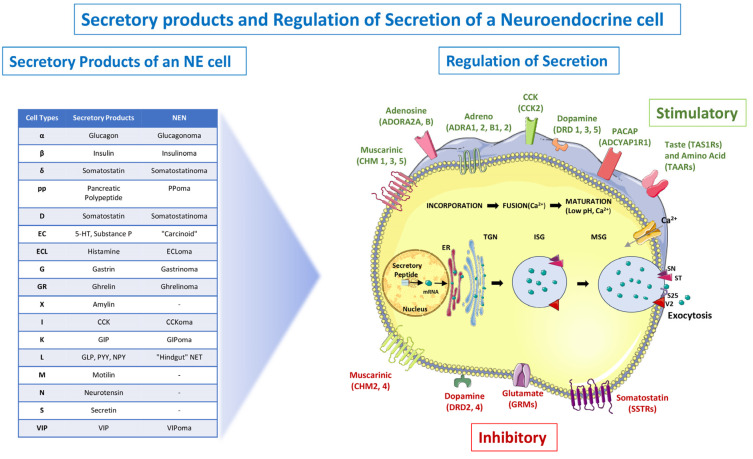
Figure 2
Figure 2
Secretory products and Regulation of Secretion of a Neuroendocrine cell. The nucleus and endoplasmic reticulum (ER) are the sites of initial transcription and processing, and secretory products aggregate in the trans-Golgi network (TGN). They are then integrated into immature vesicles together with other protein products destined for immature secretory vesicles (ISGs). Multiple ISGs fuse to form a mature secretory granule (MSG) by a process that includes calcium (Ca2+) influx, granule acidification, prohormone processing and amine uptake. Positive regulatory inputs from several regulatory G-protein coupled receptors (GPCRs) (green) direct this series of processes. Ligand binding causes both signaling pathways (PKA/cAMP, MAPK, PI3K/DAG/PKC) and membrane depolarization to be activated. Regulatory GPCRs, which include muscarinic, tastant and trace amine receptors, are often cell-type-specific. MSGs are directed to the plasma membrane as a result of activation, and docking occurs at the cell membrane following receptor-mediated Ca2+ influx. Syntaxin (SY), synaptotagmin (ST), vesicle-associated membrane protein 2 (VAMP2) (V2) and synaptosomal-associated protein, 25-kDa (SNAP25) (S25) are all expressed throughout this process (red and purple arrowheads). The resulting vesicle-and-membrane fusion process results in MSG release of contents into the extracellular space (exocytosis). Secretion is inhibited by a number of GPCRs (red) (somatostatin > muscarinic > glutamate), which, when activated, reverse the signaling pathway. Green dots in the figure represent secretory proteins. For each of the GPCRs, IUPHAR gene symbols are included. CCK—cholecystokinin; GIP—gastric inhibitory peptide; GLP-1—glucagon-like peptide 1; NPY—neuropeptide Y (tyrosine); PP—pancreatic polypeptide; PYY—polypeptide YY (tyrosine–tyrosine). Figure credit: The content of the figure is derived from the open-access information and illustrations published by Kidd et al. [21]. Parts of the figure were generated by making use of pictures available from Servier Medical Art (smart.servier.com), accessed from Servier, and licensed under a Creative Commons Attribution 3.0 unported license.
Figure 4
Figure 4
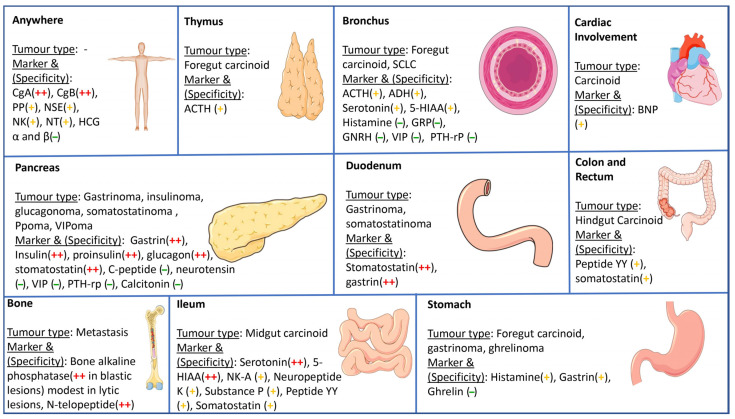
Specific biochemical markers for different NETs [153]. VIP: vasoactive intestinal peptide, NSE: neuron-specific enolase CgA: chromogranin A, CgB: chromogranin B, HCG: human chorionic gonadotropin, ACTH: adrenocorticotropic hormone, 5HIAA: 5-hydroxyindoleacetic acid, GRP: gastrin-releasing peptide, GNRH: gonadotropin-releasing hormone, PTH-rP: parathyroid hormone-related protein, peptide YY: peptide tyrosine–tyrosine, ADH: antidiuretic hormone, NK: neurokinin, NT: neurotensin, (++): high specificity-red, (+): intermediate specificity-yellow, (−): low specificity-green. Figure credit: parts of the figure were generated by making use of pictures available from Servier Medical Art, accessed from Servier, and licensed under a Creative Commons Attribution 3.0 unported licens Published with permission from PearResearch.
Figure 1
Figure 1
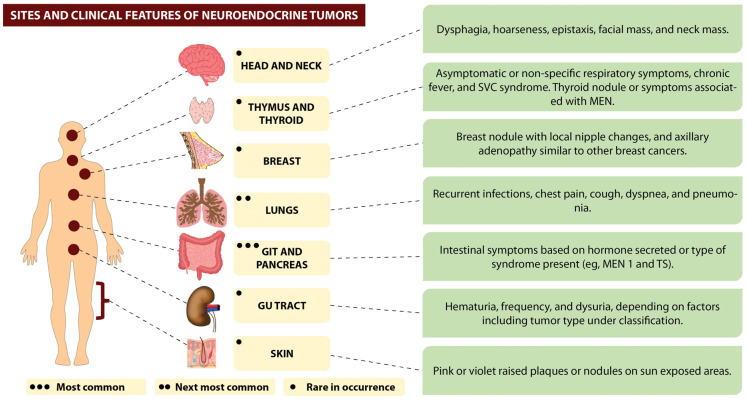
Common locations and clinical features of neuroendocrine tumors. SVC—superior vena cava syndrome; MEN 1—multiple endocrine neoplasia, type 1. Figure credit: segments of the figure were generated by making use of pictures available from Servier Medical Art, accessed from Servier, and licensed under a Creative Commons Attribution 3.0 unported Published with permission from PearResearch.
Figure 3
Figure 3
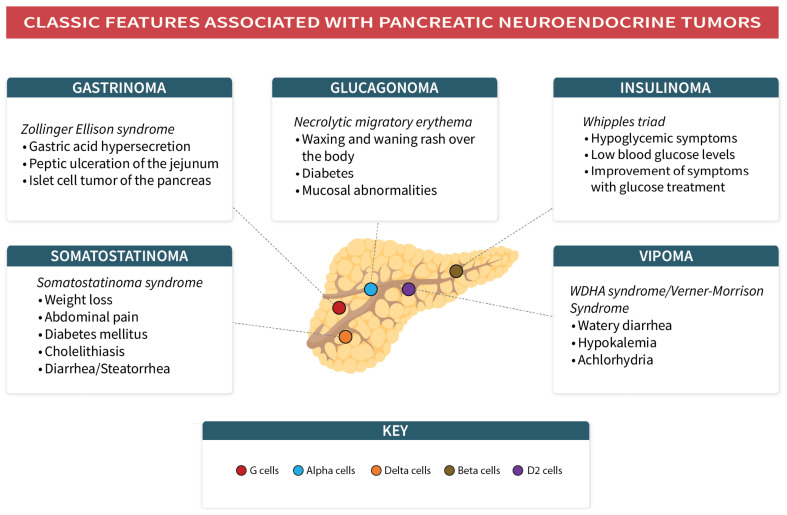
Classic symptoms associated with pancreatic NET. WDHA: watery diarrhea, hypokalemia and achlorhydria; D2 cells: dopamine-D2 cells. Figure credit: segments of the figure were generated by making use of pictures available from Servier Medical Art, accessed from Servier, and licensed under a Creative Commons Attribution 3.0 unported license Published with permission from PearResearch.
Figure 5
Figure 5
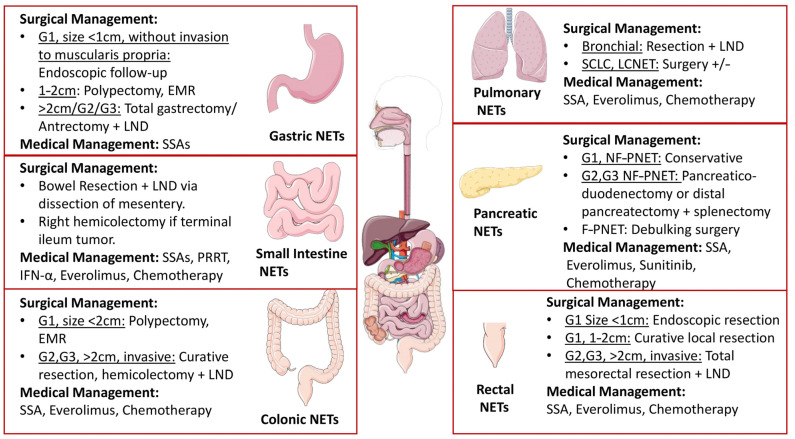
Treatment for various NETs. LND: lymph node dissection, EMR: endoscopic mucosal resection, SSA: somatostatin analog, PRRT: peptide receptor radionuclide therapy, IFN: interferon, NF-NET: non-functioning neuroendocrine tumor, LCNEC: large cell neuroendocrine carcinoma, SCLC: small cell lung carcinoma, F-NET: functioning neuroendocrine tumor. TME: total mesorectal excision, TEM: transanal endoscopic microsurgery, LAR: low anterior resection, ESD: endoscopic submucosal dissection. Figure credit: segments of the figure were generated by making use of pictures available from Servier Medical Art, accessed from Servier, and licensed under a Creative Commons Attribution 3.0 unported license. Published with permission from PearResearch.
Figure 6
Figure 6
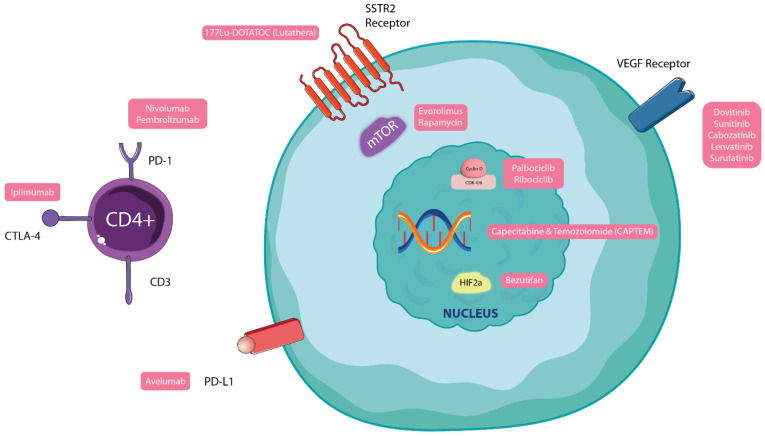
Potential drug targets for NEN and the important drugs. CDK: cyclin-dependent kinase; VEGF: vascular endothelial growth factor; mTOR: mammalian target of rapamycin; HIF: hypoxia-inducible factor. Figure credit: parts of the figure were generated by making use of pictures available from Servier Medical Art, accessed from Servier, and licensed under a Creative Commons Attribution 3.0 unported license Published with permission from PearResearch.

References

    1. Cives M., Strosberg J.R. Gastroenteropancreatic Neuroendocrine Tumors. CA Cancer J. Clin. 2018;68:471–487. doi: 10.3322/caac.21493. - DOI - PubMed
    1. Gaudenzi G., Carra S., Dicitore A., Cantone M.C., Persani L., Vitale G. Fishing for Neuroendocrine Tumors. Endocr. Relat. Cancer. 2020;27:R163–R176. doi: 10.1530/ERC-19-0437. - DOI - PubMed
    1. Dasari A., Shen C., Halperin D.M., Zhao B., Zhou S., Xu Y., Shih T., Yao J.C. Trends in the Incidence, Prevalence, and Survival Outcomes in Patients with Neuroendocrine Tumors in the United States. JAMA Oncol. 2017;3:1335–1342. doi: 10.1001/jamaoncol.2017.0589. - DOI - PMC - PubMed
    1. Oronsky B., Ma P.C., Morgensztern D., Carter C.A. Nothing But NET: A Review of Neuroendocrine Tumors and Carcinomas. Neoplasia. 2017;19:991–1002. doi: 10.1016/j.neo.2017.09.002. - DOI - PMC - PubMed
    1. Yao J.C., Hassan M.M., Phan A.T., Dagohoy C.G., Leary C., Mares J.E., Abdalla E.K., Fleming J.B., Vauthey J.N., Rashid A., et al. One Hundred Years after “Carcinoid”: Epidemiology of and Prognostic Factors for Neuroendocrine Tumors in 35,825 Cases in the United States. J. Clin. Oncol. 2008;26:3063–3072. doi: 10.1200/JCO.2007.15.4377. - DOI - PubMed