Review
. 2023 Aug 4;24(15):12433.
doi: 10.3390/ijms241512433.

Corneal Endothelial-like Cells Derived from Induced Pluripotent Stem Cells for Cell Therapy

Affiliations
Review

Corneal Endothelial-like Cells Derived from Induced Pluripotent Stem Cells for Cell Therapy

Xiao Yu Ng et al. Int J Mol Sci. .

Abstract

Corneal endothelial dysfunction is one of the leading causes of corneal blindness, and the current conventional treatment option is corneal transplantation using a cadaveric donor cornea. However, there is a global shortage of suitable donor graft material, necessitating the exploration of novel therapeutic approaches. A stem cell-based regenerative medicine approach using induced pluripotent stem cells (iPSCs) offers a promising solution, as they possess self-renewal capabilities, can be derived from adult somatic cells, and can be differentiated into all cell types including corneal endothelial cells (CECs). This review discusses the progress and challenges in developing protocols to induce iPSCs into CECs, focusing on the different media formulations used to differentiate iPSCs to neural crest cells (NCCs) and subsequently to CECs, as well as the characterization methods and markers that define iPSC-derived CECs. The hurdles and solutions for the clinical application of iPSC-derived cell therapy are also addressed, including the establishment of protocols that adhere to good manufacturing practice (GMP) guidelines. The potential risks of genetic mutations in iPSC-derived CECs associated with long-term in vitro culture and the danger of potential tumorigenicity following transplantation are evaluated. In all, this review provides insights into the advancement and obstacles of using iPSC in the treatment of corneal endothelial dysfunction.

Keywords: cell therapy; corneal endothelial; iPSC.


Conflict of interest statement

The authors declare no conflict of interest.

Figures

Figure 5
Figure 5
(A) Schematic diagram of the differentiation process for deriving human CEC from iPSC, created with BioRender.com. (B) Brightfield image of an iPSC colony [82]. (C) Brightfield image of NCSCs/NCCs [82]. (D) Brightfield image of iPSC-derived CECs [82]. Scale bar (BD): 200 μm, (D) magnified image: 50 μm.
Figure 1
Figure 1
Schematic diagram of the effect of corneal endothelial cell density (ECD) on cornea opacity. Created with BioRender.com.
Figure 2
Figure 2
(A) Patient with corneal blindness due to severe corneal edema (bullous keratopathy) [12]. (B) 1-year post-DSAEK showing a clear cornea with healthy endothelial cells (20× magnification) [8].
Figure 3
Figure 3
(A) Slit lamp image and anterior segment OCT (ASOCT) of DMEK patient [12]. (B) Slit lamp image and ASOCT of DSAEK patient [8,12].
Figure 4
Figure 4
(A) Schematic diagram of corneal endothelial cells at different endothelial cell density (ECD). Created with BioRender.com. (B) Cultured primary human corneal endothelial cells (CECs) of different cell density at 10× magnification, taken using a Nikon Eclipse TS 100, Nikon Instruments, Melville, NY, USA [25].
Figure 6
Figure 6
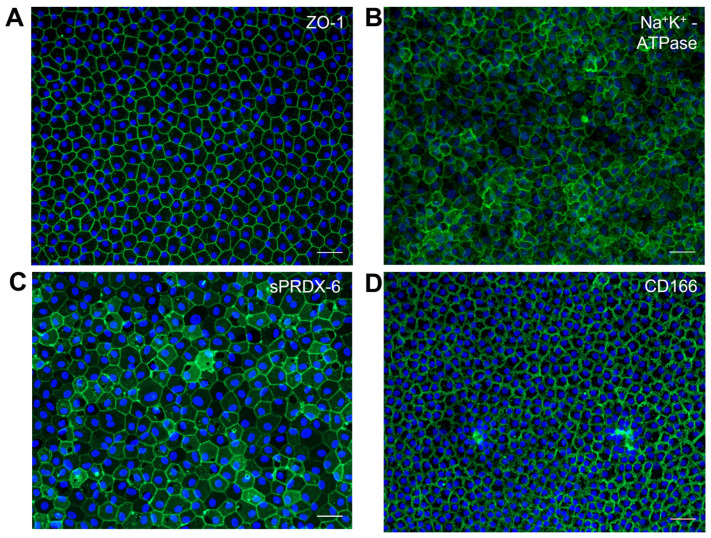
Cultured primary human corneal endothelial cells (CECs) at 20× magnification, taken on ZEISS Axio Imager M2m, Carl Zeiss Microscopy, LLC, White Plains, New York, USA. (A) Passage 2 CEC stained with Zonula occludens-1 (ZO-1) [28]. (B) Passage 2 CEC stained with Na+K+-ATPase [28]. (C) Passage 3 CEC stained with sPRDX-6 [28]. (D) Passage 2 CEC stained with CD166 [28].

References

    1. Ong H.S., Peh G., Neo D.J.H., Ang H.P., Adnan K., Nyein C.L., Morales-Wong F., Bhogal M., Kocaba V., Mehta J.S. A Novel Approach of Harvesting Viable Single Cells from Donor Corneal Endothelium for Cell-Injection Therapy. Cells. 2020;9:1428. doi: 10.3390/cells9061428. - DOI - PMC - PubMed
    1. Maurice D.M. The location of the fluid pump in the cornea. J. Physiol. 1972;221:43–54. doi: 10.1113/jphysiol.1972.sp009737. - DOI - PMC - PubMed
    1. Bourne W.M. Clinical estimation of corneal endothelial pump function. Trans. Am. Ophthalmol. Soc. 1998;96:229–239; discussion 239–242. - PMC - PubMed
    1. Bonanno J.A. Molecular mechanisms underlying the corneal endothelial pump. Exp. Eye Res. 2012;95:2–7. doi: 10.1016/j.exer.2011.06.004. - DOI - PMC - PubMed
    1. Srinivas S.P. Dynamic regulation of barrier integrity of the corneal endothelium. Optom. Vis. Sci. 2010;87:E239–E254. doi: 10.1097/OPX.0b013e3181d39464. - DOI - PMC - PubMed

LinkOut - more resources