Review
. 2023 Aug 7;24(15):12529.
doi: 10.3390/ijms241512529.

Tackling Sleeping Sickness: Current and Promising Therapeutics and Treatment Strategies

Affiliations
Review

Tackling Sleeping Sickness: Current and Promising Therapeutics and Treatment Strategies

Miebaka Jamabo et al. Int J Mol Sci. .

Abstract

Human African trypanosomiasis is a neglected tropical disease caused by the extracellular protozoan parasite Trypanosoma brucei, and targeted for eradication by 2030. The COVID-19 pandemic contributed to the lengthening of the proposed time frame for eliminating human African trypanosomiasis as control programs were interrupted. Armed with extensive antigenic variation and the depletion of the B cell population during an infectious cycle, attempts to develop a vaccine have remained unachievable. With the absence of a vaccine, control of the disease has relied heavily on intensive screening measures and the use of drugs. The chemotherapeutics previously available for disease management were plagued by issues such as toxicity, resistance, and difficulty in administration. The approval of the latest and first oral drug, fexinidazole, is a major chemotherapeutic achievement for the treatment of human African trypanosomiasis in the past few decades. Timely and accurate diagnosis is essential for effective treatment, while poor compliance and resistance remain outstanding challenges. Drug discovery is on-going, and herein we review the recent advances in anti-trypanosomal drug discovery, including novel potential drug targets. The numerous challenges associated with disease eradication will also be addressed.

Keywords: African trypanosomiasis; COVID-19; Trypanosoma brucei; drug discovery; drug resistance; drug target; sleeping sickness.


Conflict of interest statement

The authors declare no conflict of interest.

Figures
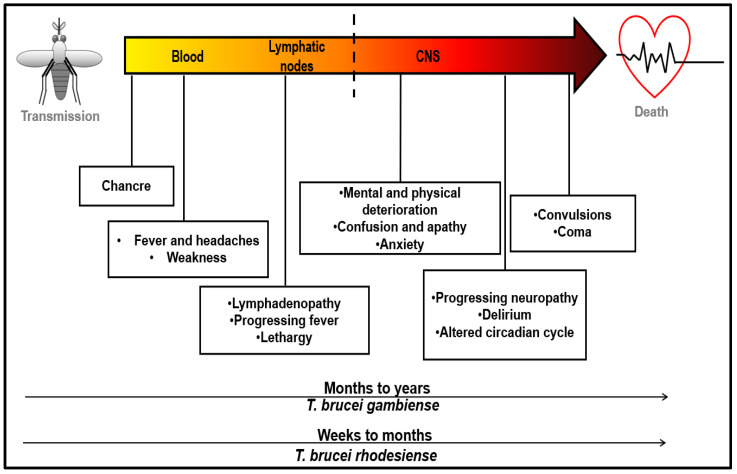
Figure 3
Figure 3
Progression of human African trypanosomiasis. The diagram highlights some of the defining symptoms of HAT as they relate to the progression of the T. brucei infection. The dashed line demarcates the point at which the parasitic infection infiltrates the CNS. The arrows at the bottom of the infographic indicate the different rates at which R-HAT and G-HAT progress. Adapted from [69].
Figure 1
Figure 1
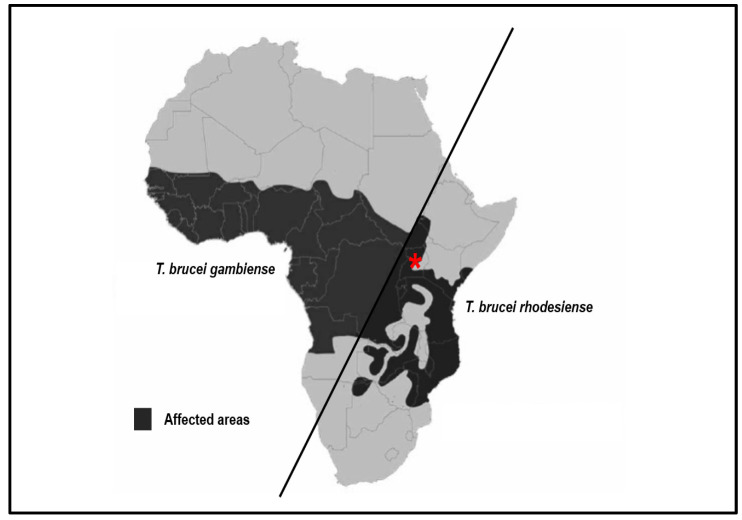
Distribution map for human African trypanosomiasis. The map illustrates the distribution of R-HAT and G-HAT (black). The bold line is a demarcation separating the regions in which T. b. rhodesiense and T. b. gambiense occur. The red asterisk serves to highlight Uganda, the only country in which both subspecies are found [13].
Figure 2
Figure 2
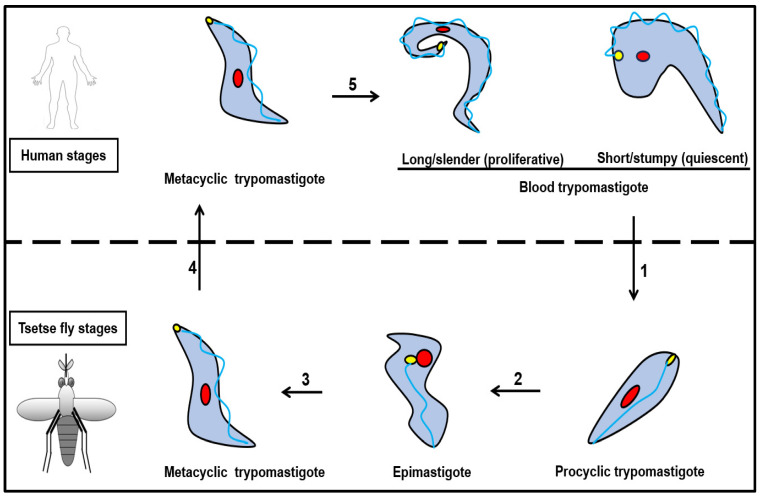
Transmission and lifecycle of the T. brucei parasite. The trypanosome is digenetic, shuttling between the tsetse fly and a mammalian host. (1) An uninfected tsetse fly takes up the non-proliferative short stumpy bloodstream trypomastigotes during its bloodmeal. The bloodstream trypomastigotes form procyclic trypomastigotes that multiply by binary fission. (2 and 3) The procyclic trypomastigotes transform into epimastigotes in the salivary glands where they differentiate into the human infective metacyclic trypomastigote. (4) The bite of an infected tsetse fly injects the metacyclic trypomastigote into its next mammalian host. (5) The trypomastigote is transformed into the bloodstream form, which multiplies by binary fission and spreads in the body fluids. The bloodstream forms are either present as long slender or short stumpy forms. The blue lines represent the flagellum as protruding from the flagellar pocket (shown in yellow). The nuclei of the various morphotypes are shown in red. Adapted from [4].

References

    1. Raper J., Portela M.P.M., Lugli E., Frevert U., Tomlinson S. Trypanosome lytic factors: Novel mediators of human innate immunity. Curr. Opin. Microbiol. 2001;4:402–408. doi: 10.1016/S1369-5274(00)00226-5. - DOI - PubMed
    1. Lopes A.H., Souto-Padrón T., Dias F.A., Gomes M.T., Rodrigues G.C., Zimmermann L.T., e Silva T.L.A., Vermelho A.B. Trypanosomatids: Odd Organisms, Devastating Diseases. Open Parasitol. J. 2010;4:30–59. doi: 10.2174/1874421401004010030. - DOI
    1. Alsan M. The Effect of the TseTse Fly on African Development. Am. Econ. Rev. 2015;105:382–410. doi: 10.1257/aer.20130604. - DOI
    1. Kennedy P.G. Clinical features, diagnosis, and treatment of human African trypanosomiasis (sleeping sickness) Lancet Neurol. 2013;12:186–194. doi: 10.1016/S1474-4422(12)70296-X. - DOI - PubMed
    1. Babokhov P., Sanyaolu A.O., Oyibo W.A., Fagbenro-Beyioku A.F., Iriemenam N.C. A current analysis of chemotherapy strategies for the treatment of human African trypanosomiasis. Pathog. Glob. Health. 2013;107:242–252. - PMC - PubMed