


Exploring Nanocarriers as Treatment Modalities for Skin Cancer
- PMID: 37570875
- PMCID: PMC10421083
- DOI: 10.3390/molecules28155905
Exploring Nanocarriers as Treatment Modalities for Skin Cancer
Abstract
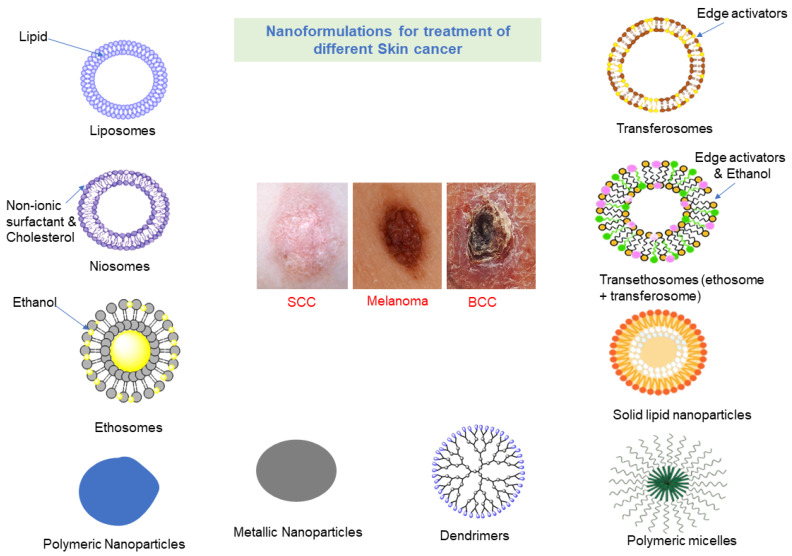
Cancer is a progressive disease of multi-factorial origin that has risen worldwide, probably due to changes in lifestyle, food intake, and environmental changes as some of the reasons. Skin cancer can be classified into melanomas from melanocytes and nonmelanoma skin cancer (NMSC) from the epidermally-derived cell. Together it constitutes about 95% of skin cancer. Basal cell carcinoma (BCC) and cutaneous squamous cell carcinoma (CSCC) are creditworthy of 99% of NMSC due to the limited accessibility of conventional formulations in skin cancer cells of having multiple obstacles in treatment reply to this therapeutic regime. Despite this, it often encounters erratic bioavailability and absorption to the target. Nanoparticles developed through nanotechnology platforms could be the better topical skin cancer therapy option. To improve the topical delivery, the nano-sized delivery system is appropriate as it fuses with the cutaneous layer and fluidized membrane; thus, the deeper penetration of therapeutics could be possible to reach the target spot. This review briefly outlooks the various nanoparticle preparations, i.e., liposomes, niosomes, ethosomes, transferosomes, transethosomes, nanoemulsions, and nanoparticles technologies tested into skin cancer and impede their progress tend to concentrate in the skin layers. Nanocarriers have proved that they can considerably boost medication bioavailability, lowering the frequency of dosage and reducing the toxicity associated with high doses of the medication.
Keywords: basal cell carcinoma; cutaneous squamous cell carcinoma; nanoformulations; skin cancer; skin permeation.
Conflict of interest statement
The authors declare no conflict of interest.
Figures
References
Publication types
Grants and funding
LinkOut - more resources
Full Text Sources
