


Are Energy and Protein Intakes Lower Than Requirements in Older Adults? An Urgent Issue in Hospitals and Nursing Homes
- PMID: 37571245
- PMCID: PMC10421298
- DOI: 10.3390/nu15153307
Are Energy and Protein Intakes Lower Than Requirements in Older Adults? An Urgent Issue in Hospitals and Nursing Homes
Abstract
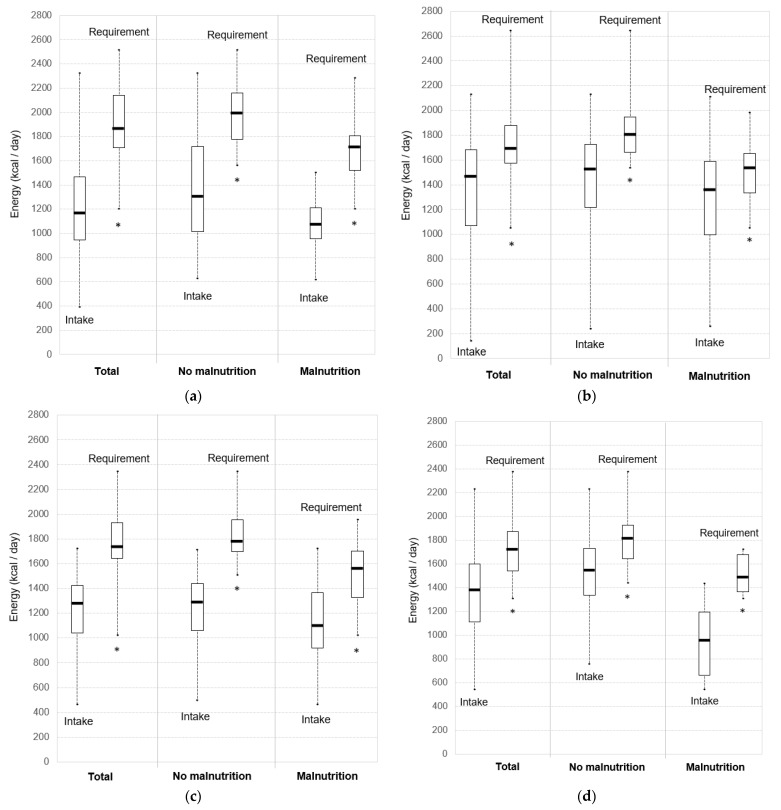
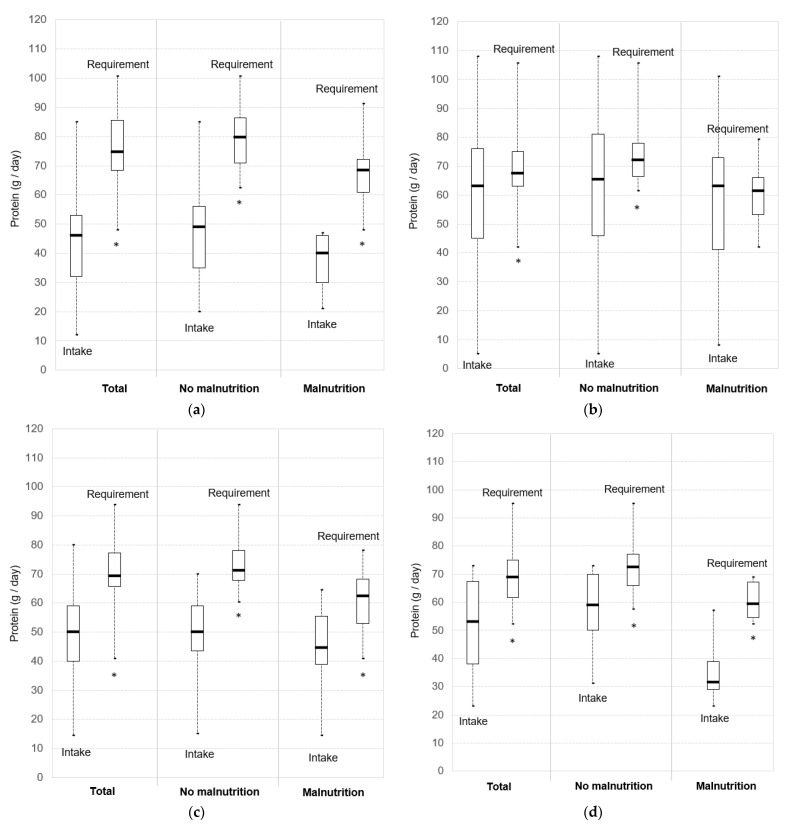
Energy and protein intakes lower than requirements are associated with worsening health outcomes. Here we set out to evaluate gaps between energy and protein intakes and requirements in older adults in hospitals and in nursing homes (NH). A cross-sectional study included 360 inpatients and residents aged 75 years and older in two acute care wards; i.e., a multidisciplinary care unit (MCU) and a geriatric care unit (GCU), a geriatric rehabilitation unit (GRU), and two NH. Intakes were measured for three days. Requirements were based on French National Health Authority recommendations. Energy and protein intakes were under the minimum requirement of 30 kcal/kg/day and 1.2 g/kg/day in 89.5% and 100% of MCU patients, respectively, 75.5% and 64.2% of GCU patients, 92.7% and 90.9% of GRU patients, and 83.8% and 83.8 of NH residents. Intake-to-requirement gaps were not significantly associated with malnutrition, except in the GCU group where non-malnourished patients had higher energy gaps than malnourished patients. Intakes fell dramatically short of requirements in older adults in both hospital and NH settings irrespective of malnutrition status. A new paradigm based on a patient-centered approach should be developed to adapt meals served in hospital and in NH.
Keywords: energy intake; hospitalization; malnutrition; nursing home; nutrient gap; nutritional assessment; older adults; protein intake.
Conflict of interest statement
The authors declare no conflict of interest. The funders had no role in the design of the study; in the collection, analyses, or interpretation of data; in the writing of the manuscript; or in the decision to publish the results.
Figures
References
-
- Agarwal E., Ferguson M., Banks M., Batterham M., Bauer J., Capra S., Isenring E. Malnutrition and poor food intake are associated with prolonged hospital stay, frequent readmissions, and greater in-hospital mortality: Results from the Nutrition Care Day Survey 2010. Clin. Nutr. 2013;32:737–745. doi: 10.1016/j.clnu.2012.11.021. - DOI - PubMed
MeSH terms
Grants and funding
LinkOut - more resources
Full Text Sources
Medical
Miscellaneous
