


Dietary Behaviour and Sociocultural Determinants of Dietary Diversity among Rural Women of Reproductive Age: A Case of Amhara Region, Ethiopia
- PMID: 37571306
- PMCID: PMC10420930
- DOI: 10.3390/nu15153369
Dietary Behaviour and Sociocultural Determinants of Dietary Diversity among Rural Women of Reproductive Age: A Case of Amhara Region, Ethiopia
Abstract
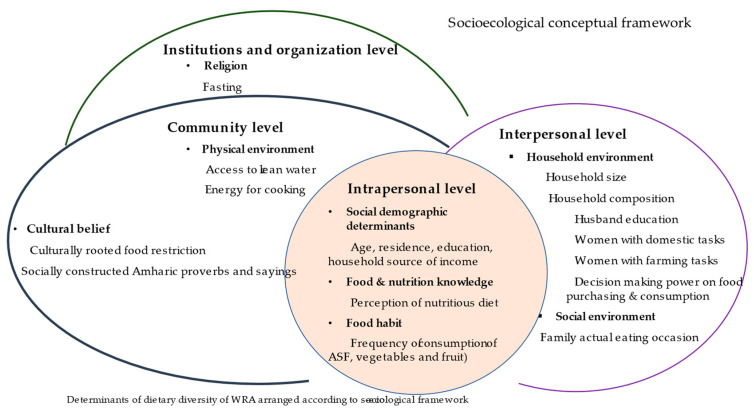
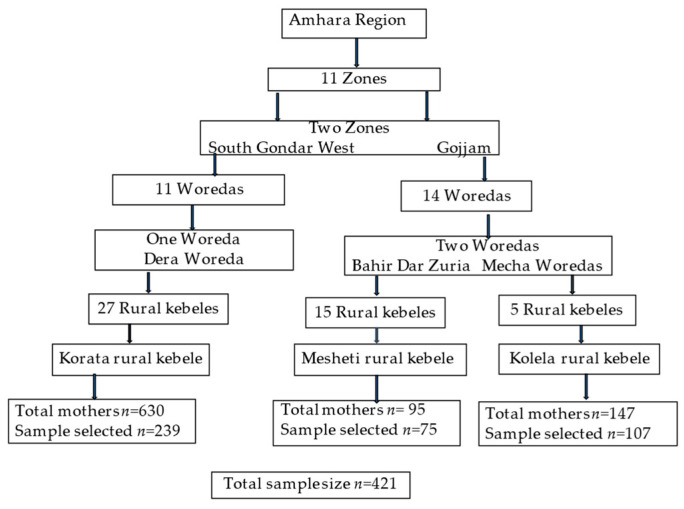
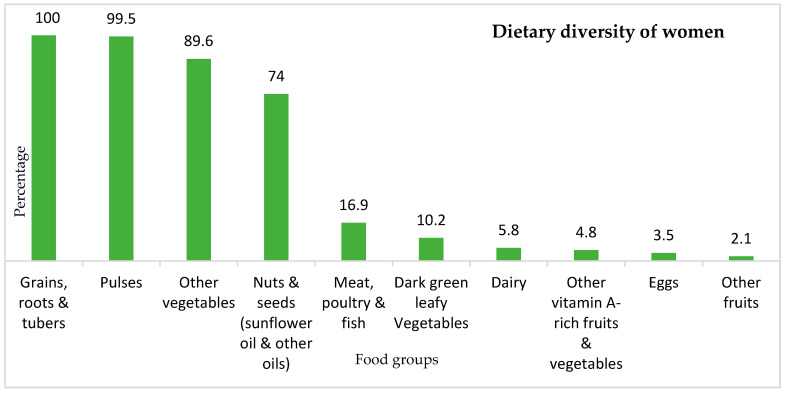
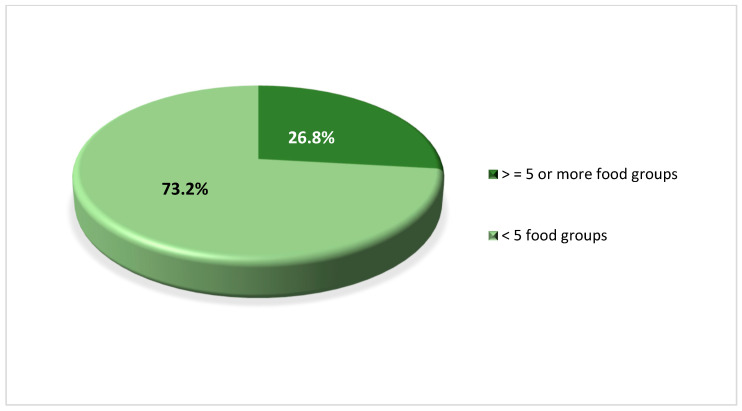
Women of reproductive age have specific nutritional requirements due to pregnancy and lactation. Little is known about the sociocultural determinants of dietary diversity among women of reproductive age. This study assesses trends of dietary behaviour and associated determinants of dietary diversity of women of reproductive age. A community-based cross-sectional study was conducted in the Amhara region of Ethiopia in 2019. Using multistage systematic random sampling, the dietary diversity of n = 421 women of reproductive age was assessed by a qualitative 24 h dietary recall. Descriptive analysis revealed characteristics of dietary behaviour and a chi-square test enabled the identification of associated determinants of women's dietary diversity. Only about a quarter (26.8%) of the women consumed five or more food groups per day and met the minimum dietary diversity score (MDD-W). Drawing on the socioecological framework, at an intrapersonal/individual level, women's education, age, perception of nutritious diet, and frequency of consumption of animal-sourced foods, vegetables, and fruit were significantly associated with MDD-W. At an interpersonal/household level, the husbands' education, women's decision-making regarding food purchase/consumption, the family's actual eating occasion, and women's engagement in domestic and farming tasks were significantly associated with MDD-W. At a community level, access to clean water and especially cultural beliefs were significant determinants of MDD-W. Amharic proverbs and sayings prioritise men and pose severe restrictions on women regarding food allocation. The majority (76.7%) of women of reproductive age practise frequent religious fasting, relating to the institutional/national level. This undermines efforts to support healthy dietary behaviour of women of reproductive age. Indepth studies on religious and cultural practices are needed, to assess not only their negative effects on the dietary diversity of women of reproductive age but also on women's lives.
Keywords: Ethiopia; dietary behaviour; dietary diversity; sociodemographic and sociocultural determinants; women of reproductive age.
Conflict of interest statement
The authors declare no conflict of interest.
Figures
References
-
- UN Food and Agriculture Organization (FAO) Minimum Dietary Diversity for Women. UN Food and Agriculture Organisation (FAO); Rome, Italy: 2021. [(accessed on 10 March 2022)]. Available online: https://www.fao.org/3/cb3434en/cb3434en.pdf.
-
- World Health Organization, Regional Office for Europe . Good Maternal Nutrition: The Best Start in Life. World Health Organization, Regional Office for Europe; Copenhagen, Denmark: 2016. [(accessed on 26 June 2022)]. Available online: https://apps.who.int/iris/handle/10665/329459.
-
- Global Nutrition Report . 2021 Global Nutrition Report: The State of Global Nutrition. Development Initiatives; Bristol, UK: 2021. [(accessed on 25 January 2023)]. Available online: https://globalnutritionreport.org/reports/2021-global-nutrition-report/
-
- Ethiopian Public Health Institute . Ethiopian National Micronutrient Survey Report. Ethiopian Public Health Institute; Addis Ababa, Ethiopia: 2016.
Publication types
MeSH terms
LinkOut - more resources
Full Text Sources
Miscellaneous
