


Associations between weight change, knee subcutaneous fat and cartilage thickness in overweight and obese individuals: 4-Year data from the osteoarthritis initiative
- PMID: 37574110
- PMCID: PMC10848315
- DOI: 10.1016/j.joca.2023.07.011
Associations between weight change, knee subcutaneous fat and cartilage thickness in overweight and obese individuals: 4-Year data from the osteoarthritis initiative
Abstract
Objective: To assess (i) the impact of changes in body weight on changes in joint-adjacent subcutaneous fat (SCF) and cartilage thickness over 4 years and (ii) the relation between changes in joint-adjacent SCF and knee cartilage thickness.
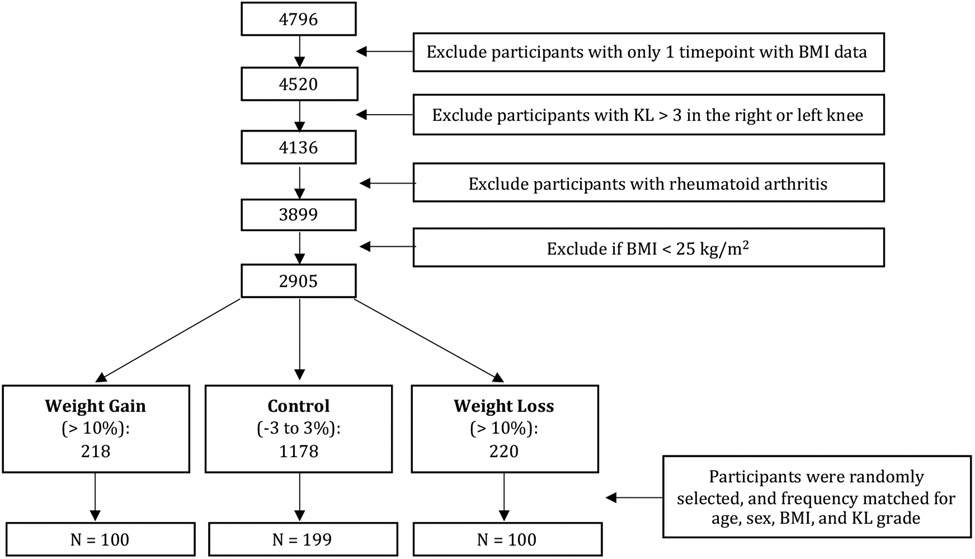
Design: Individuals from the Osteoarthritis Initiative (total=399) with > 10% weight gain (n=100) and > 10% weight loss (n=100) over 4 years were compared to a matched control cohort with less than 3% change in weight (n=199). 3.0T Magnetic Resonance Imaging (MRI) of the right knee was performed at baseline and after 4 years to quantify joint-adjacent SCF and cartilage thickness. Linear regression models were used to evaluate the associations between the (i) weight change group and 4-year changes in both knee SCF and cartilage thickness, and (ii) 4-year changes in knee SCF and in cartilage thickness. Analyses were adjusted for age, sex, baseline body mass index (BMI), tibial diameter (and weight change group in analysis (ii)).
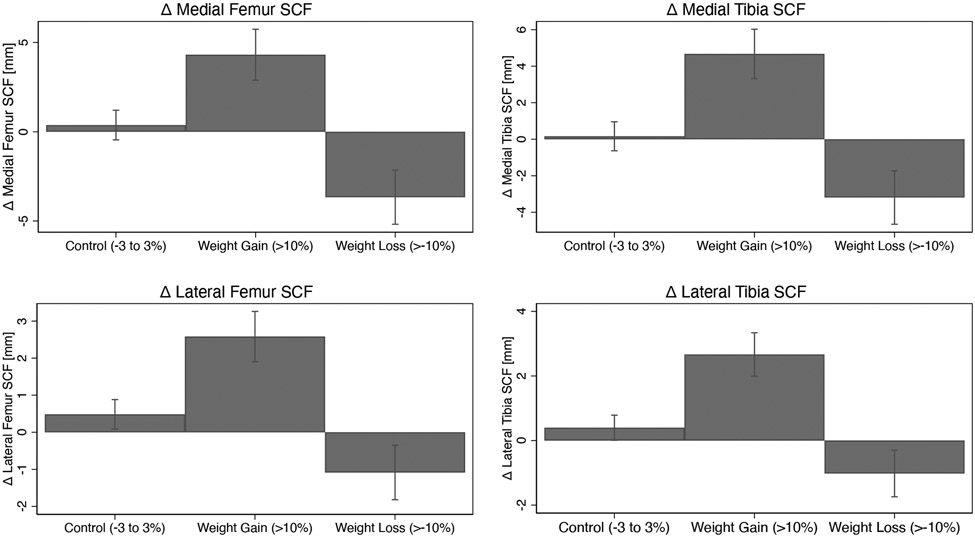
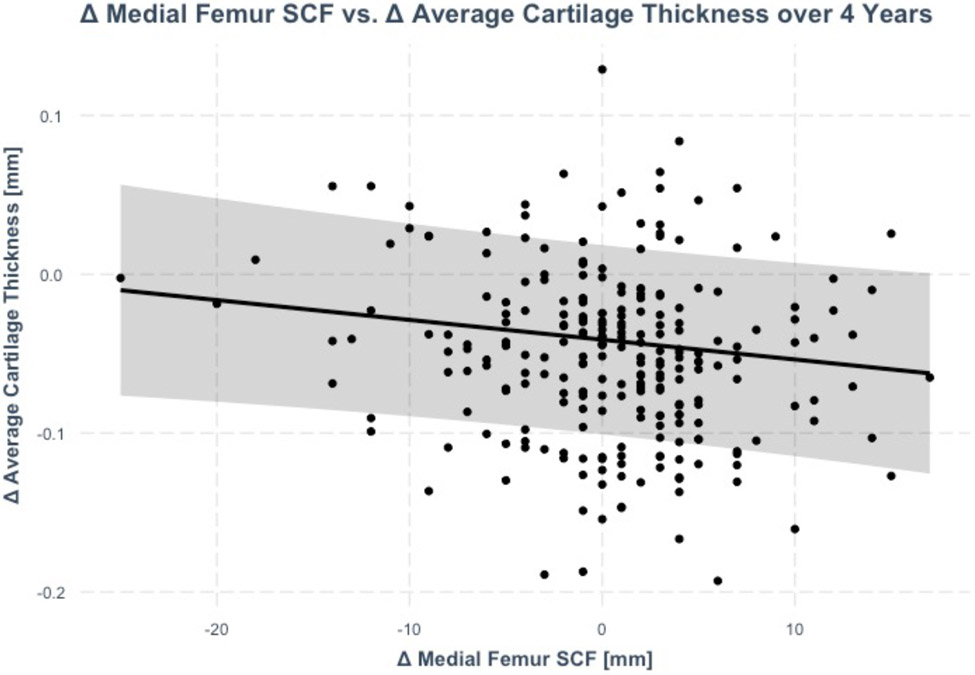
Results: Individuals who lost weight over 4-years had significantly less joint-adjacent SCF (beta range, medial/lateral joint sides: 2.2-4.2 mm, p < 0.001) than controls; individuals who gained weight had significantly greater joint-adjacent SCF than controls (beta range: -1.4 to -3.9 mm, p < 0.001). No statistically significant associations were found between weight change and cartilage thickness change. However, increases in joint-adjacent SCF over 4 years were significantly associated with decreases in cartilage thickness (p = 0.04).
Conclusions: Weight change was associated with joint-adjacent SCF, but not with change in cartilage thickness. However, 4-year increases in joint-adjacent SCF were associated with decreases in cartilage thickness independent of baseline BMI and weight change group.
Keywords: Cartilage thickness; Knee subcutaneous fat; MRI; Weight change.
Copyright © 2023 Osteoarthritis Research Society International. Published by Elsevier Ltd. All rights reserved.
Conflict of interest statement
Conflict of interest The authors declared no conflict of interest.
Figures
Comment in
-
Joint-adjacent subcutaneous adipose tissue - An obesity-related imaging biomarker associated with structural osteoarthritis progression?Osteoarthritis Cartilage. 2023 Nov;31(11):1420-1422. doi: 10.1016/j.joca.2023.08.002. Epub 2023 Aug 18. Osteoarthritis Cartilage. 2023. PMID: 37597653 No abstract available.
References
-
- Callahan LF, Ambrose KR, Albright AL, Altpeter M, Golightly YM, Huffman KF, et al. Public health interventions for osteoarthritis-updates on the osteoarthritis action Alliance’s efforts to address the 2010 OA public health agenda recommendations. Clin Exp Rheumatol 2019; 37: 31–39. - PubMed
-
- Tanamas SK, Wluka AE, Davies-Tuck M, Wang Y, Strauss BJ, Proietto J, et al. Association of weight gain with incident knee pain, stiffness, and functional difficulties: a longitudinal study. Arthritis care & research 2013; 65: 34–43. - PubMed
-
- Apold H, Meyer H, Nordsletten L, Furnes O, Baste V, Flugsrud G. Weight gain and the risk of knee replacement due to primary osteoarthritis: a population based, prospective cohort study of 225,908 individuals. Osteoarthritis and Cartilage 2014; 22: 652–658. - PubMed
