


Slittable sheath supported right ventricular pacing lead implantation in persistent left superior vena cava with absent right superior vena cava: a case report
- PMID: 37574534
- PMCID: PMC10424350
- DOI: 10.1186/s13256-023-04073-y
Slittable sheath supported right ventricular pacing lead implantation in persistent left superior vena cava with absent right superior vena cava: a case report
Abstract
Background: Persistent left superior vena cava (PLSVC) is the most common variant of systemic venous drainage. In the absence of the right superior vena cava (RSVC), implantation of a right ventricular pacing lead may be challenging. Therefore specific implantation techniques and experiences in PLSVC are worth reporting.
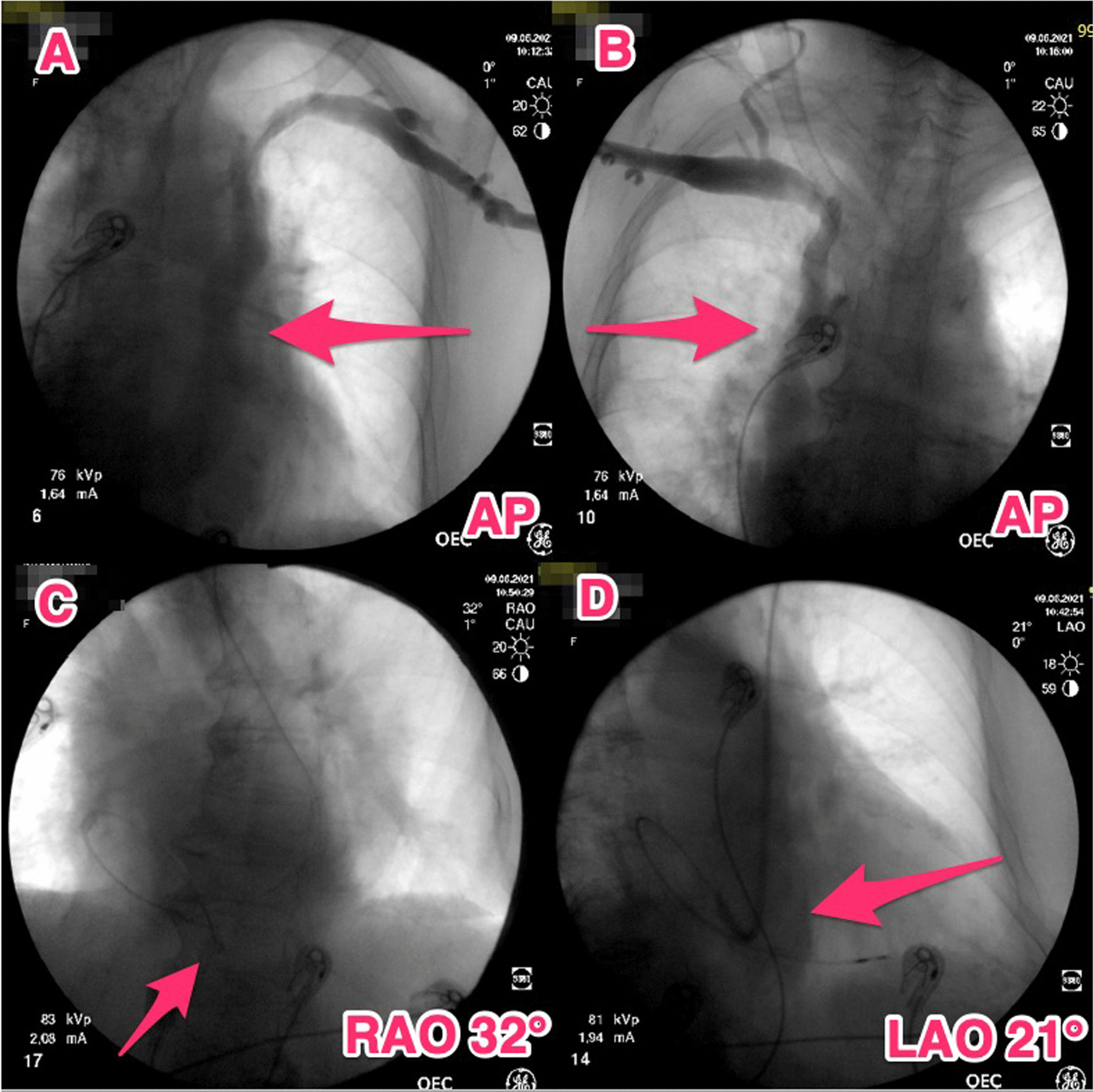
Case presentation: We present a case report of a 90-year-old Caucasian female patient with PLSVC during single chamber pacemaker implantation due to the third-degree atrioventricular block. With common implantation techniques, we did not even reach the right ventricle. Therefore slittable CPS Direct ™ Universal sheath was employed to overcome the acute angle from PLSVC to tricuspid valve and ensure more fixation stability for longer 100-cm right ventricular lead placement.
Conclusion: This case demonstrates safe implantation of 100-cm long right ventricular bipolar active fixation pacing lead using common slittable CPS Direct ™ Universal sheath after failed attempts with "C" and "J" stylet shaped electrode. This sheath provides different angle towards tricuspid valve and more fixation stability in patient with PLSVC and absent connection to right atrium.
Keywords: Cardiac pacing; PLSVC; Persistent left superior vena cava; RSVC; Right superior vena cava; Slittable sheath.
© 2023. BioMed Central Ltd., part of Springer Nature.
Conflict of interest statement
The authors declare that they have no competing interests.
Figures

References
-
- Van Gelder BM, Verberkmoes N, Nathoe R, Bracke FA. Late asymptomatic atrial lead perforation, a fortuitous finding during led extraction using thoracoscopic surveillance: a case report and review of the literature. Europace. 2016;18(12):1773–1778. - PubMed
-
- Sinha SK, Goel A, Razi M, Jha MJ, Mishra V, Aggarwaal P, et al. Permanent pacemaker implantation in patients with isolated persistent left superior vena cava from a righ-sided approach: technical considerations and follow-up outcome. Cardiol Res. 2019;10(1):18–23. doi: 10.14740/cr784. - DOI - PMC - PubMed
Publication types
MeSH terms
Grants and funding
LinkOut - more resources
Full Text Sources
Medical
