


The demographic features of fatigue in the general population worldwide: a systematic review and meta-analysis
- PMID: 37575103
- PMCID: PMC10416797
- DOI: 10.3389/fpubh.2023.1192121
The demographic features of fatigue in the general population worldwide: a systematic review and meta-analysis
Abstract
Background: Fatigue is one of the most common subjective symptoms that impairs daily life and predict health-related events. This study aimed to estimate the prevalence of fatigue in the global population.
Methods: PubMed and the Cochrane Library were used to search for relevant articles from inception to December 31, 2021. Studies with prevalence data of fatigue in the general population were selected and reviewed by three authors independently and cross-checked. Regarding subgroups, adults (≥18 years), minors (<18 years), and specific occupation population (participants in each study being limited to a specific occupational group), and fatigue types and severity, meta-analysis was conducted to produce point estimates and 95% confidence intervals (95% CI).
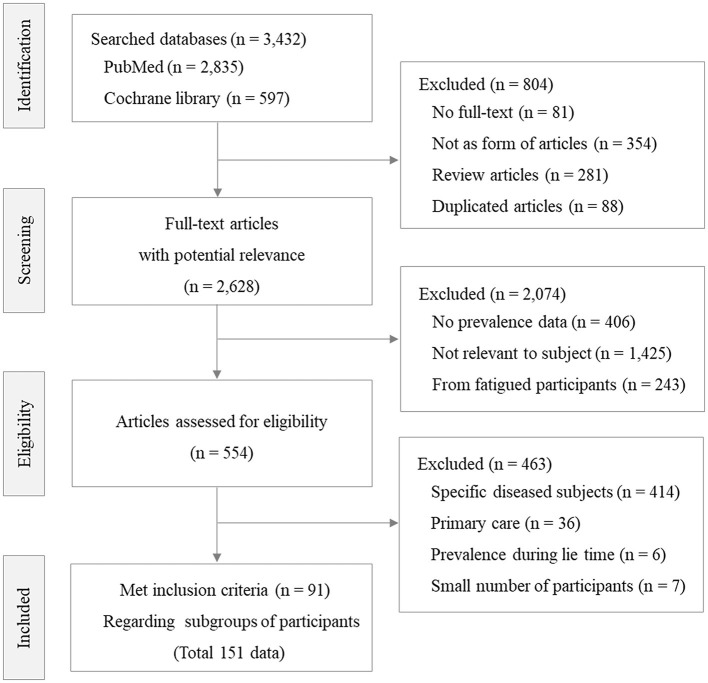
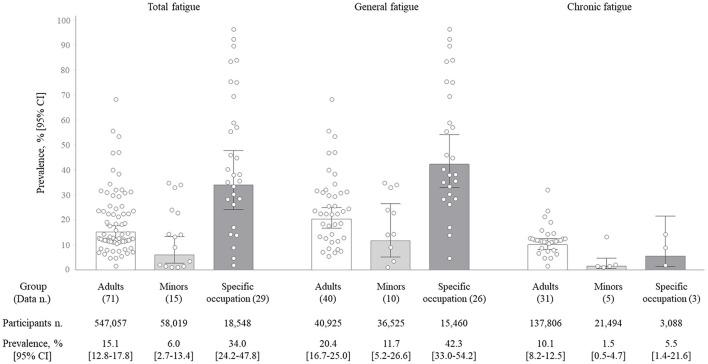
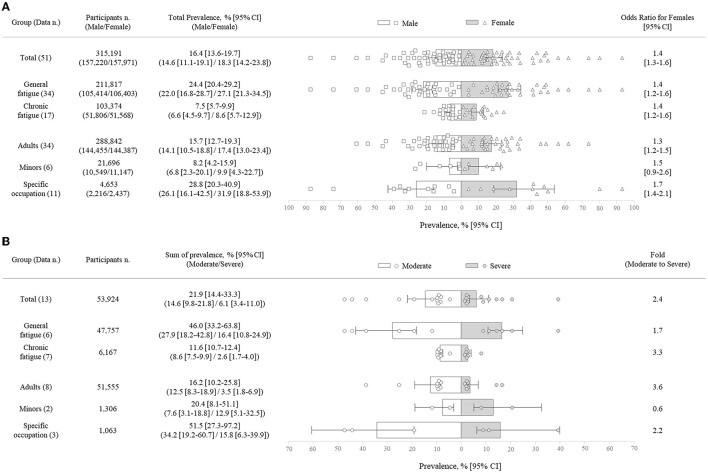
Results: From the initial 3,432 studies, 91 studies accounting for 115 prevalence data points (623,624 participants) were finally selected. The prevalence of general fatigue (fatigue lasting < 6 months, or fatigue of unspecified duration) was 20.4% (95% CI, 16.7-25.0) in adults, 11.7% (95% CI, 5.2-26.6) in minors, and 42.3% (95% CI, 33.0-54.2) in specific occupations. Chronic fatigue (fatigue lasting more than 6 months) affected 10.1% (95% CI, 8.2-12.5) of adults, 1.5% (95% CI, 0.5-4.7) of minors, and 5.5% (95% CI, 1.4-21.6) of subjects in specific occupations. There was an overall female-predominant prevalence for all subgroup analyses, with a total odds ratio of 1.4 (95% CI, 1.3-1.6). Regarding the severity and presence of medical causes, the total prevalence of moderate fatigue [14.6% (95% CI, 9.8-21.8)] was 2.4-fold that of severe fatigue [6.1% (95% CI, 3.4-11.0)], while unexplained fatigue (fatigue experienced by individuals without any underlying medical condition that can explain the fatigue) was ~2.7-fold that of explained fatigue (fatigue experienced by individuals with a medical condition that can explain the fatigue); as proportion of 40.0% of physical, 8.6% of mental, and 28.4% of mixed cause.
Conclusions: This study has produced the first comprehensive picture of global fatigue prevalence in the general population, which will provide vital reference data contributing to fatigue-related research, including the prevention of diseases.
Systematic review registration: Identifier: CRD42021270498.
Keywords: chronic fatigue; fatigue; general population; global population; meta-analysis; prevalence; systematic review.
Copyright © 2023 Yoon, Park, Kang, Ahn, Lee and Son.
Conflict of interest statement
The authors declare that the research was conducted in the absence of any commercial or financial relationships that could be construed as a potential conflict of interest.
Figures
References
-
- Rosenthal TC, Majeroni BA, Pretorious R, Malik K. Fatigue: an overview. Am Fam Physician. (2008) 78:1173–9. - PubMed
-
- Brenna E, Gitto L. The economic burden of chronic fatigue syndrome/myalgic encephalomyelitis (CFS/ME): an initial summary of the existing evidence and recommendations for further research. Eur J Pers Cent Healthc. (2017) 5:413–20. 10.5750/ejpch.v5i3.1379 - DOI
Publication types
MeSH terms
LinkOut - more resources
Full Text Sources
Medical
