


Arterial Versus Venous Blood Gas Analysis Comparisons, Appropriateness, and Alternatives in Different Acid/Base Clinical Settings: A Systematic Review
- PMID: 37575851
- PMCID: PMC10414547
- DOI: 10.7759/cureus.41707
Arterial Versus Venous Blood Gas Analysis Comparisons, Appropriateness, and Alternatives in Different Acid/Base Clinical Settings: A Systematic Review
Abstract
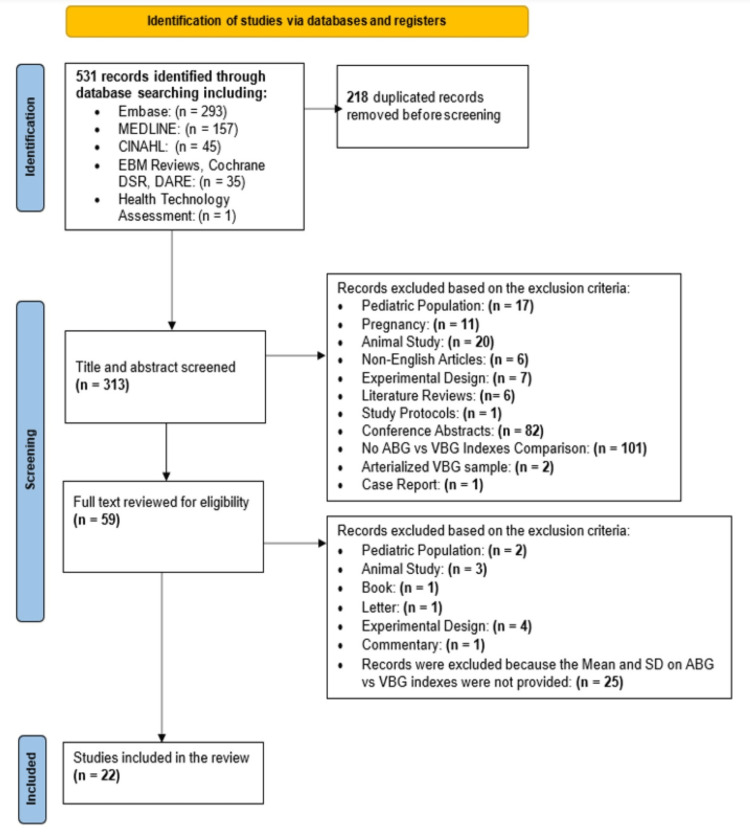
Arterial blood gases (ABGs) are routinely done in critical clinical settings to ascertain acid-base status. Due to difficulties and the potential side effects following arterial blood sampling, much research has been done to find the possibility of using venous samples as an alternative. However, this comparison needs to be evaluated in various contexts. Hence, this systematic review aims to explore the differences, appropriateness, and alternatives of arterial versus venous blood gas (VBG) analysis in different acid-base states. A comprehensive literature search was conducted through electronic databases using the terms "ABG," "VBG," "Arterial Blood Gas," "Venous Blood Gas," and "Gas analysis." Studies' qualities were assessed by using Newcastle - Ottawa Quality Assessment Scale. Of 531 articles, 22 were included in the study after title, abstract, and full-text screening. Based on the Newcastle - Ottawa Quality Assessment Scale, 23% of the studies had good quality (score ≥ 7), 77% fair quality (score 2-6), and none of the studies had poor quality (score ≤ 1). Moreover, 22.5% of the included articles found a strong correlation between ABG and VBG. 73% compared arterial and VBG parameters among patients with any clinical contexts, 22.5% in respiratory diseases, and 4.5% in metabolic conditions, and their results had a significant disparity. There was a considerable discrepancy among authors about the appropriateness and utilization of VBG as an alternative to ABG. Our findings suggest that those studies did not consider physiological differences between venous and arterial blood values and obviated the significance of sampling procedures.
Keywords: arterial blood gas; central; comparison; gas analysis; peripheral; venous blood gas.
Copyright © 2023, Saberian et al.
Conflict of interest statement
The authors have declared that no competing interests exist.
Figures
References
-
- Comparison of arterial and venous blood gas values in the initial emergency department evaluation of patients with diabetic ketoacidosis. Brandenburg MA, Dire DJ. Ann Emerg Med. 1998;31:459–465. - PubMed
-
- Peripheral venous and arterial blood gas analysis in adults: are they comparable? A systematic review and meta-analysis. Byrne AL, Bennett M, Chatterji R, Symons R, Pace NL, Thomas PS. Respirology. 2014;19:168–175. - PubMed
-
- Prediction of arterial blood gas values from venous blood gas values in patients with acute exacerbation of chronic obstructive pulmonary disease. Ak A, Ogun CO, Bayir A, Kayis SA, Koylu R. Tohoku J Exp Med. 2006;210:285–290. - PubMed
-
- Defining conditions that lead to the retention of water: the importance of the arterial sodium concentration. Shafiee MA, Charest AF, Cheema-Dhadli S, et al. Kidney Int. 2005;67:613–621. - PubMed
Publication types
LinkOut - more resources
Full Text Sources