


Effects of Cuminum cyminum L. essential oil and its nanoemulsion on oxidative stability and microbial growth in mayonnaise during storage
- PMID: 37576044
- PMCID: PMC10420787
- DOI: 10.1002/fsn3.3457
Effects of Cuminum cyminum L. essential oil and its nanoemulsion on oxidative stability and microbial growth in mayonnaise during storage
Abstract
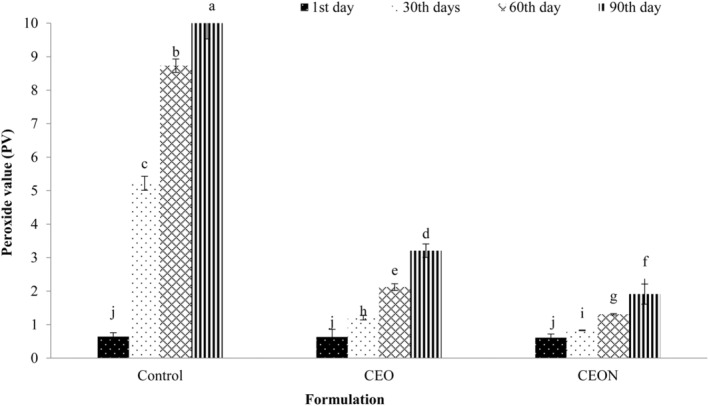
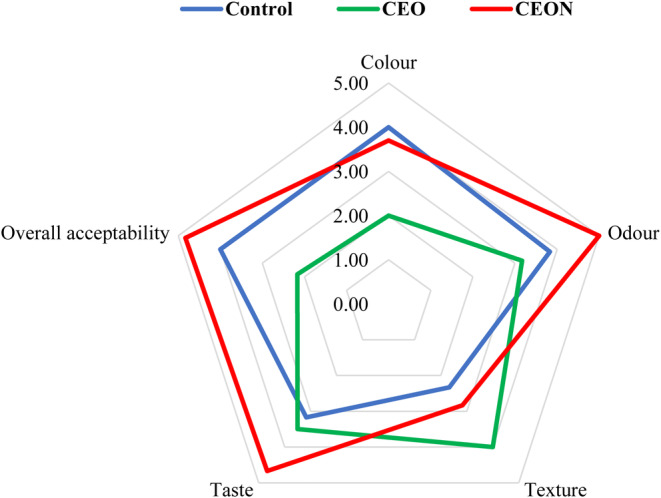
The present study aimed to investigate the effects of Cuminum cyminum L. essential oil (CEO) and its nanoemulsion (CEON) on oxidative stability and microbial growth of mayonnaise during storage. The GC analysis indicated that Cuminaldehyde (27.99%), o-Cymene (17.31%), γ-Terpinen (16.67%), and β-Pinene (9.35%) were the major components of CEO, respectively. The assessments of minimum inhibitory concentration (MIC) and minimum bactericidal concentration (MBC) showed that Escherichia coli ATCC 25922 (MBCCEO = 12 and MBCCEON = 6 mg/mL) was the most resistant bacteria, and in contrast, Staphylococcus aureus ATCC 29213 (MBCCEO = 6 and MBCCEON = 3 mg/mL) was the most sensitive bacteria. In the radical-scavenging assay, CEON (IC50 = 5 ± 0.07 μg/mL) exhibited a higher antioxidant activity than CEO (IC50 = 10 ± 0.13 μg/mL). The results showed that applying the MBC of CEO and CEON in mayonnaise led to a significant decrease (p < .05) in acidity, peroxide value, number of acid-resistant bacteria and fungi, and total microbial count compared with the control sample. In conclusion, this study demonstrated that using CEON resulted in oxidative stability, microbial growth control, and desirable sensorial attributes in mayonnaise compared with CEO and control samples.
Keywords: Cuminum cyminum L.; essential oil; mayonnaise; nanoemulsion.
© 2023 The Authors. Food Science & Nutrition published by Wiley Periodicals LLC.
Conflict of interest statement
The authors declare that they do not have any conflict of interest.
Figures




References
-
- Akrami, F. , Rodríguez‐Lafuente, A. , Bentayeb, K. , Pezo, D. , Ghalebi, S. , & Nerín, C. (2015). Antioxidant and antimicrobial active paper based on Zataria (Zataria multiflora) and two cumin cultivars (Cuminum cyminum). LWT – Food Science and Technology, 60(2), 929–933.
-
- Alizadeh, L. , Abdolmaleki, K. , Nayebzadeh, K. , & Shahin, R. (2019). Effects of tocopherol, rosemary essential oil and Ferulago angulata extract on oxidative stability of mayonnaise during its shelf life: A comparative study. Food Chemistry, 285, 46–52. 10.1016/j.foodchem.2019.01.028 - DOI - PubMed
-
- Allahghadri, T. , Rasooli, I. , Owlia, P. , Nadooshan, M. J. , Ghazanfari, T. , Taghizadeh, M. , & Astaneh, S. D. (2010). Antimicrobial property, antioxidant capacity, and cytotoxicity of essential oil from cumin produced in Iran. Journal of Food Science, 75(2), H54–H61. 10.1111/j.1750-3841.2009.01467.x - DOI - PubMed
-
- Andres, A. , Cava, R. , Martin, D. , Ventanas, J. , & Ruiz, J. (2005). Lipolysis in dry‐cured ham: Influence of salt content and processing conditions. Food Chemistry, 90(4), 523–533.
-
- AOCS . (1997). AOCS official method Cd 3d‐63: Acid value. Official Methods and Recommended Practices of American Oil Chemist' s Society.
LinkOut - more resources
Full Text Sources
Molecular Biology Databases
Miscellaneous
