[Preprint]. 2023 Aug 2:arXiv:2308.01431v1.

Using Single Molecule Imaging to Explore Intracellular Heterogeneity

Affiliations

Using Single Molecule Imaging to Explore Intracellular Heterogeneity

James A Galbraith et al. ArXiv. .

Update in

Abstract

Despite more than 100 years of study, it is unclear if the movement of proteins inside the cell is best described as a mosh pit or an exquisitely choreographed dance. Recent studies suggest the latter. Local interactions induce molecular condensates such as liquid-liquid phase separations (LLPSs) or non-liquid, functionally significant molecular aggregates, including synaptic densities, nucleoli, and Amyloid fibrils. Molecular condensates trigger intracellular signaling and drive processes ranging from gene expression to cell division. However, the descriptions of condensates tend to be qualitative and correlative. Here, we indicate how single-molecule imaging and analyses can be applied to quantify condensates. We discuss the pros and cons of different techniques for measuring differences between transient molecular behaviors inside and outside condensates. Finally, we offer suggestions for how imaging and analyses from different time and space regimes can be combined to identify molecular behaviors indicative of condensates within the dynamic high-density intracellular environment.


Figures

Figure 1.
Figure 1.. Ensemble techniques for quantifying the behaviors of fluorescent molecules.
a) Fluorescence Recovery After photobleaching (FRAP) bleaches a region of interest (ROI) and fits the recovery of fluorescence in the bleached region to describe the molecular behavior of the population. b) Fluorescence Correlation Spectroscopy (FCS) monitors the fluctuations in the fluorescence of individual molecules within an excitation volume and uses temporal autocorrelation to quantify average molecular behaviors. c) However, condensates are often crowded molecular environments with heterogeneous, not homogeneous, molecular behaviors that can change over time.
Figure 2.
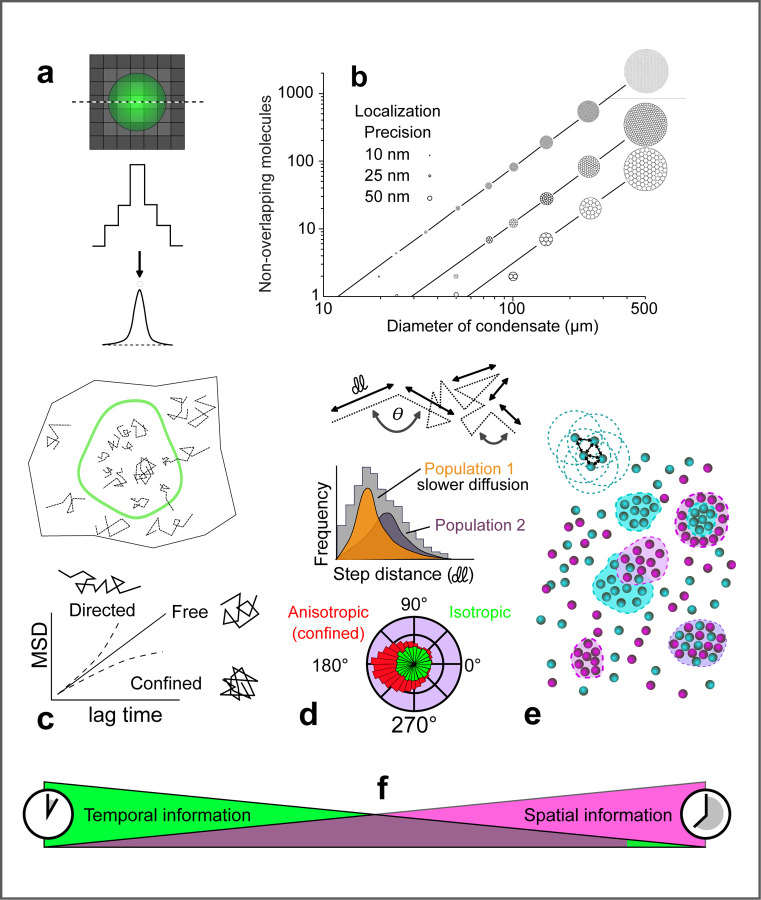
Figure 2.. Single-molecule techniques for quantifying molecular behaviors.
a) By controlling the fluorescent ON/OFF state so that only a small subset of molecules is visible at any given time, the position of the ON molecules can be mathematically determined (localized) with high precision. b) When the distance separating each visualized molecule equals the localization precision, the maximum number of non-overlapping “molecules” that will fit inside a circular region follows a second-order power law, giving a rough upper bound on molecular density. c) The trajectories or positions of individual molecules can be spatially separated according to whether they are inside or outside a condensate. Trajectories obtained by single-molecule tracking (SMT) can be analyzed by techniques such as mean squared displacement (MSD) to biophysically quantify their diffusivity and type of motility (directed, free, or confined). d) The distribution of single molecule trajectory length or orientation angle can be used to identify different diffusive behaviors in populations of molecules or whether molecule movements are anisotropic and confined. e) Localizing many stationary or slowly moving molecules can define molecular nanoarchitecture and quantify distributions of molecular clusters over a larger cell region but requires a longer collection window. f) The density of spatial information is inversely proportional to collection time, resulting in a trade-off between spatial and temporal resolution of the final dataset. Fast events are blurred at long times, while at short times requiring higher excitation power, molecules are bleached faster, yielding fewer trajectories.

References

    1. Alberti S., Gladfelter A., and Mittag T.. 2019. Considerations and Challenges in Studying Liquid-Liquid Phase Separation and Biomolecular Condensates. Cell. 176:419–434. - PMC - PubMed
    1. Banani S.F., Lee H.O., Hyman A.A., and Rosen M.K.. 2017. Biomolecular condensates: organizers of cellular biochemistry. Nat Rev Mol Cell Biol. 18:285–298. - PMC - PubMed
    1. Betzig E., Patterson G.H., Sougrat R., Lindwasser O.W., Olenych S., Bonifacino J.S., Davidson M.W., Lippincott-Schwartz J., and Hess H.F.. 2006. Imaging intracellular fluorescent proteins at nanometer resolution. Science. 313:1642–1645. - PubMed
    1. Boka A.P., Mukherjee A., and Mir M.. 2021. Single-molecule tracking technologies for quantifying the dynamics of gene regulation in cells, tissue and embryos. Development. 148. - PubMed
    1. Brangwynne C.P., Eckmann C.R., Courson D.S., Rybarska A., Hoege C., Gharakhani J., Julicher F., and Hyman A.A.. 2009. Germline P granules are liquid droplets that localize by controlled dissolution/condensation. Science. 324:1729–1732. - PubMed

Publication types

LinkOut - more resources