


Antimicrobial Resistance Profile of Pseudomonas aeruginosa from Different Clinical Samples in Debre Tabor Comprehensive Specialized Hospital, Northwest Ethiopia
- PMID: 37576170
- PMCID: PMC10416326
- DOI: 10.4314/ejhs.v33i3.5
Antimicrobial Resistance Profile of Pseudomonas aeruginosa from Different Clinical Samples in Debre Tabor Comprehensive Specialized Hospital, Northwest Ethiopia
Abstract
Background: Pseudomonas aeruginosa is one of the leading causes of hospital-acquired infections and the most common antimicrobial-resistant pathogens. It is associated with a variety of infections. This study aimed to determine the prevalence of P. aeruginosa and its antimicrobial resistance profile from different clinical specimens at Debre Tabor Comprehensive Referral Hospital (DTCRH).
Methods: A cross-sectional study was conducted from May to July 2022 at DTCRH. Socio-demographic and clinical data were collected using a structured questionnaire. Clinical samples (blood, wound swab, urine, and sputum) were collected from 348 study participants and processed following the standard bacteriological techniques. Antibiotic susceptibility testing was done by the Kirby-Bauer disc diffusion method. Data were entered and analyzed using SPSS version 25 statistical software. Descriptive statistics was used to present the findings of the study.
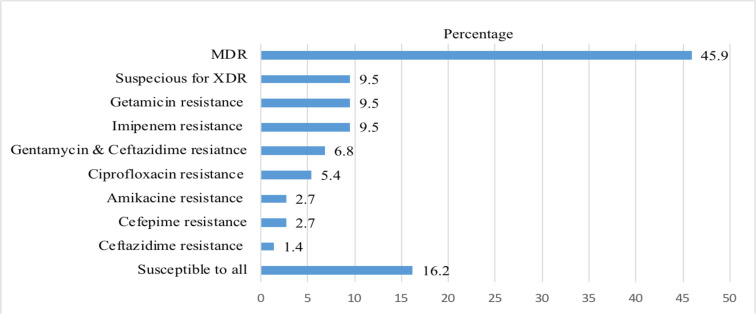
Results: The prevalence of P.aeruginosa was 74(19.3%). The detection of the isolates was different based on the type of samples that ranged from 0% to 54.5% from sputum and wound swabs, respectively. P.aeruginosa showed resistance against gentamicin at 62.2%, ceftazidime 51.4%, cefepime 50%, amikacin 29.7%, imipenem 28.4% and ciprofloxacin 14.9%. The level of multi-drug resistance (MDR) was 45.9%, and the suspicious extreme-drug resistance (XDR) rate was 9.5%. Being inpatient and wound swab samples were factors associated with the detection of P.aeruginosa from clinical samples.
Conclusion: The antibiotic resistance profile of P. aeruginosa isolates in the present study area was found to be alarming. Actions to minimize the effect of antimicrobial resistance should be strengthened, and further large-scale study should be conducted to find out the main reasons behind antibiotic resistance of P.aeruginosa and other clinically relevant isolates.
Keywords: Antimicrobial susceptibility profile; Debre Tabor; Pseudomonas aeruginosa.
© 2023 Tsigereda Asminew, et al.
Figures
References
-
- Mbim Elizabeth N, Mboto Clement I, Agbo Bassey E. A Review of Nosocomial Infections in Sub-Saharan Africa A Review of Nosocomial Infections in Sub-Saharan Africa. British Microbiology Research Journal. 2016;15(1) doi: 10.9734/BMRJ/2016/25895. - DOI
-
- Mizan Kindu, Derseh Lemma, Gelaw Baye, Moges Feleke. Carbapenemase-Producing Non-Glucose-Fermenting Gram-Negative Bacilli in Africa, Pseudomonas Aeruginosa and Acinetobacter Baumannii: A Systematic Review and Meta-Analysis. International Journal of Microbiology. 2020:9461901. doi: 10.1155/2020/9461901. - DOI - PMC - PubMed
-
- Khan Hassan Ahmed, Ahmad Aftab, Mehboob Riffat. Nosocomial Infections and Their Control Strategies. Asian Pacific Journal of Tropical Biomedicine. 2015;5(7):509–514. doi: 10.1016/j.apjtb.2015.05.001. - DOI
MeSH terms
Substances
LinkOut - more resources
Full Text Sources
Medical
Molecular Biology Databases