Review
. 2023 Jul 27:11:1232528.
doi: 10.3389/fcell.2023.1232528. eCollection 2023.

Organoids: opportunities and challenges of cancer therapy

Affiliations
Review

Organoids: opportunities and challenges of cancer therapy

Xianjie Jiang et al. Front Cell Dev Biol. .

Abstract

Organoids are a class of multicellular structures with the capability of self-organizing and the characteristic of original tissues, they are generated from stem cells in 3D culture in vitro. Organoids can mimic the occurrence and progression of original tissues and widely used in disease models in recent years. The ability of tumor organoids to retain characteristic of original tumors make them unique for tumorigenesis and cancer therapy. However, the history of organoid development and the application of organoid technology in cancer therapy are not well understood. In this paper, we reviewed the history of organoids development, the culture methods of tumor organoids establishing and the applications of organoids in cancer research for better understanding the process of tumor development and providing better strategies for cancer therapy. The standardization of organoids cultivation facilitated the large-scale production of tumor organoids. Moreover, it was found that combination of tumor organoids and other cells such as immune cells, fibroblasts and nervous cells would better mimic the microenvironment of tumor progression. This might be important developing directions for tumor organoids in the future.

Keywords: application; cancer therapy; establishing; organoids; organoids development.


Conflict of interest statement

The authors declare that the research was conducted in the absence of any commercial or financial relationships that could be construed as a potential conflict of interest.

Figures
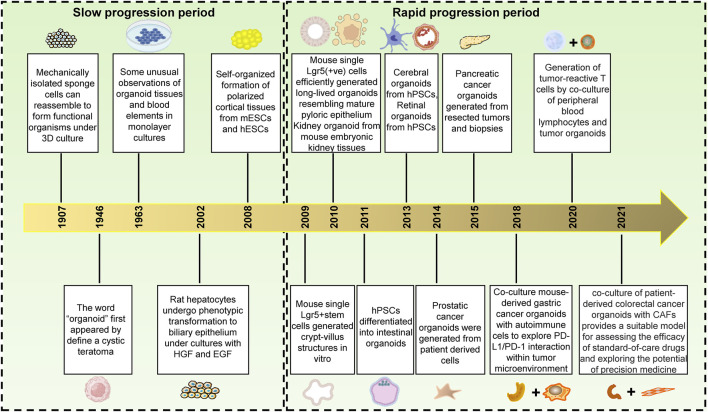
FIGURE 1
FIGURE 1
The history of organoids development. From 1907–2008, the development of organoids progressed slowly; however, from 2009 to present day, there has been a rapid advancement in organoid technology. This is evidenced by the initial successful culture of small intestinal crypt organoids and culminating in the maturation of tumor organoid co-culture. These milestones mark an increasingly widespread application of organoid technology within medicine.
FIGURE 2
FIGURE 2
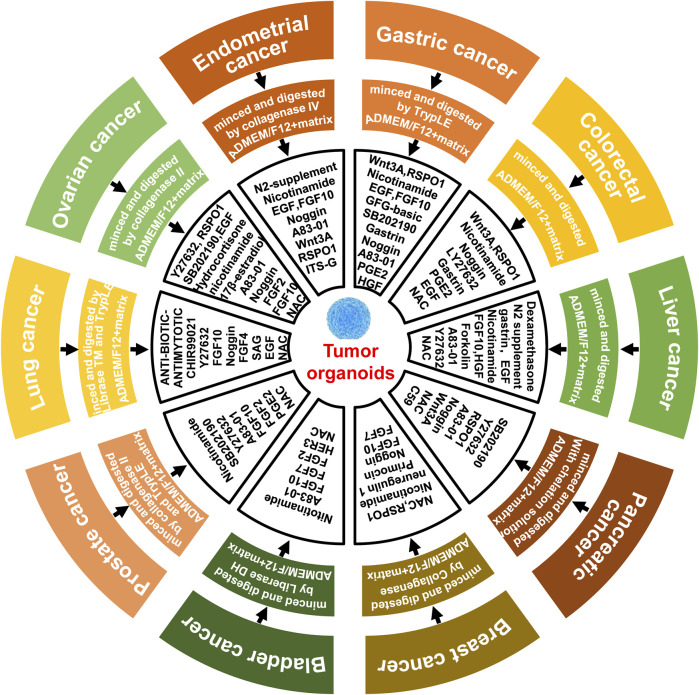
Summary of cytokines required for the cultivation of tumor organoids. In general, the establishment of organoid cultures involves the procurement of tumor tissue, followed by mechanical and enzymatic dissociation to obtain individual cells that are subsequently cultured in Advanced DMEM/F12 medium supplemented with basal membrane matrix and various cytokines. The specific cytokine requirements vary among different tumor types, including but not limited to gastric cancer (Vlachogiannis et al., 2018), colorectal cancer (van de Wetering et al., 2015), liver cancer (Broutier et al., 2017), pancreatic cancer (Seino et al., 2018), breast cancer (Sachs et al., 2018), bladder cancer (Whyard et al., 2020), prostate cancer (Zhou et al., 2021), lung cancer (Shi et al., 2020), ovarian cancer (Hill et al., 2018) and endometrial carcinoma (Boretto et al., 2019).
FIGURE 3
FIGURE 3
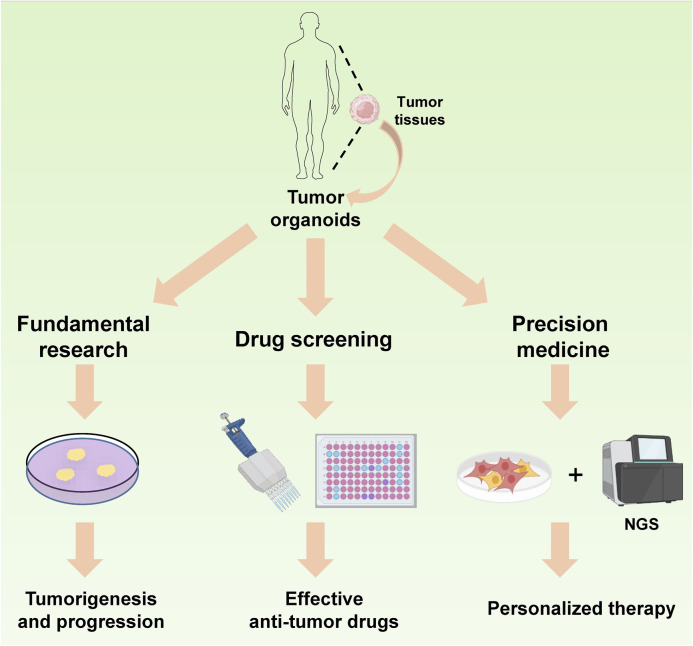
Application of organoids in cancer. The tumor organoids serve as an ideal model for investigating tumor progression. Moreover, owing to their inherited characteristics from parental tumor tissues and rapid culture ability, they can be effectively utilized for antitumor drug screening and play a crucial role in the precision treatment of cancer patients.

References

    1. Aboulkheyr Es H., Montazeri L., Aref A. R., Vosough M., Baharvand H. (2018). Personalized cancer medicine: An organoid approach. Trends Biotechnol. 36, 358–371. 10.1016/j.tibtech.2017.12.005 - DOI - PubMed
    1. Artegiani B., Clevers H. (2018). Use and application of 3D-organoid technology. Hum. Mol. Genet. 27, R99–R107. 10.1093/hmg/ddy187 - DOI - PubMed
    1. Balani S., Nguyen L. V., Eaves C. J. (2017). Modeling the process of human tumorigenesis. Nat. Commun. 8, 15422. 10.1038/ncomms15422 - DOI - PMC - PubMed
    1. Barker N., Huch M., Kujala P., van de Wetering M., Snippert H. J., van Es J. H., et al. (2010). Lgr5(+ve) stem cells drive self-renewal in the stomach and build long-lived gastric units in vitro . Cell Stem Cell 6, 25–36. 10.1016/j.stem.2009.11.013 - DOI - PubMed
    1. Bellapianta A., Cetkovic A., Bolz M., Salti A. (2022). Retinal organoids and retinal prostheses: An overview. Int. J. Mol. Sci. 23, 2922. 10.3390/ijms23062922 - DOI - PMC - PubMed

LinkOut - more resources