. 2023 Feb:30:101721.
doi: 10.1016/j.apmt.2022.101721. Epub 2022 Dec 20.

Ink Material Selection and Optical Design Considerations in DLP 3D Printing

Affiliations

Ink Material Selection and Optical Design Considerations in DLP 3D Printing

Hossein G Hosseinabadi et al. Appl Mater Today. 2023 Feb.

Abstract

Digital light processing (DLP) 3D printing has become a powerful manufacturing tool for the fast fabrication of complex functional structures. The rapid progress in DLP printing has been linked to research on optical design factors and ink selection. This critical review highlights the main challenges in the DLP printing of photopolymerizable inks. The kinetics equations of photopolymerization reaction in a DLP printer are solved, and the dependence of curing depth on the process optical parameters and ink chemical properties are explained. Developments in DLP platform design and ink selection are summarized, and the roles of monomer structure and molecular weight on DLP printing resolution are shown by experimental data. A detailed guideline is presented to help engineers and scientists to select inks and optical parameters for fabricating functional structures for multi-material and 4D printing applications.

Keywords: 3D printing; Digital light processing; ink selection; photosensitive monomer; resolution improvement.


Conflict of interest statement

Declaration of interests The authors declare that they have no known competing financial interests or personal relationships that could have appeared to influence the work reported in this paper.

Figures

Figure 1.
Figure 1.. DLP 3D printing,
a) a typical LCD-based platform as a transmissive method for 2D patterning of the light, b) a typical DMD-based DLP platform as a reflective technology for 2D patterning of the light, c) An anatomical photograph of a porcine heart showing the diversity in a natural biological organ (red represents the arterial blood supply and blue represents the venous blood supply) obtained by corrosion casting [35], d) a successful production of an (i) fractal tree, (ii) a hollow blood vessel with a pure non-scattering material (PEGDA, 1% w/v Irgacure 819 ), and zoom-in detail of vessel opening, (iii) the same material including light scattering bead (glass beads of 4 μm diameter, 1% w/v) resembling scattering due to presence of live cells, leading to the formation of clogged blood vessels through DMD-DLP printing [36].
Figure 2.
Figure 2.. The advancements in DLP platforms:
a) Rapid printing of conjunctival stem cell micro constructs in 18 cylindrical shapes for subconjunctival ocular injection, [59], b) Microfluidics enabled multi-material maskless DLP 3D printing [2]. c) Flashing photopolymerization 3D printing, i) Schematic diagram of the printer, ii, iv) 3D models of a micro altar and micro apple, iii,v) SEM image of the printed models by flash photopolymerization with 100 μm layer thickness [57], d) Projection-based 3D printing of cell patterning scaffolds with multiscale channels [58], e) Xolography linear volumetric 3D printing, i) diagram of xolography and the thin light sheet intensity distribution, ii) Rendered illustration of the printing zone and associated photoinduced reaction pathways of the DCPI, iii) Absorbance spectrum of DCPI under dark conditions (grey) and 375 nm UV irradiation (blue), iv) photoswitch kinetics probed at 585 nm, v) the model, ink under 3D printing and the fabricated part which is a spherical cage with free-floating ball [60].
Figure 3.
Figure 3.. Light-material interactions:
a) Diagram of basic concepts; b) Single photon absorption process; c) Sketch of particle size effect on scattering; d) Diagram of the two primary methodologies to measure scattering in an ink material; E) Effect of different photo absorbers (i.e., methylene blue, coccine, and tartrazine) on the printability of convex cone and vertical channel; (i) Wavelength scan results of the photoinitiator (i.e., Diphenyl (2,4,6-trimethylbenzoyl) phosphine oxide, DPPO) and photo absorbers; f) Effect of tartrazine concentration on (i) Patency degree of the vertical channel with a diameter of 1.5 mm, and (ii) The minimum printable diameter (Dmin) of the vertical channel with different diameters, and typical sample with 0.25% tartrazine [71].
Figure 4-
Figure 4-
3D curves and relevant 2D contour plots to address the dependence of the curing depth on the photoinitiator concentration and (a) the light intensity at fixed exposure time, t=0.2 s, (b) the exposure time at fixed light intensity, I0=50mWcm2, in a DLP printing platform. The ink chemical properties (α and ε parameters) obtained from Lee et al. [79].
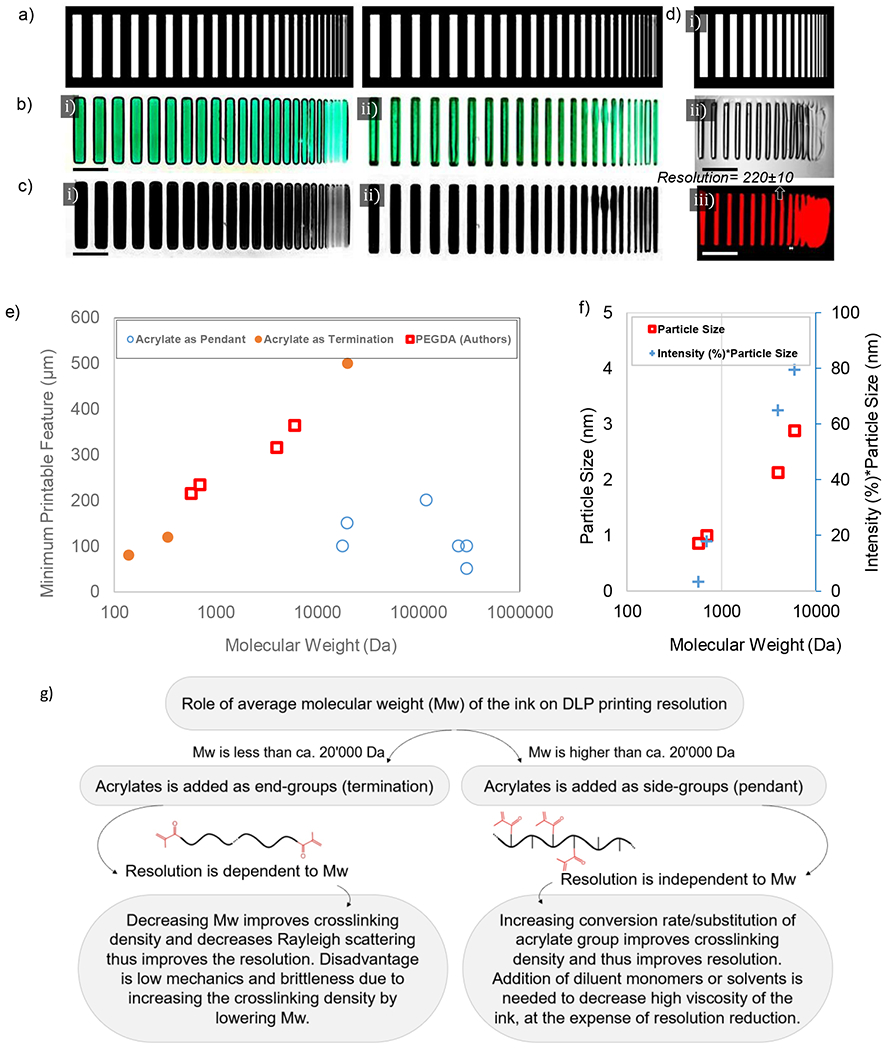
Figure 5.
Figure 5.. Role of molecular structure on obtained resolution during DLP printing;
a) used photomask for DLP printing of PEGDA; b) printed structures achieved from (i) PEGDA 6000 Da and (ii) PEGDA 700 Da (3 mM Ru:SPS), scale bar 5 mm; c) same patterns after removing background in grayscale mode; d) parallel lines photomask (i), obtained pattern under optical microscopy (ii), obtained pattern under fluorescent microscopy when Comarin 6 is used (iii) and the demonstration of estimated resolution based on the thinnest printable line, scale bar 1 mm; e) variations of the minimum printable feature size obtained from different formulations shown in Table 3 and the authors measurements on PEGDA samples; f) particle size obtained by DLS for uncrosslinked PEGDA samples of different molecular weights where size of particles are much smaller than the laser wavelength, ca. 200 nm; g) decision tree to help improving resolution of DLP printing based on the ink molecular structure.

References

    1. Ahn D, Stevens LM, Zhou K, Page ZA, Rapid High-Resolution Visible Light 3D Printing, ACS Cent. Sci 6 (2020) 1555–1563. 10.1021/acscentsci.0c00929. - DOI - PMC - PubMed
    1. Miri AK, Nieto D, Iglesias L, Goodarzi Hosseinabadi H, Maharjan S, Ruiz-Esparza GU, Khoshakhlagh P, Manbachi A, Dokmeci MR, Chen S, Shin SR, Zhang YS, Khademhosseini A, Microfluidics-Enabled Multimaterial Maskless Stereolithographic Bioprinting, Adv. Mater 30 (2018) 1–9. 10.1002/adma.201800242. - DOI - PMC - PubMed
    1. Lu Y, Mapili G, Suhali G, Chen S, Roy K, A digital micro-mirror device-based system for the microfabrication of complex, spatially patterned tissue engineering scaffolds, J. Biomed. Mater. Res. - Part A 77 (2006) 396–405. 10.1002/jbin.a.30601. - DOI - PubMed
    1. Goodarzi Hosseinabadi H, Dogan E, Miri AK, Ionov L, Digital Light Processing Bioprinting Advances for Microtissue Models, ACS Biomater. Sci. Eng 8 (2022) 1381. 10.1021/acsbiomaterials.lc01509. - DOI - PMC - PubMed
    1. Absolute Reports® - Market research Reports and Industry Analysis Reports, (n.d.). https://www.absolutereports.com/ (accessed February 14, 2022).

LinkOut - more resources