


Long-term sedation with remimazolam besylate versus propofol in critically ill patients during invasive mechanical ventilation: a study protocol for a multicenter randomized non-inferior trial
- PMID: 37576823
- PMCID: PMC10416620
- DOI: 10.3389/fphar.2023.1139872
Long-term sedation with remimazolam besylate versus propofol in critically ill patients during invasive mechanical ventilation: a study protocol for a multicenter randomized non-inferior trial
Abstract
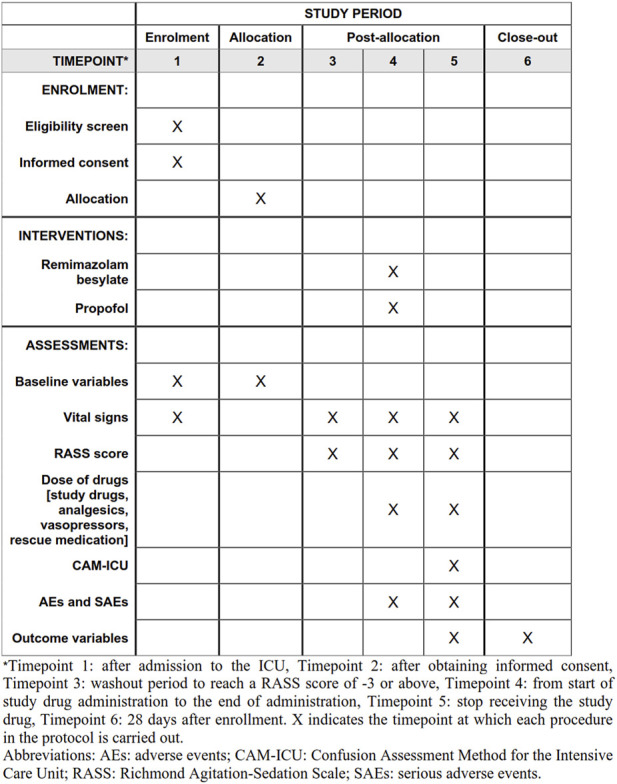
Background: Remimazolam besylate is a novel ultra-short-acting benzodiazepine that can potentially be a safe and effective sedative in intensive care units. This study aims to assess whether remimazolam besylate is not inferior to propofol in maintaining mild-to-moderate sedation in critically ill patients receiving long-term mechanical ventilation. Methods and analysis: This is a multicenter, randomized, single-blind, propofol-controlled, non-inferiority study. Eligible patients are randomly assigned to receive remimazolam besylate or propofol in a 1:1 ratio to maintain a Richmond Agitation-Sedation Scale score between -3 and 0. When patients are under-sedated, rescue sedation of dexmedetomidine is added. The primary outcome is the percentage of time in the target sedation range. The secondary outcomes are hours free from the invasive ventilator in 7 days, successful extubation in 7 days, and weaning time, the length of intensive care unit stay, the length of hospital stay, and mortality in 28 days. Modified intention-to-treat and safety analysis is performed. Clinical trial registration number: https://clinicaltrials.gov/ct2/show/NCT05555667.
Keywords: intensive care; mechanical ventilation; propofol; remimazolam; sedation.
Copyright © 2023 Yang, Tang, Du, Yu, Xu, Zhang, Liu, Zou, Ren, Yuan and Shang.
Conflict of interest statement
This study was sponsored by Yichang Humanwell Pharmaceutical Co., Ltd., China, who provided remimazolam besylate without charge for our study. Additionally, they contributed funds to hire a site management organization for this research project. They did not contribute to the design, analysis, and interpretation of the study. The authors declare that the research was conducted in the absence of any commercial or financial relationships that could be construed as a potential conflict of interest.
Figures
References
-
- Antonik L. J., Goldwater D. R., Kilpatrick G. J., Tilbrook G. S., Borkett K. M. (2012). A placebo- and midazolam-controlled phase I single ascending-dose study evaluating the safety, pharmacokinetics, and pharmacodynamics of remimazolam (CNS 7056): Part I. Safety, efficacy, and basic pharmacokinetics. Anesth. Analg. 115 (2), 274–283. 10.1213/ANE.0b013e31823f0c28 - DOI - PubMed
-
- Des B., Andreas K., Manu M., Morais R., Albrecht S., Jarnvig I. L., et al. (2005). Decreased duration of mechanical ventilation when comparing analgesia-based sedation using remifentanil with standard hypnotic-based sedation for up to 10 days in intensive care unit patients: A randomised trial [ISRCTN47583497]. Crit. Care 9 (3), R200–R210. 10.1186/cc3495 - DOI - PMC - PubMed
-
- Devlin J. W., Skrobik Y., Gélinas C., Needham D. M., Slooter A. J. C., Pandharipande P. P., et al. (2018). Clinical practice guidelines for the prevention and management of pain, agitation/sedation, delirium, immobility, and sleep disruption in adult patients in the ICU. Crit. Care Med. 46 (9), e825–e873. 10.1097/CCM.0000000000003299 - DOI - PubMed
Associated data
LinkOut - more resources
Full Text Sources
Medical
