


Evolution of primate interferon-induced transmembrane proteins (IFITMs): a story of gain and loss with a differentiation into a canonical cluster and IFITM retrogenes
- PMID: 37577422
- PMCID: PMC10415907
- DOI: 10.3389/fmicb.2023.1213685
Evolution of primate interferon-induced transmembrane proteins (IFITMs): a story of gain and loss with a differentiation into a canonical cluster and IFITM retrogenes
Abstract
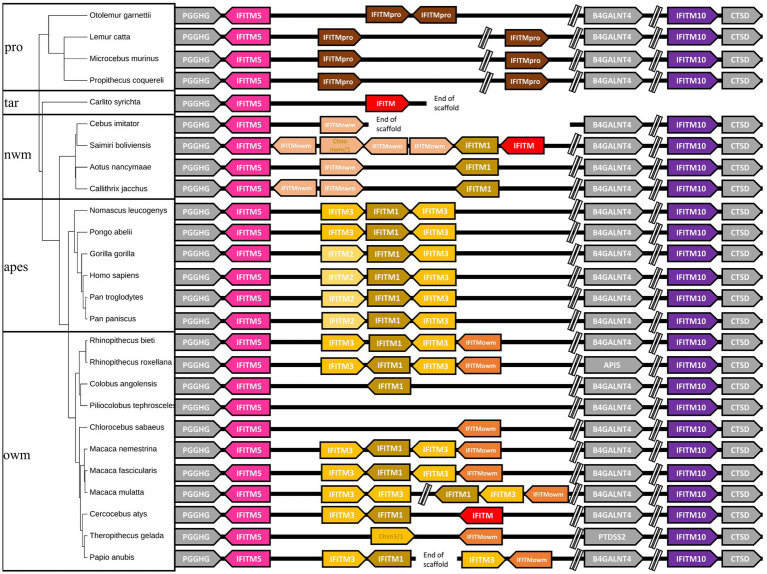
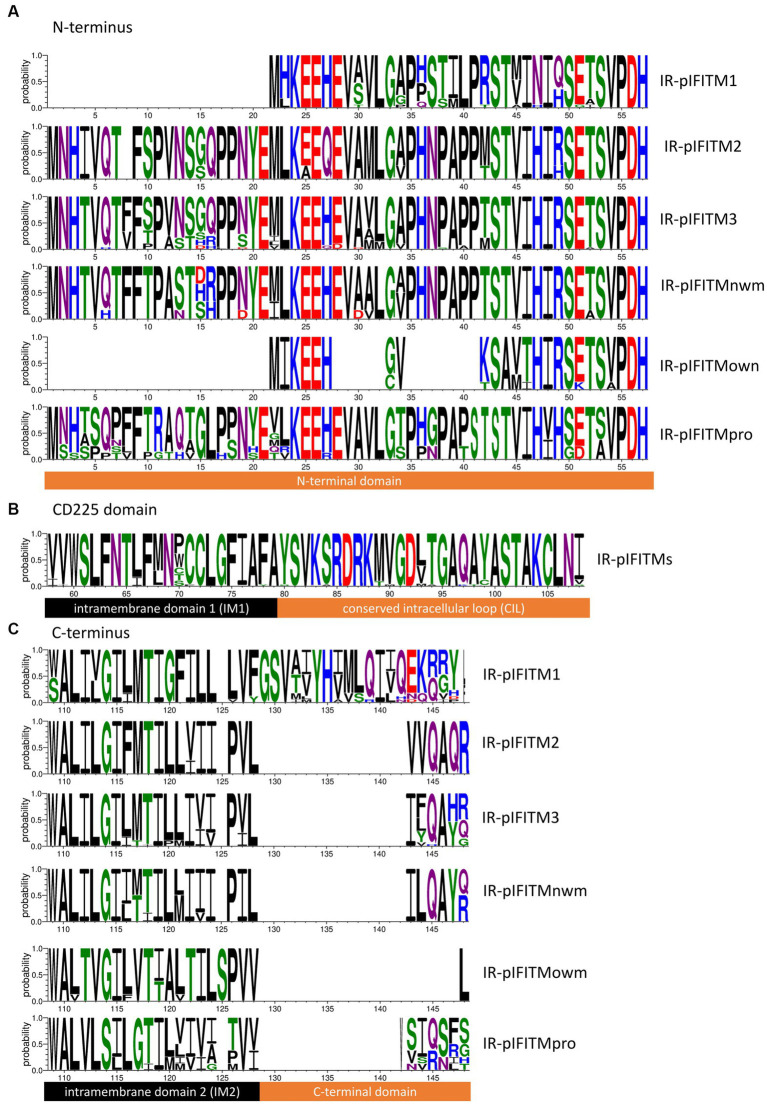
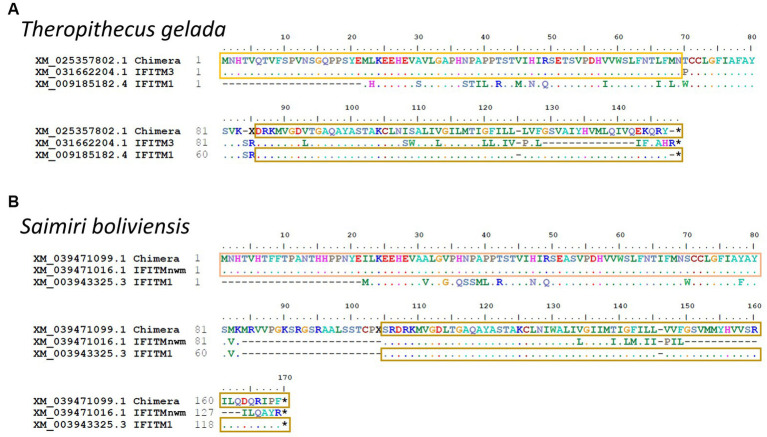
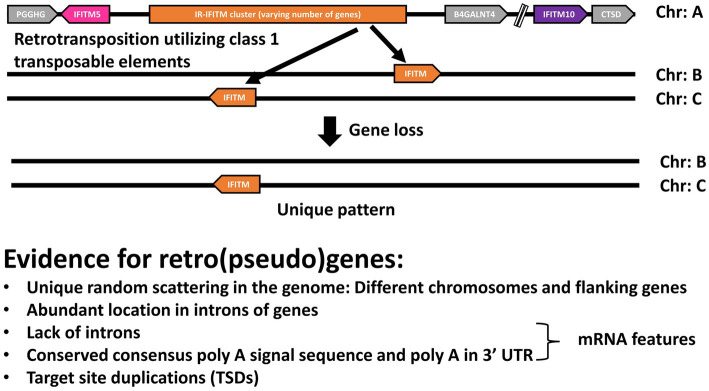
Interferon-inducible transmembrane proteins (IFITMs) are a family of transmembrane proteins. The subgroup of immunity-related (IR-)IFITMs is involved in adaptive and innate immune responses, being especially active against viruses. Here, we suggest that IFITMs should be classified as (1) a canonical IFITM gene cluster, which is located on the same chromosome, and (2) IFITM retrogenes, with a random and unique location at different positions within the genome. Phylogenetic analyses of the canonical cluster revealed the existence of three novel groups of primate IFITMs (pIFITM) in the IR-IFITM clade: the prosimian pIFITMs(pro), the new world monkey pIFITMs(nwm) and the old world monkey pIFITMs(owm). Therefore, we propose a new nomenclature: IR-pIFITM1, IR-pIFITM2, IR-pIFITM3, IR-pIFITMnwm, IR-pIFITMowm, and IR-pIFITMpro. We observed divergent evolution for pIFITM5 and pIFITM10, and evidence for concerted evolution and a mechanism of birth-and-death evolution model for the IR-pIFITMs. In contrast, the IFITMs scattered throughout the genomes possessed features of retrogenes retrotransposed by class 1 transposable elements. The origin of the IFITM retrogenes correspond to more recent events. We hypothesize that the transcript of a canonical IFITM3 has been constantly retrotransposed using class 1 transposable elements resulting in the IFITM retro(pseudo)genes. The unique pattern of each species has most likely been caused by constant pseudogenization and loss of the retro(pseudo)genes. This suggests a third mechanism of evolution for the IR-IFITMs in primates, similar to the birth-and-death model of evolution, but via a transposable element mechanism, which resulted in retro(pseudo)genes.
Keywords: antiviral proteins; evolution; innate immunity; interferon-induced transmembrane proteins; primates; retrogene; transposable elements.
Copyright © 2023 Schelle, Abrantes, Baldauf and Esteves.
Conflict of interest statement
The authors declare that the research was conducted in the absence of any commercial or financial relationships that could be construed as a potential conflict of interest.
Figures


References
LinkOut - more resources
Full Text Sources
