[Preprint]. 2023 Sep 26:2023.06.15.545144.
doi: 10.1101/2023.06.15.545144.

Molecular tuning of sea anemone stinging

Affiliations

Molecular tuning of sea anemone stinging

Lily S He et al. bioRxiv. .

Update in

  • Molecular tuning of sea anemone stinging.
    He LS, Qi Y, Allard CAH, Valencia-Montoya WA, Krueger SP, Weir K, Seminara A, Bellono NW. He LS, et al. Elife. 2023 Oct 31;12:RP88900. doi: 10.7554/eLife.88900. Elife. 2023. PMID: 37906220 Free PMC article.

Abstract

Jellyfish and sea anemones fire single-use, venom-covered barbs to immobilize prey or predators. We previously showed that the anemone Nematostella vectensis uses a specialized voltage-gated calcium (CaV) channel to trigger stinging in response to synergistic prey-derived chemicals and touch (Weir et al., 2020). Here we use experiments and theory to find that stinging behavior is suited to distinct ecological niches. We find that the burrowing anemone Nematostella uses uniquely strong CaV inactivation for precise control of predatory stinging. In contrast, the related anemone Exaiptasia diaphana inhabits exposed environments to support photosynthetic endosymbionts. Consistent with its niche, Exaiptasia indiscriminately stings for defense and expresses a CaV splice variant that confers weak inactivation. Chimeric analyses reveal that CaVβ subunit adaptations regulate inactivation, suggesting an evolutionary tuning mechanism for stinging behavior. These findings demonstrate how functional specialization of ion channel structure contributes to distinct organismal behavior.


Conflict of interest statement

Competing Interests: The authors declare no competing financial interests.

Figures
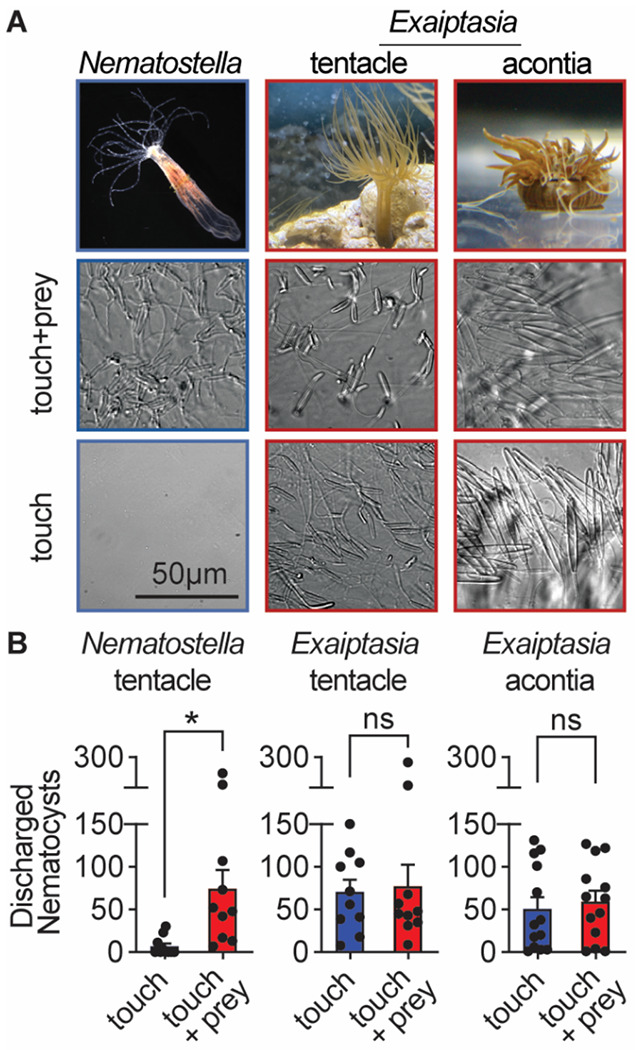
Figure 1.
Figure 1.. Comparative sea anemone stinging behavior.
A) Nematostella vectensis stings with tentacles while Exaiptasia diaphana also stings with acontia filaments that are ejected from its body for defense. Left: Nematostella nematocyte discharge was only observed in response to simultaneous prey chemicals and touch stimuli. Middle, Right: Exaiptasia nematocyte discharge from tentacles and acontia occurred irrespective of prey cues (touch alone). Scale bar = 50μm. B) Nematostella nematocyte discharge was elicited by simultaneous touch and prey chemical stimuli (n = 10 trials). Exaiptasia tentacle (n = 10) and acontia (n = 13) nematocytes discharged only to touch, with or without prey chemicals. p < 0.05 for Nematostella, paired two-tailed student’s t-test. Data represented as mean ± sem.
Figure 2.
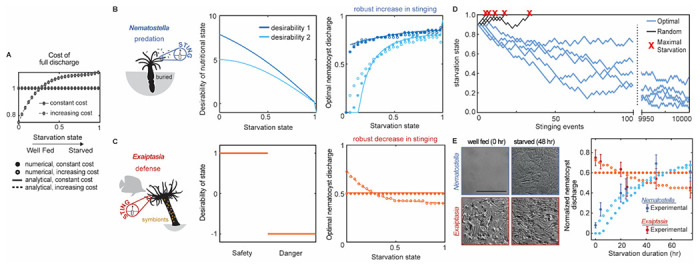
Figure 2.. Nematostella stinging is regulated by predation while Exaiptasia stings for defense.
A) The cost of stinging is c = coa, where co is the cost for full nematocyte discharge and it either does not change (solid lines filled circles) or increases slightly (dashed lines empty circles) with starvation state. These symbols are used throughout the figure to represent each cost function. The increasing cost is obtained by fitting the Exaiptasia behavior (see fitting procedure in Materials and Methods). B) Left: Nematostella burrows in the substrate and stings for predation. Center: Desirability of nutritional state, or reward, decreases with starvation. Two examples are shown: example 1, r(s) = 10 tan−1 (1 − s); example 2, r(s)=5cos(sπ2). Right: Predicted optimal stinging obtained by solving equation (1) with numerical simulations (circles) and approximate analytical solutions (lines) assuming: p(a) = pM a(2 − a) and pM = 0.8; c = c0a with cost for full discharge c0 matching panel A (full circles and solid lines for constant cost; empty circles for increasing cost); reward in Left panels (colors match). For all reward and cost functions, optimal predatory stinging increases with starvation under broad assumptions (see Materials and Methods). C) Left: Exaiptasia diaphana relies heavily on endosymbiotic algae for nutrients and stings primarily for defense. Center: We assumed there are two states, safety (L), and danger (D). The state of safety can transition to danger, but not the other way around. We assumed the agent obtains reward 1 in state L and penalty −1 in state D. Right: Predicted optimal stinging obtained by solving equation (2) with numerical simulations (circles) and analytical solutions (lines). Styles match the costs in panel A; we assume p(a) = pM a(2 − a) and pM = 0.8 as before. Optimal defensive stinging is constant or decreases with starvation under broad assumptions (see Materials and Methods). D) Examples of optimal (blue) versus random (black) predatory stinging. Each agent (anemone) starts with s = 0.9, and stings sequentially for many events (represented on the x axis). The random agent almost always reaches maximal starvation before 50 events (grey lines, five examples shown). In comparison, the optimal agent effectively never starves due to a successful stinging strategy optimized for predation (blue lines, five examples shown, parameters as in panel B, curve with matching color). E) Left: Nematostella nematocyte discharge was affected by prey availability while Exaiptasia stung at a similar rate regardless of feeding. p < 0.0001 for Nematostella, two-way ANOVA with post hoc Bonferroni test (n = 10 animals, data represented as mean ± sem). Right: Experimental data (circles with error bars representing standard deviation) are well fit by normalized optimal nematocyst discharge predicted from MDP models for both Exaiptasia (orange full and empty circles for constant and increasing cost, panel A) and Nematostella (light blue full and empty circles for constant and increasing cost, panel A and desirability 2 in panel B). We match the last experimental data point to s = 0.5, the precise value of this parameter is irrelevant as long as it is smaller than 1, representing that animals are not severely starved during the experiment.
Figure 3.
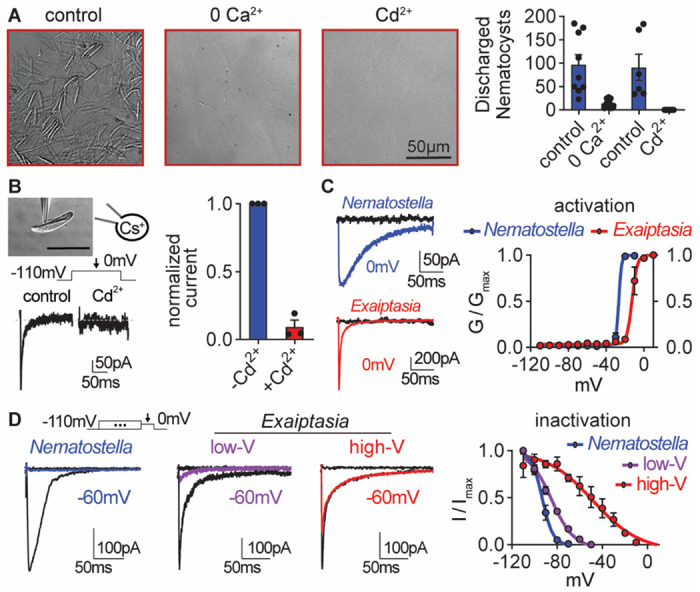
Figure 3.. Exaiptasia nematocyte voltage-gated Ca2+ currents exhibit minimal steady-state inactivation compared with Nematostella.
A) Touch-elicited Exaiptasia tentacle nematocyte discharge was blocked in the absence of Ca2+ (p < 0.01, paired two-tailed student’s t-test, n = 9 animals) or by addition of the CaV channel blocker Cd2+ (500μM, p < 0.05, paired two-tailed student’s t-test, n = 6 animals). Scale bar = 50μm. B) Top: Representative patch clamp experiment from an Exaiptasia nematocyte. Scale bar = 20μm. Bottom: Nematocyte voltage-gated currents elicited by a maximally activating 0mV pulse were blocked by Cd2+ (n = 3 cells, p < 0.01, paired two-tailed student’s t-test). C) Nematocyte voltage-gated currents elicited by −120mV (black) or 0mV pulses (colored). Conductance-voltage curves for Nematostella nematocyte (Va1/2 = −26.54 ± 0.78mV, n = 3) and Exaiptasia nematocyte (Va1/2 = −12.47 ± 0.70mV, n = 3). D) Nematocyte voltage-gated currents elicited by a maximally activating voltage pulse following 1 s pre-pulses to −110 mV (max current, black), −50 mV (colored), or 20 mV (inactivated, no current). Nematostella nematocytes inactivated at very negative voltages (Vi1/2 = −93.22 ± 0.42mV, n = 7) while Exaiptasia contained two populations of nematocytes: low-voltage threshold (Vi1/2 = −84.94 ± 0.70mV, n = 4), and high-voltage threshold (Vi1/2 = −48.17 ± 3.32mV, n = 3). Data represented as mean ± sem.
Figure 4.
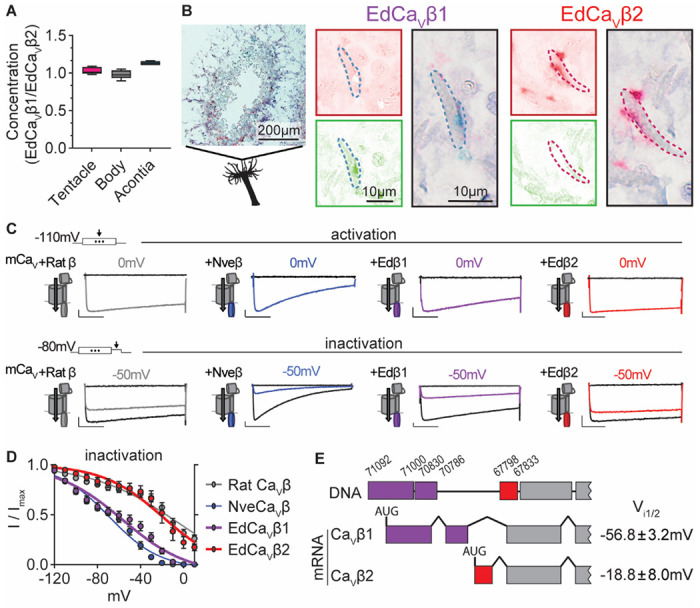
Figure 4.. Exaiptasia expresses a CaV β subunit splice isoform that confers weak voltage-dependent inactivation.
A) ddPCR ratio of concentrations of CaV β subunit 1 and 2 mRNAs was similar in tentacle (n = 5), body (n = 5), and acontia (n = 4 animals) tissue samples. B) EdCaVβ1 and EdCaVβ2 localized to distinct nematocytes in Exaiptasia tentacle cross section, as visualized by BaseScope in situ hybridization. Representative nematocyte expressing EdCaVβ1 (green) or EdCaVβ2 (red). Representative of 3 animals. C) Voltage-gated currents from heterologously-expressed chimeric mammalian CaV (mCaV) with different β subunits: rat (Rattus norvegicus), Nematostella (Nve), Exaiptasia EdCaVβ1 or EdCaVβ2. Top: Currents elicited by voltage pulses to −120mV (no current, black) and maximally activating 0mV (colored). Bottom: Voltage-gated currents elicited by a maximally activating voltage pulse following 1 s pre-pulses to −110 mV (max current, black), −50 mV (colored), or 20 mV (inactivated, no current, black). Scale bars = 100pA, 50ms. D) Exaiptasia CaV β subunit splice isoforms confer distinct inactivation: Nematostella β subunit (Vi1/2 = −68.93 ± 1.53mV, n = 5) and Rat β2a subunit (Vi1/2 = −2.98 ± 13.51mV, n = 12) and EdCaVβ1 (Vi1/2 = −56.76 ± 3.18mV, n = 8), and EdCaVβ2 (Vi1/2 = −18.84 ± 8.00mV, n = 5 cells). Data represented as mean ± sem. E) Genomic alignment of Exaiptasia β subunit isoforms showed that alternative splicing of the N-terminus region was associated with distinct inactivation: CaVβ1 (long N-term) had low-voltage steady-state inactivation similar to Nematostella, while CaVβ2 (short N-term) exhibited more depolarized steady-state inactivation, matching its mammalian orthologue. Genomic loci listed above sequence.
Figure 5.
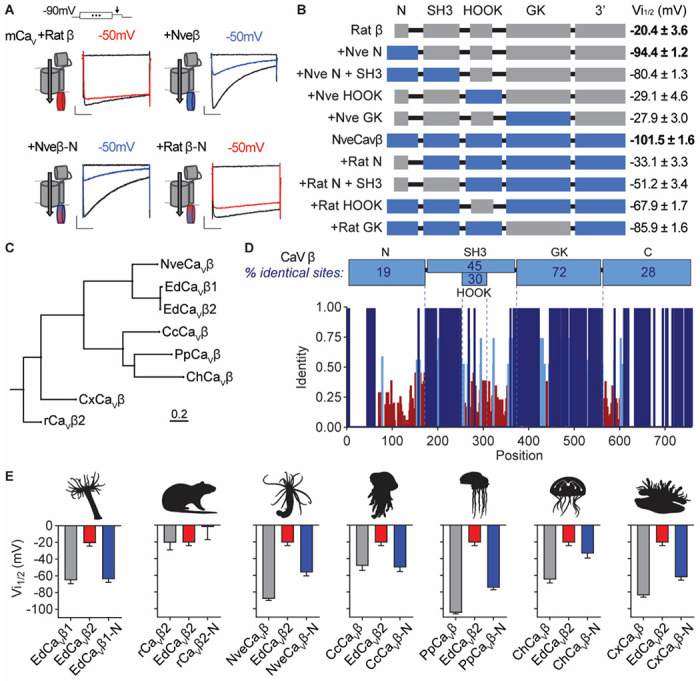
Figure 5.. Cnidarian CaV β subunit N-termini confer unique inactivation properties.
C) Voltage-gated currents from heterologously expressed CaV channels with Nematostella-rat chimeric β subunits demonstrate that the Nematostella N-terminus is sufficient to drive inactivation at negative voltages. Currents shown in response to 10 mV voltage pulses following 1 s pre-pulses to −130 mV (max current, black), −50 mV (colored), or 0 mV (inactivated, no current, black). Scale bars = 100pA, 50ms. D) Diagram of CaV Nematostella-rat β subunit domain swaps and resulting Vi1/2 values. The Nematostella β subunit N-terminus is required and sufficient for uniquely hyperpolarized CaV inactivation properties (p < 0.001 for average Vi1/2 values across mutant beta subunits, one-way ANOVA with post-hoc Tukey test, n = 2-8 cells). E) Phylogenetic tree of β subunit sequences obtained from several species of cnidarians. Abbreviations of species: Nve, Nematostella vectensis; Ed, Exaiptasia diaphana; Cc, Cyanea capillata (jellyfish); Pp, Physalia physalis (siphonophore); Ch, Clytia hemisphaerica (jellyfish); Cx, Cassiopea xamachana (jellyfish); r, Rattus norvegicus. F) Top: Percentage of identity between amino acid sequences across β subunit protein domains for NveCaVβ, EdCaVβ1, EdCaVβ2, CcCaVβ, PpCaVβ, ChCaVβ, CxCaVβ2, rCaVβ2. Bottom: Fraction of identity of amino acids across sites of the β subunit protein. Cnidarian CaV β N-termini shift depolarized, weak voltage-dependent inactivation of CaV channels containing EdCaVβ2 to more negative voltages. Voltage-dependent inactivation (Vi1/2) of heterologously-expressed CaVs with WT EdCaVβ2, β subunits from the indicated cnidarians, and chimeras with their N-termini on EdCaVβ2 (p < 0.0001 for average Vi1/2 values with multiple comparisons against WT EdCaVβ2 mean, one-way ANOVA with Bartlett’s test and post-hoc Tukey test, n = 4-9 cells). Data represented as mean ± sem.

References

    1. Aguilar-Camacho JM, Foreman K, Jaimes-Becerra A, Aharoni R, Gründer S, Moran Y (2023) Functional analysis in a model sea anemone reveals phylogenetic complexity and a role in cnidocyte discharge of DEG/ENaC ion channels. Commun Biol 6:17. - PMC - PubMed
    1. Babonis LS, Enjolras C, Ryan JF, Martindale MQ (2022) A novel regulatory gene promotes novel cell fate by suppressing ancestral fate in the sea anemone Nematostella vectensis. Proc Natl Acad Sci 119:e2113701119. - PMC - PubMed
    1. Babonis LS, Martindale MQ (2014) Old Cell, New Trick? Cnidocytes as a Model for the Evolution of Novelty. Integr Comp Biol 54:714–722. - PMC - PubMed
    1. Baumgarten S, Simakov O, Esherick LY, Liew YJ, Lehnert EM, Michell CT, Li Y, Hambleton EA, Guse A, Oates ME, Gough J, Weis VM, Aranda M, Pringle JR, Voolstra CR (2015) The genome of Aiptasia, a sea anemone model for coral symbiosis. Proc Natl Acad Sci 112:11893–11898. - PMC - PubMed
    1. Beckmann A, Özbek S (2012) The Nematocyst: a molecular map of the Cnidarian stinging organelle. Int J Dev Biol 56:577–582. - PubMed

Publication types