Review
. 2024 Jan;47(1):1-15.
doi: 10.1007/s40618-023-02166-5. Epub 2023 Aug 14.

Diabetic striatopathy: an updated overview of current knowledge and future perspectives

Affiliations
Review

Diabetic striatopathy: an updated overview of current knowledge and future perspectives

A Arecco et al. J Endocrinol Invest. 2024 Jan.

Abstract

Purpose: Diabetic striatopathy (DS) is a rare complication of poorly controlled diabetes mellitus (DM), characterized by hyperglycemia associated with chorea/ballism and characteristic reversible basal ganglia abnormalities on computed tomography (CT) and/or magnetic resonance imaging (MRI). We propose a narrative review of the literature on this topic, currently unknown to most, and about which physicians should be aware. We intend to summarize, critically review, and take to mean the evidence on this disorder, describing its typical features.

Methods: We searched Pubmed for English-language sources using the following keywords in the title and the abstract: diabetic striatopathy, hyperglycemic non-ketotic hemichorea/hemiballism, chorea/hemichorea associated with non-ketotic hyperglycemia, diabetic hemiballism/hemichorea, chorea, hyperglycemia, and basal ganglia syndrome. We collected scientific articles, including case reports, reviews, systematic reviews, and meta-analyses from the years 1975 to 2023. We eliminated duplicate, non-English language or non-related articles.

Results: Older Asian women are more frequently affected. Suddenly or insidiously hemichorea/hemiballism, mainly in the limbs, and high blood glucose with elevated HbA1c in the absence of ketone bodies have been observed. Furthermore, CT striatal hyperdensity and T1-weighted MRI hyperintensity have been observed. DS is often a treatable disease following proper hydration and insulin administration. Histopathological findings are variable, and no comprehensive hypothesis explains the atypical cases reported.

Conclusion: DS is a rare neurological manifestation of DM. If adequately treated, although treatment guidelines are lacking, the prognosis is good and life-threatening complications may occur occasionally. During chorea/hemiballism, we recommend blood glucose and HbA1c evaluation. Further studies are needed to understand the pathogenesis.

Keywords: Basal ganglia; CT hyperdensity; Hemichorea/hemiballism; Hyperglycemia; T1-weighted MRI hyperintensity.


Conflict of interest statement

The authors have nothing to disclose. The authors declare that they have no conflicts of interest.

Figures
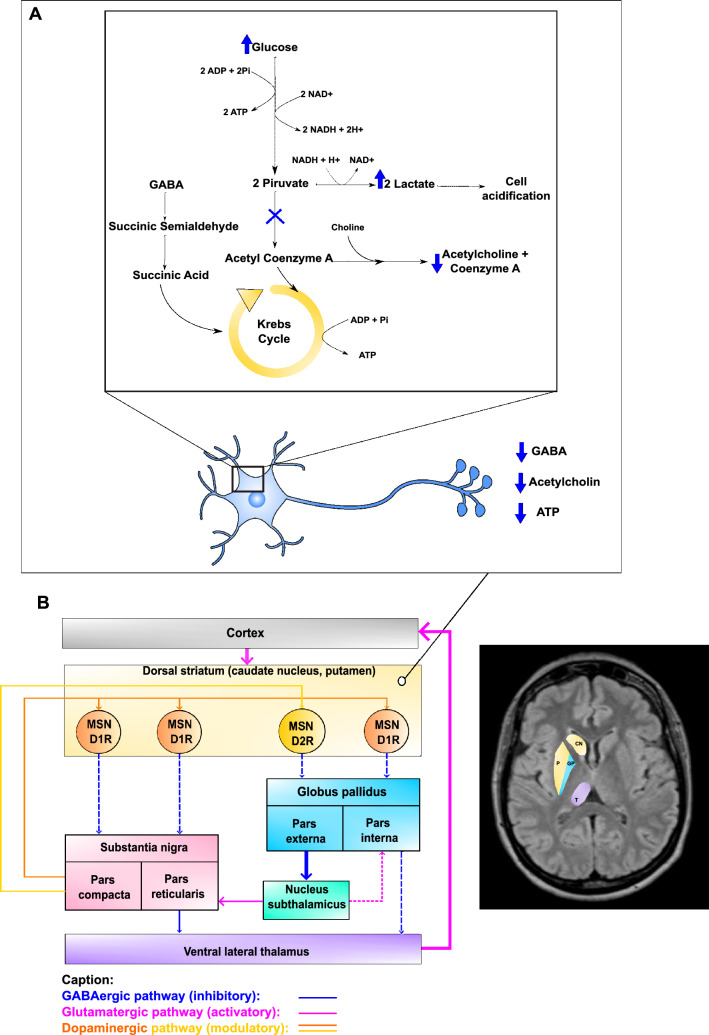
Fig. 1
Fig. 1
Metabolic theory. A Biochemical changes within basal ganglia neurons during non-ketotic hyperglycemia. B Neuroanatomical diagram of the connections between cerebral cortex and basal ganglia and visual representation of caudate nucleus (CN), putamen (P), globus pallidus (GP) and thalamus (T) on an axial T1-weighted-FLAIR MR image. Thicker arrows indicate connection becoming hyperactive because of striatal dysfunction, while dotted arrows indicate connection becoming hypoactive. Interruption of GABAergic transmission from the striatum to the external globus pallidus (GPe) [medium spiny neurons expressing dopamine D2 receptor (MSN D2R)] leads to an abnormal increase in the activity of the GPe neurons, which in turn exerts an inhibitory action on the subthalamic nucleus (STN). Increased inhibition of the STN, secondary to the increase in GPe activity, leads to a loss of control over internal globus pallidus (GPi). On the other hand, the GABAergic transmission is interrupted [medium spiny neurons expressing dopamine D1 receptor (MSN D1R)] from the striatum to the GPi, which receives this afferent and the excitatory inputs from the STN. The imbalance between the indirect excitatory and direct inhibitory pathways, resulting in a loss of inhibitory control by the GPi/substantia nigra (SNr) on the thalamus, leads to a disinhibition of the motor thalamus
Fig. 2
Fig. 2
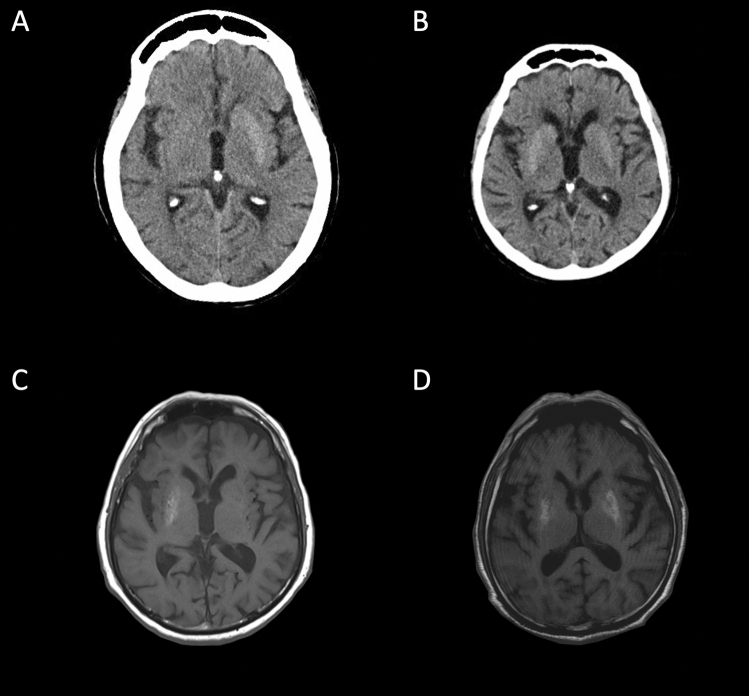
Typical neuroimaging of diabetic striatopathy. A, B Axial CT scan: contralateral caudate nucleus and putamen (A) and bilateral striatal hyperdensity (B). C, D Axial T1-weighted MR image: contralateral (C) and bilateral pallidal-putaminal (D) hyperintensity can be observed

References

    1. Das L, Pal R, Dutta P, Bhansali A. “Diabetic striatopathy” and ketoacidosis: report of two cases and review of literature. Diabetes Res Clin Pract. 2017;128:1–5. doi: 10.1016/j.diabres.2017.03.008. - DOI - PubMed
    1. Chua C-B, Sun C-K, Hsu C-W, et al. “Diabetic striatopathy”: clinical presentations, controversy, pathogenesis, treatments, and outcomes. Sci Rep. 2020;10:1594. doi: 10.1038/s41598-020-58555-w. - DOI - PMC - PubMed
    1. Homaida M, Kanodia AK, Young N, Yu WM. Diabetic striatopathy: a rare condition and diagnostic dilemma. BMJ Case Rep. 2021;14:e240141. doi: 10.1136/bcr-2020-240141. - DOI - PMC - PubMed
    1. Carrion DM, Carrion AF. Non-ketotic hyperglycaemia hemichorea-hemiballismus and acute ischaemic stroke. BMJ Case Rep. 2013 doi: 10.1136/bcr-2012-008359. - DOI - PMC - PubMed
    1. Herath HMMTB, Pahalagamage SP, Senanayake S. Case report of hyperglycemic nonketotic chorea with rapid radiological resolution. BMC Med Imaging. 2017;17:54. doi: 10.1186/s12880-017-0228-2. - DOI - PMC - PubMed