


A Clinical Study to Assess the Efficacy and Safety of MP-AzeFlu Nasal Spray in Comparison to Commercially Available Azelastine Hydrochloride and Fluticasone Propionate Nasal Sprays in Chinese Volunteers with Allergic Rhinitis
- PMID: 37580498
- PMCID: PMC10447793
- DOI: 10.1007/s41030-023-00238-8
A Clinical Study to Assess the Efficacy and Safety of MP-AzeFlu Nasal Spray in Comparison to Commercially Available Azelastine Hydrochloride and Fluticasone Propionate Nasal Sprays in Chinese Volunteers with Allergic Rhinitis
Erratum in
-
Correction: A Clinical Study to Assess the Efficacy and Safety of MP-AzeFlu Nasal Spray in Comparison to Commercially Available Azelastine Hydrochloride and Fluticasone Propionate Nasal Sprays in Chinese Volunteers with Allergic Rhinitis.Pulm Ther. 2024 Mar;10(1):143-144. doi: 10.1007/s41030-023-00250-y. Pulm Ther. 2024. PMID: 38099987 Free PMC article. No abstract available.
Abstract
Introduction: The objective of the present study was to evaluate the efficacy and safety of MP-AzeFlu nasal spray in comparison to commercially available azelastine hydrochloride and fluticasone propionate sprays in Chinese patients with moderate-to-severe allergic rhinitis (AR).
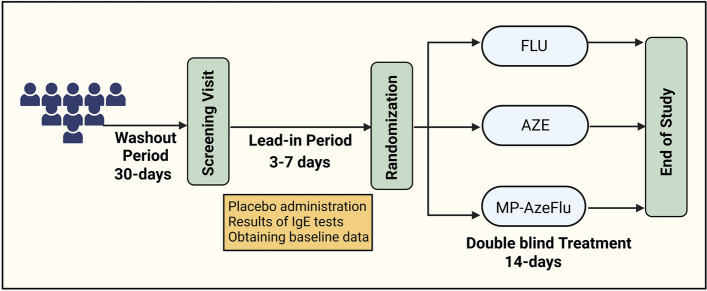
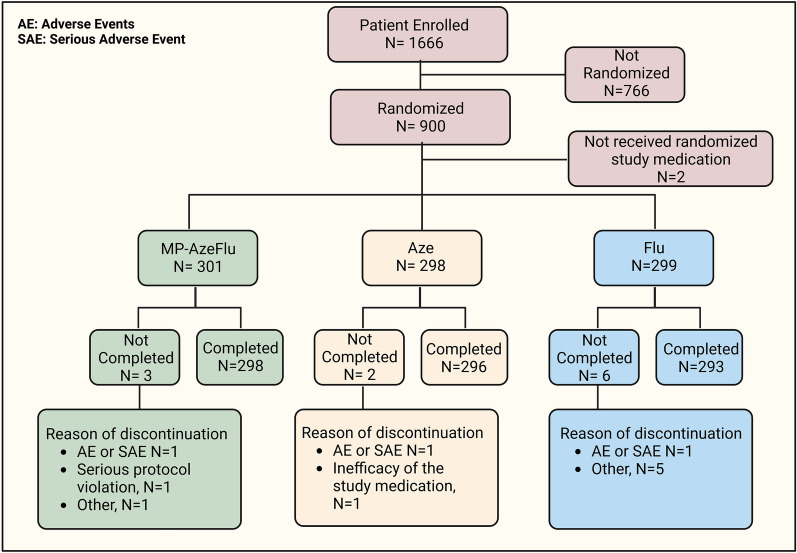
Methods: We conducted a 14-day multicenter, randomized, double-blind, active controlled prospective clinical study in adult and adolescent patients with AR, who had moderate-to-severe symptoms. The primary efficacy endpoint was the change from baseline in combined 12-h reflective total nasal symptom score (rTNSS) (morning [AM] + afternoon [PM]). The safety profile of the study medications was assessed through the recording, reporting, and analysis of baseline medical conditions, adverse events (AEs), vital signs, and focused nasal examination. Three hundred patients per treatment group were randomized, which led to a total sample size estimation of 900 patients.
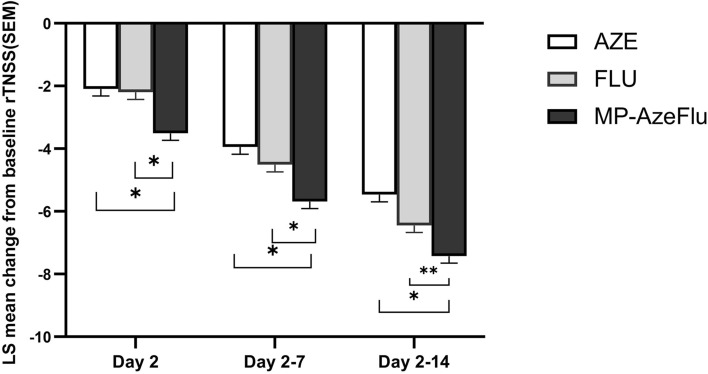
Results: MP-AzeFlu group showed significantly higher symptom reduction for the entire 2-week treatment period in rTNSS when compared with the AZE group (LS mean difference: - 1.96; 95% CI: - 2.53, - 1.39; p < 0.0001), or the FLU group (LS mean difference: - 0.98; 95% CI: - 1.55, - 0.41; p = 0.0007). The results of adult RQLQ showed improvement in QoL in all treatment groups. Except for dysgeusia (bitter taste) that was reported by more patients (13 [4.3%]) in the MP-AzeFlu group, the incidence of all other TEAEs in the MP-AzeFlu group was comparable or even lower than in other treatment groups.
Conclusions: MP-AzeFlu, when administered as one spray per nostril twice daily for 14 days, alleviated AR symptoms in Chinese patients with moderate-to-severe AR.
Trial registration: Clinicaltrials.gov; NCT03599791, Registered June 29, 2018, retrospectively registered, https://clinicaltrials.gov/ct2/show/NCT03599791 .
Keywords: Allergic rhinitis; Azelastine; Fixed-dose combination; Fluticasone; Seasonal allergic rhinitis.
© 2023. The Author(s).
Conflict of interest statement
Duc Tung Nguyen, Hans Christian Kuhl, and Rajesh Kumar R, are employees of Viatris. Bing Zhou, Lei Cheng, Jing Pan, Huizhong Wang, Yongde Jin, Changqing Zhao, Peng Lin, Goulin Tan, Hongyan Fang, Hua Zhang, Huifang Zhou, and Yaowu Dong have no other competing interests to declare.
Figures

References
-
- Liu G, Zhu R, Wang Z, et al. Assessment of quality of life in allergic rhinitis patients with Chinese version of SF-36. Lin Chuang Er Bi Yan Hou Ke Za Zhi. 2005;19(12):541–542. - PubMed
Associated data
LinkOut - more resources
Full Text Sources
Medical
Research Materials
