


Validation of the Generalized Anxiety Disorder-7 in patients with COPD: a cross-sectional study
- PMID: 37582707
- PMCID: PMC10428582
- DOI: 10.1186/s12888-023-05072-5
Validation of the Generalized Anxiety Disorder-7 in patients with COPD: a cross-sectional study
Abstract
Background: Patients with chronic obstructive pulmonary disease (COPD) often have comorbid generalized anxiety disorder (GAD), which requires early screening in respiratory clinics. The Generalized Anxiety Disorder-7 (GAD-7) questionnaire is a brief and commonly used screening tool for GAD but has not been validated among patients with COPD in China.
Methods: Stable patients with COPD from a cross-sectional observational study were assessed using the GAD-7 questionnaire and then assessed by a senior psychiatrist to confirm a diagnosis of GAD according to the criteria of the Diagnostic and Statistical Manual of Mental Disorders, Fifth Edition. Demographic characteristics, spirometry, and patient-reported outcomes were collected. Cronbach's α coefficient was calculated, and receiver operating curve (ROC) analysis was performed to validate the GAD-7.
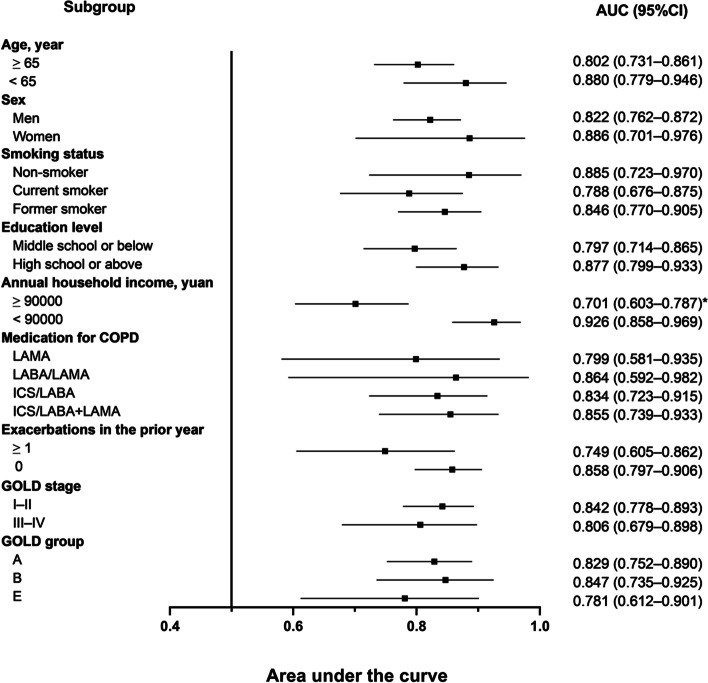
Results: A total of 226 patients with COPD were enrolled, and 50 (22.1%) of these patients were diagnosed with GAD. The Cronbach's α coefficient for the GAD-7 was 0.869, which indicated good internal consistency. ROC curve analysis showed that the GAD-7 had an area under the curve (AUC) value of 0.829 (95% CI: 0.774-0.876) for identifying GAD. The optimal cut-off score was ≥ 4, with a sensitivity of 66.0% and a specificity of 89.2%. Higher GAD-7 scores were significantly associated with health-related quality of life and the symptom burden of COPD. The discriminatory power of GAD-7 did not differ statistically when stratified by COPD severity.
Conclusions: The GAD-7 was shown to be a reliable and valid screening tool for patients with COPD in China, and its screening performance for GAD was not influenced by disease severity.
Keywords: Chronic obstructive pulmonary disease; GAD-7; Generalized anxiety disorder; Screening; Validation.
© 2023. BioMed Central Ltd., part of Springer Nature.
Conflict of interest statement
The authors declare no competing interests.
Figures

References
-
- Safiri S, Carson-Chahhoud K, Noori M, Nejadghaderi SA, Sullman MJM, Ahmadian Heris J, et al. Burden of chronic obstructive pulmonary disease and its attributable risk factors in 204 countries and territories, 1990–2019: results from the Global Burden of Disease Study 2019. BMJ. 2022;378:e069679. - PMC - PubMed
-
- Yohannes AM, Kaplan A, Hanania NA. Anxiety and Depression in Chronic Obstructive Pulmonary Disease: Recognition and Management. Cleve Clin J Med. 2018;85(2 Suppl 1):S11–S18. - PubMed
-
- Yohannes AM, Müllerová H, Hanania NA, Lavoie K, Tal-Singer R, Vestbo J, et al. Long-term Course of Depression Trajectories in Patients With COPD: A 3-Year Follow-up Analysis of the Evaluation of COPD Longitudinally to Identify Predictive Surrogate Endpoints Cohort. Chest. 2016;149(4):916–926. - PubMed
-
- Laurin C, Moullec G, Bacon SL, Lavoie KL. Impact of anxiety and depression on chronic obstructive pulmonary disease exacerbation risk. Am J Respir Crit Care Med. 2012;185(9):918–923. - PubMed
Publication types
MeSH terms
LinkOut - more resources
Full Text Sources
Medical
