


Thetha Nami ngithethe nawe (Let's Talk): a stepped-wedge cluster randomised trial of social mobilisation by peer navigators into community-based sexual health and HIV care, including pre-exposure prophylaxis (PrEP), to reduce sexually transmissible HIV amongst young people in rural KwaZulu-Natal, South Africa
- PMID: 37582746
- PMCID: PMC10428543
- DOI: 10.1186/s12889-023-16262-x
Thetha Nami ngithethe nawe (Let's Talk): a stepped-wedge cluster randomised trial of social mobilisation by peer navigators into community-based sexual health and HIV care, including pre-exposure prophylaxis (PrEP), to reduce sexually transmissible HIV amongst young people in rural KwaZulu-Natal, South Africa
Abstract
Background: Antiretroviral therapy (ART) through universal test and treat (UTT) and HIV pre-exposure prophylaxis (PrEP) substantially reduces HIV-related mortality and incidence. Effective ART based prevention has not translated into population-level impact in southern Africa due to sub-optimal coverage among youth. We aim to investigate the effectiveness, implementation and cost effectiveness of peer-led social mobilisation into decentralised integrated HIV and sexual reproductive health (SRH) services amongst adolescents and young adults in KwaZulu-Natal (KZN).
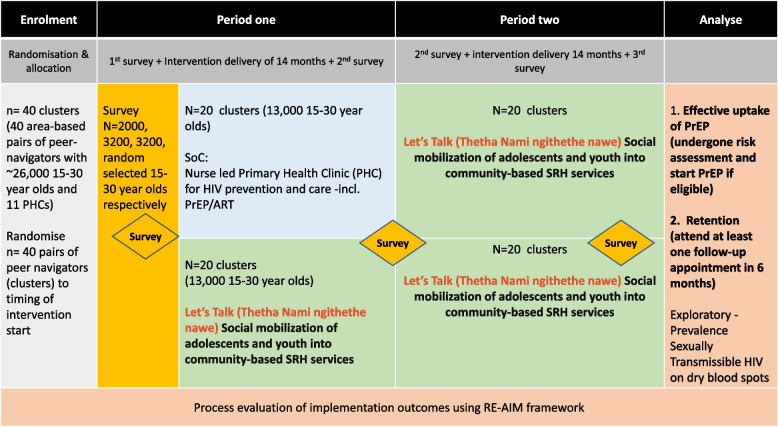
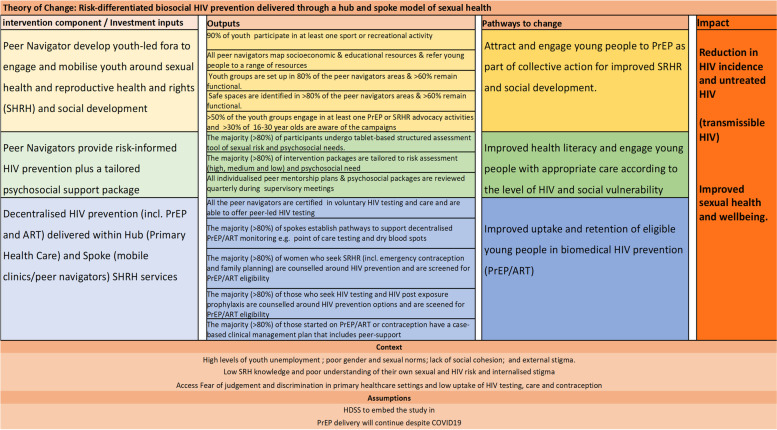
Methods: We are conducting a type 1a hybrid effectiveness/implementation study, with a cluster randomized stepped-wedge trial (SWT) to assess effectiveness and a realist process evaluation to assess implementation outcomes. The SWT will be conducted in 40 clusters in rural KZN over 45 months. Clusters will be randomly allocated to receive the intervention in period 1 (early) or period 2 (delayed). 1) Intervention arm: Resident peer navigators in each cluster will approach young men and women aged 15-30 years living in their cluster to conduct health, social and educational needs assessment and tailor psychosocial support and health promotion, peer mentorship, and facilitate referrals into nurse led mobile clinics that visit each cluster regularly to deliver integrated SRH and differentiated HIV prevention (HIV testing, UTT for those positive, and PrEP for those eligible and negative). Standard of Care is UTT and PrEP delivered to 15-30 year olds from control clusters through primary health clinics. There are 3 co-primary outcomes measured amongst cross sectional surveys of 15-30 year olds: 1) effectiveness of the intervention in reducing the prevalence of sexually transmissible HIV; 2) uptake of universal risk informed HIV prevention intervention; 3) cost of transmissible HIV infection averted. We will use a realist process evaluation to interrogate the extent to which the intervention components support demand, uptake, and retention in risk-differentiated biomedical HIV prevention.
Discussion: The findings of this trial will be used by policy makers to optimize delivery of universal differentiated HIV prevention, including HIV pre-exposure prophylaxis through peer-led mobilisation into community-based integrated adolescent and youth friendly HIV and sexual and reproductive health care.
Trial registration: ClinicalTrials.gov Identifier-NCT05405582. Registered: 6th June 2022.
Keywords: Adolescents and youth; Community-based; Differentiated HIV prevention; HIV pre-exposure prophylaxis; Implementation trials; Peer navigators; Sexual and reproductive health; Universal test and treat.
© 2023. BioMed Central Ltd., part of Springer Nature.
Conflict of interest statement
The authors declare no competing interests.
Figures
References
-
- Statistics South Africa.: Mid-year population estimates 2021 http://www.statssa.gov.za/publications/P0302/P03022021.pdfStatistics [Cited 2022 May 17]: Statistics South Africa.; 2021.
-
- Francis SC, Mthiyane TN, Baisley K, McHunu SL, Ferguson JB, Smit T, Crucitti T, Gareta D, Dlamini S, Mutevedzi T, et al. Prevalence of sexually transmitted infections among young people in South Africa: A nested survey in a health and demographic surveillance site. PLoS Med. 2018;15(2):e1002512. doi: 10.1371/journal.pmed.1002512. - DOI - PMC - PubMed
-
- Birdthistle I, Tanton C, Tomita A, de Graaf K, Schaffnit SB, Tanser F, Slaymaker E. Recent levels and trends in HIV incidence rates among adolescent girls and young women in ten high-prevalence African countries: a systematic review and meta-analysis. Lancet Glob Health. 2019;7(11):e1521–e1540. doi: 10.1016/S2214-109X(19)30410-3. - DOI - PMC - PubMed
Publication types
MeSH terms
Substances
Associated data
Grants and funding
LinkOut - more resources
Full Text Sources
Medical
Miscellaneous
