. 2023 Oct;17(10):998-1005.
doi: 10.1111/crj.13669. Epub 2023 Aug 16.

The cryobiopsy in interstitial lung diseases guided by probe-based confocal laser endomicroscopy is feasible

Affiliations

The cryobiopsy in interstitial lung diseases guided by probe-based confocal laser endomicroscopy is feasible

Yu Zheng et al. Clin Respir J. 2023 Oct.

Abstract

Background: Transbronchial lung cryobiopsy (TBLB) is routinely used to diagnose the interstitial lung disease (ILD). These results are consistent with those of surgical lung biopsy. Fluoroscopy is also used to confirm the final position of the cryoprobe; however, it can increase radiation exposure for both patients and medical care personnel. Probe-based confocal laser endomicroscopy (pCLE) is a novel optical imaging technique that allows real-time imaging at the cellular level in vivo. pCLE technology can also be used to identify malignancy, acute rejection in lung transplantation, amiodarone lung, and pulmonary alveolar proteinosis and visualize elastin fibres in the alveolar compartment.

Objectives: The aim of this study is to investigate the ability of pCLE to distinguish fibrotic pulmonary issues from normal lung disease and the safety and feasibility of CLE-guided bronchoscopy and transbronchial lung cryobiopsy (TBLC) in patients with interstitial lung disease (ILD).

Methods: pCLE images from 17 ILD patients were obtained during TBLB. These images were then compared with histology results to assess the correspondence rate.

Results: pCLE imaging of the alveolar structures was performed. Key characteristics were visible, which could potentially influence the diagnostic rate (fibrotic areas) and the complication rate (blood vessel and pleura).

Conclusion: pCLE may reduce complications and increase the diagnostic yield. It is a potential guidance tool for cryobiopsy in the patients with ILD without fluoroscopy.

Keywords: interstitial lung diseases; probe-based confocal laser endomicroscopy; real-time imaging; transbrochial lung cryobiopsy.


Conflict of interest statement

The authors have no conflicts of interest to declare.

Figures
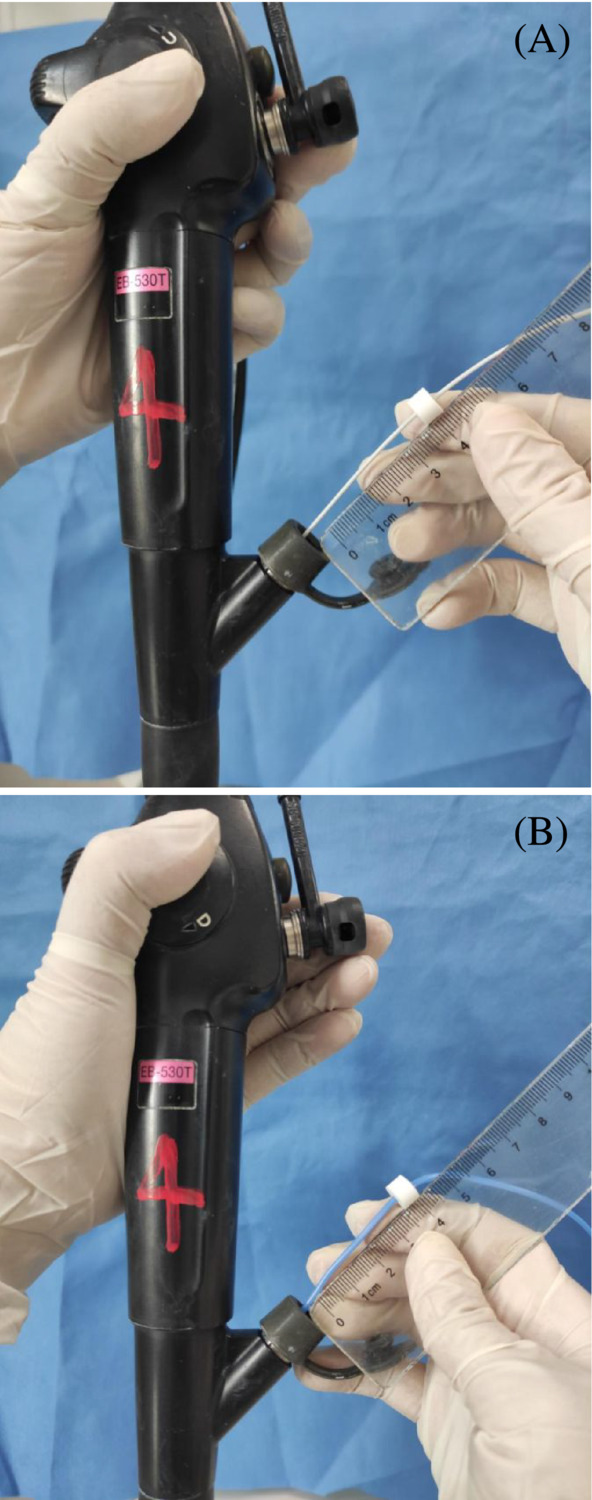
FIGURE 1
FIGURE 1
(A) The distance from the target position to the secondary carina was be recorded by marking ring. (B) Marking ring was regressed according to the distance measured before the probe reached the secondary carina.
FIGURE 2
FIGURE 2
A patient is diagnosed with pneumoconiosis. (A) pCLE imaging visualizes the alveolar airspaces (A) and elastin fibres of the alveolar septum (S). The adjacent blood vessel (B) and macrophages (M) were also seen. (B) Characteristic in vivo pCLE pattern of the alveolar septum showed evenly distributed elastin fibres, compatible with the presence of elastin fibres in the histological HE staining.
FIGURE 3
FIGURE 3
(A) pCLE imaging of the pleura: Dense tissue was observed when probe reached its limit; and (B) bronchial wall: Loose elastin fibres were visible. The density of pleura imaging is higher than bronchial wall.
FIGURE 4
FIGURE 4
(A) Granulation tissue in alveoli can be seen in the pCLE imaging. (B) Corresponding histology with granulation tissue and Masson body.
FIGURE 5
FIGURE 5
The pCLE imaging (top row) and corresponding histology (bottom row) of a normal pCLE pattern with a thin single‐fibered elastin fibre network and dark alveolar air spaces. (A) Normal alveolar structure without abnormal histology. Mild increase of elastin fibres and preserved alveolar architecture. (B) Mild lung fibrosis areas can be seen. pCLE imaging with destructed alveolar structure and increased elastin fibres. (C) Dense lung fibrosis areas can be seen.
FIGURE 6
FIGURE 6
The pCLE (A, densely packed fibres and absent alveolar structures; B, numerous inflammatory cells) and CT images of one suspected dermatomyositis associated diffuse alveolar damage (DAD) patient.

References

    1. Ravaglia C, Bonifazi M, Wells AU, et al. Safety and diagnostic yield of transbronchial lung cryobiopsy in diffuse parenchymal lung diseases: a comparative study versus video assisted thoracoscopic lung biopsy and a systematic review of the literature. Respiration. 2016;91(3):215‐227. doi: 10.1159/000444089 - DOI - PubMed
    1. Lauren KT, Christopher G, Tamera JC, et al. Diagnostic accuracy of transbronchial lung cryobiopsy for interstitial lung disease diagnosis (COLDICE): a prospective, comparative study. Lancet Respir Med. 2020;8(2):171‐181. doi: 10.1016/S2213-2600(19)30342-X - DOI - PubMed
    1. Griff S, Schonfeld N, Ammenwerth W, et al. Diagnostic yield of transbronchial cryobiopsy in non‐neoplastic lung disease: a retrospective case series. BMC Pulm Med. 2014;14(1):171. doi: 10.1186/1471-2466-14-171 - DOI - PMC - PubMed
    1. Cascante JA, Cebollero P, Herrero S, et al. Transbronchial cryobiopsy in interstitial lung disease: are we on the right path? J Bronchol Interv Pulmonol. 2016;23:204‐209. doi: 10.1097/LBR.0000000000000292 - DOI - PubMed
    1. Hetzel J, Eberhardt R, Petermann C, et al. Bleeding risk of transbronchial cryobiopsy compared to transbronchial forceps biopsy in interstitial lung disease—a prospective, randomized, multicentre cross‐over trial. Respir Res. 2019;20(1):140. doi: 10.1186/s12931-019-1091-1 - DOI - PMC - PubMed
