. 2023 Aug 29;95(34):12884-12892.
doi: 10.1021/acs.analchem.3c02230. Epub 2023 Aug 16.

Analysis of Cell Glycogen with Quantitation and Determination of Branching Using Liquid Chromatography-Mass Spectrometry

Affiliations

Analysis of Cell Glycogen with Quantitation and Determination of Branching Using Liquid Chromatography-Mass Spectrometry

Siyu Chen et al. Anal Chem. .

Abstract

Glycogen is a highly branched biomacromolecule that functions as a glucose buffer. It is involved in multiple diseases such as glycogen storage disorders, diabetes, and even liver cancer, where the imbalance between biosynthetic and catabolic enzymes results in structural alterations and abnormal accumulation of glycogen that can be toxic to cells. Accurate and sensitive glycogen quantification and structural determination are prerequisites for understanding the phenotypes and biological functions of glycogen under these conditions. In this research, we furthered cell glycogen characterization by presenting a highly sensitive method to measure the glycogen content and degree of branching. The method employed a novel fructose density gradient as an alternative to the traditional sucrose gradient to fractionate glycogen from cell mixtures using ultracentrifugation. Fructose was used to avoid the large glucose background, allowing the method to be highly quantitative. The glycogen content was determined by quantifying 1-phenyl-3-methyl-5-pyrazolone (PMP)-derivatized glucose residues obtained from acid-hydrolyzed glycogen using ultra-high-performance liquid chromatography/triple quadrupole mass spectrometry (UHPLC/QqQ-MS). The degree of branching was determined through linkage analysis where the glycogen underwent permethylation, hydrolysis, PMP derivatization, and UHPLC/QqQ-MS analysis. The new approach was used to study the effect of insulin on the glycogen phenotypes of human hepatocellular carcinoma (Hep G2) cells. We observed that cells produced greater amounts of glycogen with less branching under increasing insulin levels before reaching the cell's insulin-resistant state, where the trend reversed and the cells produced less but higher-branched glycogen. The advantage of this method lies in its high sensitivity in characterizing both the glycogen level and the structure of biological samples.


Conflict of interest statement

Declaration of interests

The authors declare that they have no known competing financial interests or personal relationships that could have appeared to influence the work reported in this paper.

Figures

Figure 1.
Figure 1.
Sample preparation workflow of cell glycogen for quantification and degree of branching analysis via LC-MS. (a) Glycogen was extracted from cells through lysis, a series of centrifugations, and ethanol precipitation. All centrifugations were performed at 4°C. (b) The glycogen was hydrolyzed and derivatized for monosaccharide composition analysis (top) or permethylated before hydrolyzed and derivatized for glycosidic linkage analysis (bottom). (c) The derivatized glycosides from glycogen samples were subjected to UHPLC/QqQ-MS analysis, resulting in chromatograms with the green peaks. Reference peaks obtained from pooled mono- or oligo-saccharide standards were shown in blue and superimposed on the sample peaks. The green fructose peak in the monosaccharide analysis originated from the fructose gradient.
Figure 2.
Figure 2.
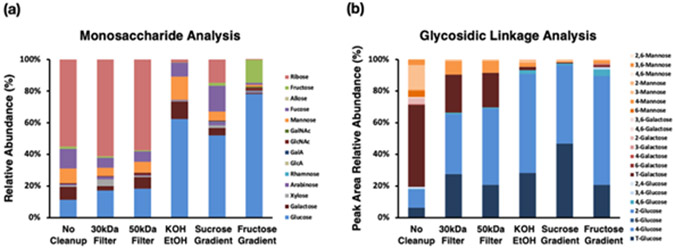
The cell glycogen extraction method was optimized based on the (a) monosaccharide composition analysis which characterized the absolute abundances of 14 monosaccharides and (b) glycosidic linkage analysis of the extracted samples which characterized the relative abundances of 21 glycosidic linkages.
Figure 3.
Figure 3.
TFA and AMG methods resulted in different LC-MS responses when same amount of rabbit liver glycogen was hydrolyzed and injected. The x-axis has been adjusted according to the purity of the standard. Both methods yielded comparable limits of quantification (5 ng), linear ranges (5-1250 ng) and coefficients of variance (5-6%). The regression equations for the two methods were y = 0.8669x – 0.0012 (R2 = 0.9996) and y = 0.3233x + 0.0300 (R2 = 0.9985). The error bars represent the standard deviations based on triplicates.
Figure 4.
Figure 4.
Commercial glycogen standards were analyzed directly for their (a) glycogen contents (data adjusted according to the purities of the standards) and (b) degree of branching. Higher relative abundances of terminal glucose and 4,6-linked glucose compared to 4-linked glucose indicated a higher degree of branching.
Figure 5.
Figure 5.
Changes of Hep G2 cell (a) glucose consumption, (b) glycogen content and (c) glycogen degree of branching under treatments of different concentrations of insulin (increasing from left to right). Cell insulin-resistant states were identified when a less-than-expected cell response was noticed for the treatment and were labelled with red arrows. Statistical significance was determined with unpaired t-test (n = 3). *P < 0.05, **P < 0.01, ***P < 0.001. The data are presented as mean ± standard deviation.

References

    1. Rocha Leão MHM In Encyclopedia of Food Sciences and Nutrition (Second Edition); Caballero B, Ed.; Academic Press: Oxford, 2003, DOI: 10.1016/B0-12-227055-X/00563-0. - DOI
    1. Engelking LR In Textbook of Veterinary Physiological Chemistry (Third Edition); Engelking LR, Ed.; Academic Press: Boston, 2015, DOI:10.1016/B978-0-12-391909-0.50023-2. - DOI

    1. Ellingwood SS; Cheng A Biochemical and clinical aspects of glycogen storage diseases. Journal of Endocrinology 2018, 238 (3), R131, doi: 10.1530/JOE-18-0120. - DOI - PMC - PubMed
    1. Ashcroft FM; Rohm M; Clark A; Brereton MF Is Type 2 Diabetes a Glycogen Storage Disease of Pancreatic β Cells? Cell Metab 2017, 26 (1), 17, doi: 10.1016/j.cmet.2017.05.014. - DOI - PMC - PubMed
    1. Liu Q; Li J; Zhang W; Xiao C; Zhang S; Nian C; Li J; Su D; Chen L; Zhao Q et al. Glycogen accumulation and phase separation drives liver tumor initiation. Cell 2021, 184 (22), 5559, doi: 10.1016/j.cell.2021.10.001. - DOI - PubMed

Publication types