


Effects of Community-Based Caring Contact in Reducing Thwarted Belongingness Among Postdischarge Young Adults With Self-Harm: Randomized Controlled Trial
- PMID: 37585260
- PMCID: PMC10468708
- DOI: 10.2196/43526
Effects of Community-Based Caring Contact in Reducing Thwarted Belongingness Among Postdischarge Young Adults With Self-Harm: Randomized Controlled Trial
Abstract
Background: For patients with self-harm behaviors, the urge to hurt themselves persists after hospital discharge, leading to costly readmissions and even death. Hence, postdischarge intervention programs that reduce self-harm behavior among patients should be part of a cogent community mental health care policy.
Objective: We aimed to determine whether a combination of a self-help mobile app and volunteer support could complement treatment as usual (TAU) to reduce the risk of suicide among these patients.
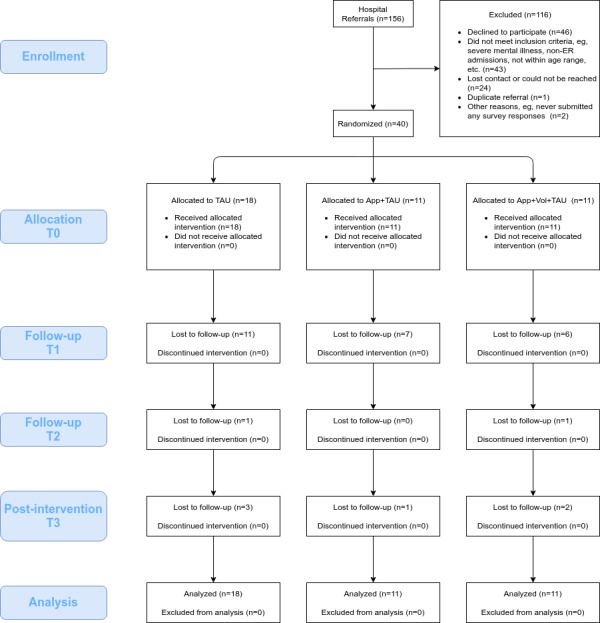
Methods: We conducted a pragmatic randomized controlled trial on discharged patients aged between 18 and 45 years with self-harm episodes/suicide attempts, all of whom were recruited from 4 hospital emergency departments in Hong Kong. Participants were randomly assigned to one of three groups: (1) mobile app + TAU ("apps"), (2) mobile app + volunteer support + TAU ("volunteers"), or (3) TAU only as the control group ("TAU"). They were asked to submit a mobile app-based questionnaire during 4 measurement time points at monthly intervals.
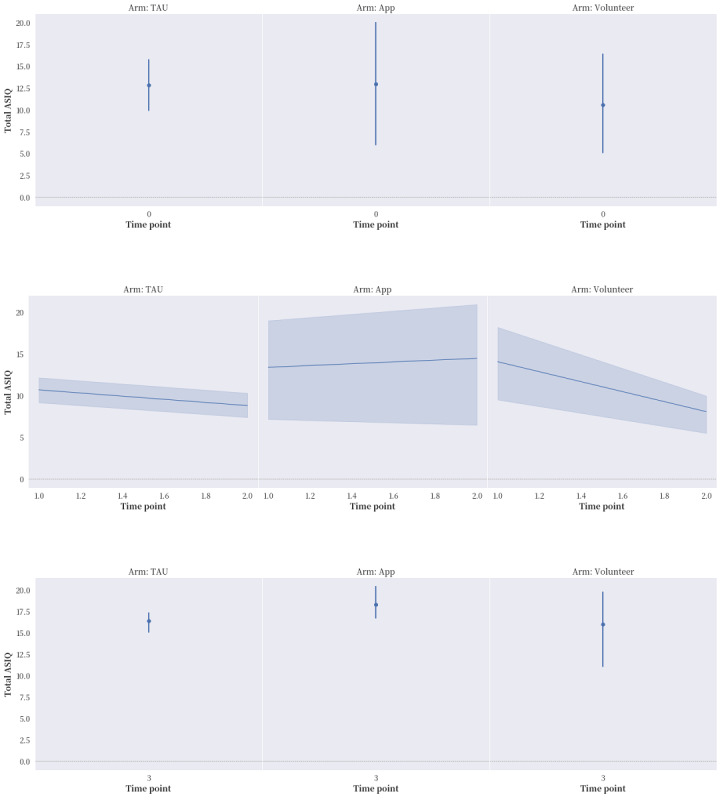
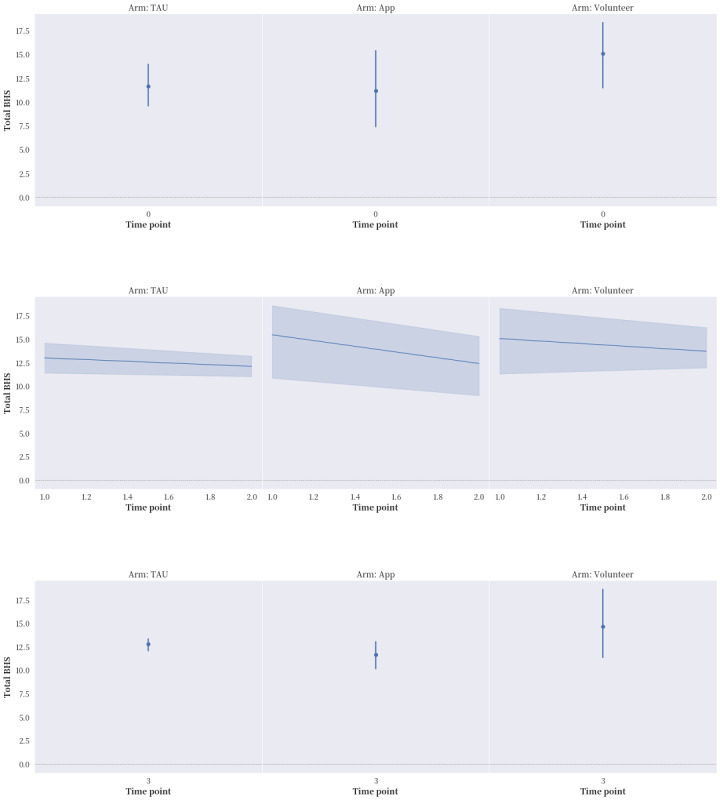
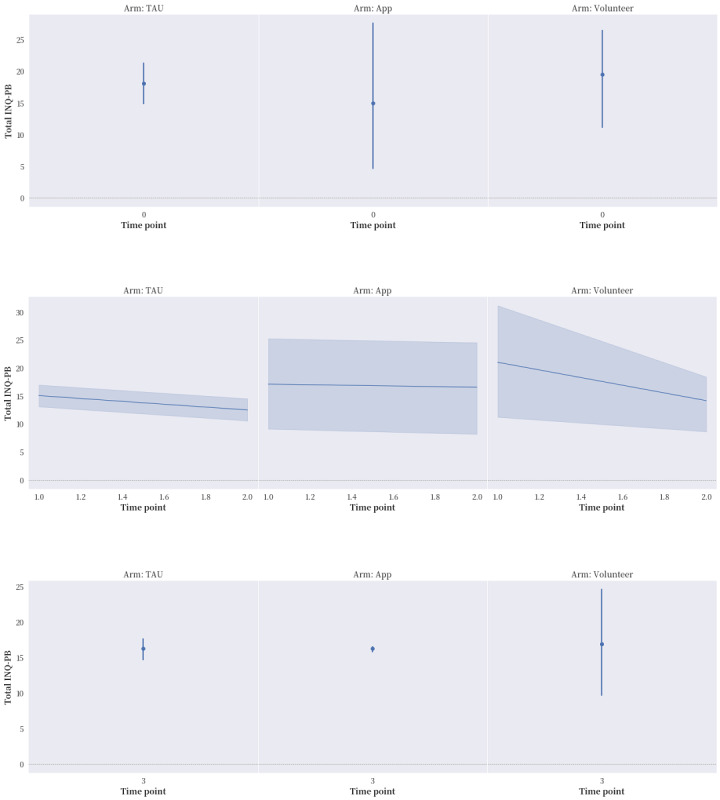
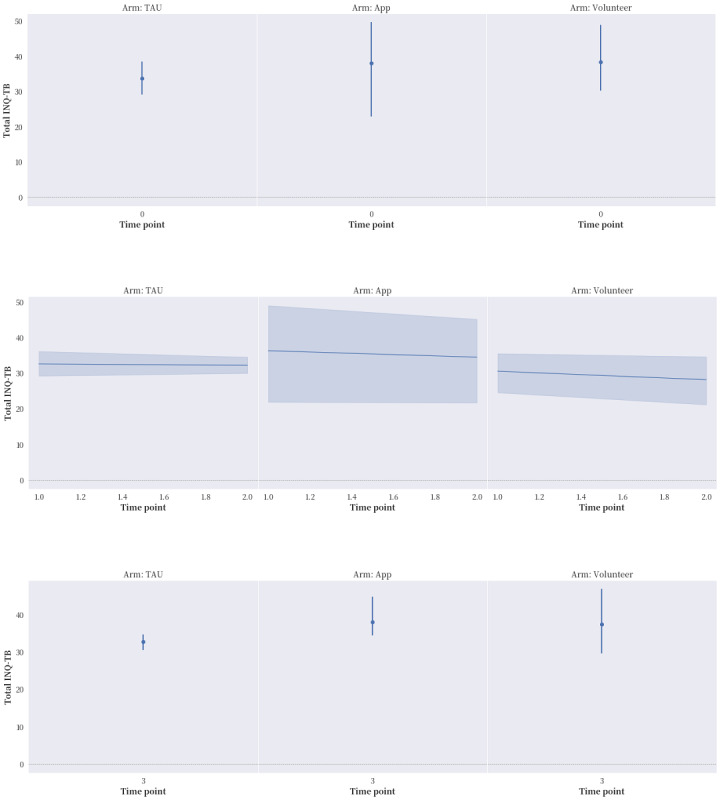
Results: A total of 40 participants were recruited. Blending volunteer care with a preprogrammed mobile app was found to be effective in improving service compliance. Drawing upon the interpersonal-psychological theory of suicide, our findings suggested that a reduction in perceived burdensomeness and thwarted belongingness through community-based caring contact are linked to improvement in hopelessness, albeit a transient one, and suicide risk.
Conclusions: A combination of volunteer care with a self-help mobile app as a strategy for strengthening the continuity of care can be cautiously implemented for discharged patients at risk of self-harm during the transition from the hospital to a community setting.
Trial registration: ClinicalTrials.gov NCT03081078; https://clinicaltrials.gov/study/NCT03081078.
Keywords: care; community; effectiveness; hospital; intervention; mobile app; model; patient; risk; self-harm; suicidal ideation; suicide; support; thwarted belongingness; treatment; volunteers; youth.
©Yik Wa Law, Rita Hui Ting Lok, Byron Chiang, Carmen Chui Shan Lai, Sik Hon Matthew Tsui, Pui Yin Joseph Chung, Siu Chung Leung. Originally published in JMIR Formative Research (https://formative.jmir.org), 16.08.2023.
Conflict of interest statement
Conflicts of Interest: None declared.
Figures
References
-
- Chai Y, Luo H, Yip PS. Prevalence and risk factors for repetition of non-fatal self-harm in Hong Kong, 2002-2016: A population-based cohort study. Lancet Reg Health West Pac. 2020 Sep;2:100027. doi: 10.1016/j.lanwpc.2020.100027. https://linkinghub.elsevier.com/retrieve/pii/S2666-6065(20)30027-4 S2666-6065(20)30027-4 - DOI - PMC - PubMed
-
- Dimeff LA, Jobes DA, Chalker SA, Piehl BM, Duvivier LL, Lok BC, Zalake MS, Chung J, Koerner K. A novel engagement of suicidality in the emergency department: Virtual collaborative assessment and management of suicidality. Gen Hosp Psychiatry. 2020 Mar;63:119–126. doi: 10.1016/j.genhosppsych.2018.05.005.S0163-8343(18)30088-4 - DOI - PubMed
-
- Milner AJ, Carter G, Pirkis J, Robinson J, Spittal MJ. Letters, green cards, telephone calls and postcards: Systematic and meta-analytic review of brief contact interventions for reducing self-harm, suicide attempts and suicide. Br J Psychiatry. 2018 Jan 02;206(3):184–190. doi: 10.1192/bjp.bp.114.147819. - DOI - PubMed
-
- Simon GE, Shortreed SM, Rossom RC, Beck A, Clarke GN, Whiteside U, Richards JE, Penfold RB, Boggs JM, Smith J. Effect of offering care management or online dialectical behavior therapy skills training vs usual care on self-harm among adult outpatients with suicidal ideation: a randomized clinical trial. J Am Med Assoc. 2022 Feb 15;327(7):630–638. doi: 10.1001/jama.2022.0423. https://europepmc.org/abstract/MED/35166800 2789028 - DOI - PMC - PubMed
Associated data
LinkOut - more resources
Full Text Sources
Medical
