


Association of Labor Neuraxial Analgesia with Maternal Blood Transfusion
- PMID: 37585507
- PMCID: PMC10841247
- DOI: 10.1097/ALN.0000000000004743
Association of Labor Neuraxial Analgesia with Maternal Blood Transfusion
Abstract
Background: Labor neuraxial analgesia may reduce the odds of postpartum hemorrhage, the leading indication for maternal blood transfusion during childbirth. This study tested the hypothesis that labor neuraxial analgesia is associated with reduced odds of maternal blood transfusion overall.
Methods: U.S. birth certificate data in the Natality File of the National Vital Statistics System for all 50 states from 2015 to 2018 for vaginal and intrapartum cesarean deliveries were analyzed. The exposure was labor neuraxial analgesia. The primary outcome was maternal blood transfusion, recorded on the birth certificate, which has low sensitivity for this outcome. Adjusted odds ratios and 95% CIs of blood transfusion associated with neuraxial analgesia were estimated using propensity score matching. The adjusted odds ratios were estimated overall and according to delivery mode, and treatment effect was compared between vaginal and intrapartum cesarean deliveries using an interaction term. Sensitivity analyses were performed using inverse propensity score weighting and quantitative bias analysis for outcome misclassification.
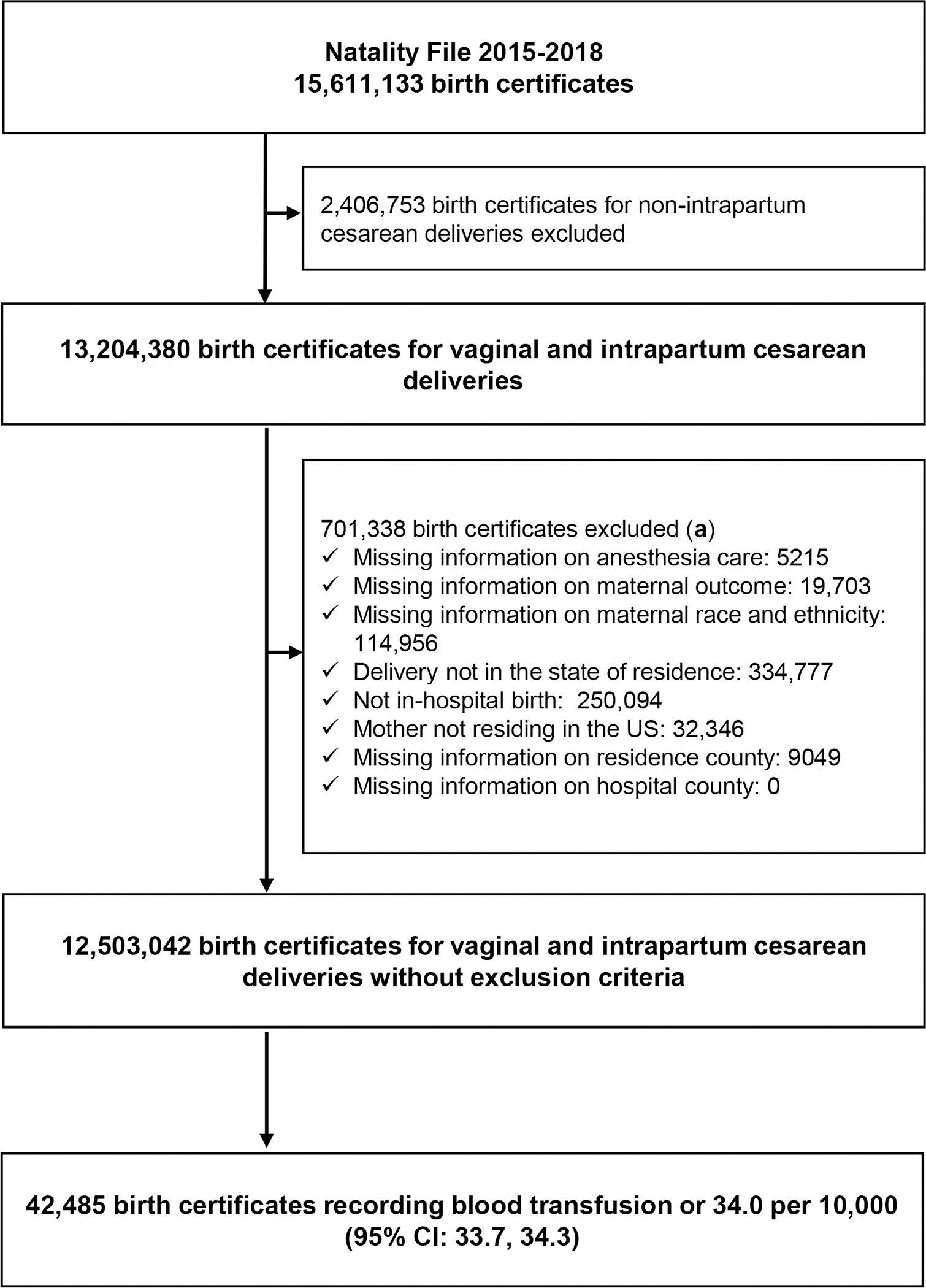
Results: Of the 12,503,042 deliveries analyzed, 9,479,291 (75.82%) were with neuraxial analgesia, and 42,485 (0.34%) involved maternal blood transfusion. After propensity score matching, the incidence of blood transfusion was 0.30% in women without neuraxial analgesia (7,907 of 2,589,493) and 0.20% in women with neuraxial analgesia (5,225 of 2,589,493), yielding an adjusted odds ratio of 0.87 (95% CI, 0.82 to 0.91) overall. For intrapartum cesarean deliveries, the adjusted odds ratio was 0.55 (95% CI, 0.48 to 0.64), and for vaginal deliveries it was 0.93 (95% CI,. 0.88 to 0.98; P value for the interaction term < 0.001). The results were consistent in the sensitivity analyses, although the quantitative bias analysis demonstrated wide variation in potential effect size point estimates.
Conclusions: Labor neuraxial analgesia may be associated with reduced odds of maternal blood transfusion in intrapartum cesarean deliveries and, to a lesser extent, vaginal deliveries. The specific effect size varies widely by delivery mode and is unclear given the poor sensitivity of the data set for the maternal transfusion primary outcome.
Copyright © 2023 American Society of Anesthesiologists. All Rights Reserved.
Conflict of interest statement
Conflicts of Interest:
- Jean Guglielminotti is supported by grants from the National Institute on Minority Health and Health Disparities (R01 MD018410, R21 MD016414) and from the National Institute of Mental Health (R21 MH126096), National Institutes of Health.
- Alexander Friedman is supported by grant from the National Institute of Child Health and Human Development (R01 HD104943) not related to the study and has served on an advisory board for Sage and Biogen.
- Ruth Landau was a consultant for Pacira Pharmaceuticals Incorporated and serves on the editorial board of the journal Regional Anesthesia and Pain Medicine.
Figures
Comment in
-
Embracing Labor Neuraxial Analgesia as a Tool to Reduce Health Inequities and Hemorrhage-related Maternal Morbidity.Anesthesiology. 2023 Dec 1;139(6):717-718. doi: 10.1097/ALN.0000000000004783. Anesthesiology. 2023. PMID: 37934107 No abstract available.
Comment on
-
Association of Genetic Variants with Postsurgical Pain: A Systematic Review and Meta-analyses.Anesthesiology. 2023 Dec 1;139(6):827-839. doi: 10.1097/ALN.0000000000004677. Anesthesiology. 2023. PMID: 37774411 Free PMC article.
References
-
- American College of Obstetricians and Gynecologists, the Society for Maternal-Fetal Medicine, Kilpatrick SK, Ecker JL: Severe maternal morbidity: screening and review. Am J Obstet Gynecol 2016; 215: B17–22 - PubMed
Publication types
MeSH terms
Grants and funding
LinkOut - more resources
Full Text Sources
Medical
