. 2023 Aug 16;14(1):4946.
doi: 10.1038/s41467-023-40693-0.

Genome-wide association studies reveal novel loci associated with pyrethroid and organophosphate resistance in Anopheles gambiae and Anopheles coluzzii

Affiliations

Genome-wide association studies reveal novel loci associated with pyrethroid and organophosphate resistance in Anopheles gambiae and Anopheles coluzzii

Eric R Lucas et al. Nat Commun. .

Abstract

Resistance to insecticides in Anopheles mosquitoes threatens the effectiveness of malaria control, but the genetics of resistance are only partially understood. We performed a large scale multi-country genome-wide association study of resistance to two widely used insecticides: deltamethrin and pirimiphos-methyl, using sequencing data from An. gambiae and An. coluzzii from ten locations in West Africa. Resistance was highly multi-genic, multi-allelic and variable between populations. While the strongest and most consistent association with deltamethrin resistance came from Cyp6aa1, this was based on several independent copy number variants (CNVs) in An. coluzzii, and on a non-CNV haplotype in An. gambiae. For pirimiphos-methyl, signals included Ace1, cytochrome P450s, glutathione S-transferases and the nAChR target site of neonicotinoid insecticides. The regions around Cyp9k1 and the Tep family of immune genes showed evidence of cross-resistance to both insecticides. These locally-varying, multi-allelic patterns highlight the challenges involved in genomic monitoring of resistance, and may form the basis for improved surveillance methods.


Conflict of interest statement

The authors declare no competing interests.

Figures

Fig. 1
Fig. 1. Sampling locations for the study.
From each site, samples used for whole genome sequencing were An. gambiae (blue) or An. coluzzii (red). Axes show latitude and longitude.
Fig. 2
Fig. 2. Allele frequencies for SNPs in known resistance loci.
No wild-type haplotypes were found in Vgsc, with all samples carrying either the 995F mutation (100% of An. gambiae samples) or the 402L/1527T combination. Cells are colour-coded according to species (An. gambiae in blue, An. coluzzii in red) with darkness related to allele frequency. SNPs that were completely absent are not shown.
Fig. 3
Fig. 3. Proportion of samples with increased copy number in genes from four major resistance loci (Ace1, the Cyp6aa/Cyp6p cluster, the Gste2 cluster and Cyp9k1).
Cells are colour-coded according to species (An. gambiae in blue, An. coluzzii in red) with darkness related to proportion.
Fig. 4
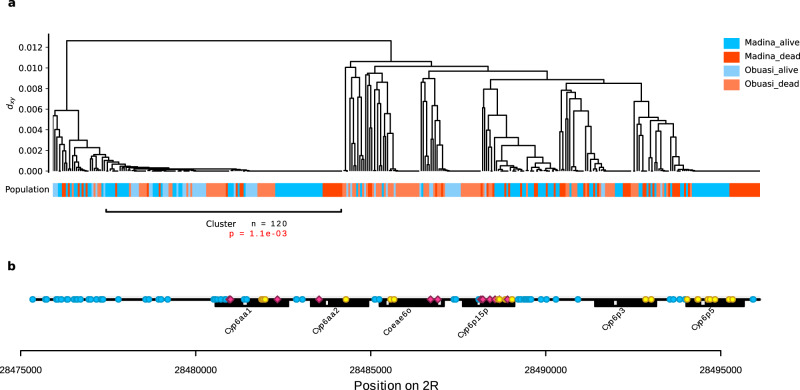
Fig. 4. A shared haplotype cluster around the Cyp6aa/Cyp6p cluster at high frequency in An gambiae from Madina and Obuasi is positively associated with resistance to deltamethrin.
a Hierarchical clustering dendrogram of haplotypes with leaves labelled by population and phenotype. The tree was cut at a height of dxy = 0.001 to obtain haplotype clusters. b SNPs that were significantly more frequent on the haplotype than in the rest of the population (Fisher test, alpha = 0.001) are shown and labelled as non-synonymous (red), synonymous (yellow) and non-coding (blue, including UTRs).

Update of

References

    1. Roth GA, et al. Global, regional, and national age-sex-specific mortality for 282 causes of death in 195 countries and territories, 1980-2017: a systematic analysis for the Global Burden of Disease Study 2017. Lancet. 2018;392:1736–1788. doi: 10.1016/S0140-6736(18)32203-7. - DOI - PMC - PubMed
    1. Bhatt S, et al. The effect of malaria control on Plasmodium falciparum in Africa between 2000 and 2015. Nature. 2015;526:207–211. doi: 10.1038/nature15535. - DOI - PMC - PubMed
    1. Hancock PA, et al. Mapping trends in insecticide resistance phenotypes in African malaria vectors. PLoS Biol. 2020;18:e3000633. doi: 10.1371/journal.pbio.3000633. - DOI - PMC - PubMed
    1. Clarkson CS, et al. Adaptive introgression between Anopheles sibling species eliminates a major genomic island but not reproductive isolation. Nat. Commun. 2014;5:4248. doi: 10.1038/ncomms5248. - DOI - PMC - PubMed
    1. Grau-Bové X, et al. Evolution of the insecticide target Rdl in African Anopheles is driven by interspecific and interkaryotypic introgression. Mol. Biol. Evol. 2020;37:2900–2917. doi: 10.1093/molbev/msaa128. - DOI - PMC - PubMed

Publication types