. 2022 Aug 27;2(4):442-450.
doi: 10.1016/j.xrrt.2022.08.001. eCollection 2022 Nov.

Stemless anatomic total shoulder arthroplasty: surgical technique and review of the literature

Affiliations

Stemless anatomic total shoulder arthroplasty: surgical technique and review of the literature

Erick M Marigi et al. JSES Rev Rep Tech. .

Abstract

Stemless anatomic total shoulder arthroplasty (aTSA) is a promising option for the treatment of degenerative disease in patients. This novel technique avoids the stem-related complications associated with the traditional stemmed aTSA. Stemless aTSA offers additional benefits such as decreased operative time, preservation of bone stock, improved radiographic outcomes, and easier revision. Moreover, loading of the metaphyseal region rather than the diaphysial region with traditional stemmed implants can decrease stress shielding. When compared to stemmed-implants, stemless aTSA has demonstrated similar outcomes and complication rates. The purpose of this article is to analyze published outcomes and complications following the utilization of stemless aTSA. Additionally, key aspects of the surgical technique that may promote optimal results in stemless aTSA implantation are presented.

Keywords: Anatomic total shoulder arthroplasty; Literature review; Proximal humerus; Stemless; Stemmed; Total shoulder arthroplasty.


Figures

Figure 1
Figure 1
Proximal humerus osteophyte removal.
Figure 2
Figure 2
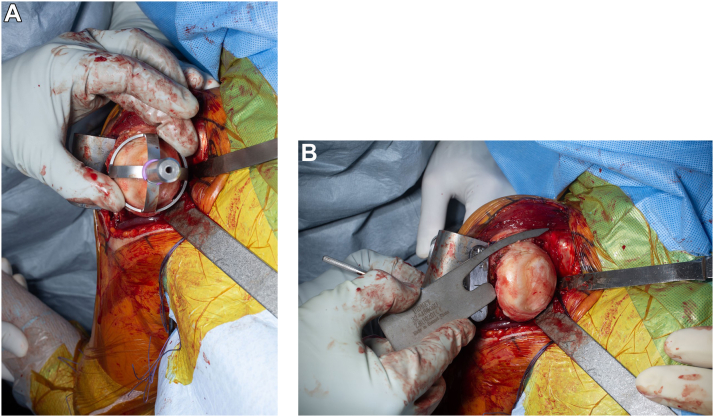
(A) Humeral resection utilizing an extramedullary humeral cutting guide that fits over the humeral head, (B) an extramedullary guide that includes a bar that goes down the forearm indicating 30 degrees of retroversion and an inclination of 135 degrees. An angel wing is used to ensure the osteotomy is performed right below at the level of the rotator cuff insertion.
Figure 3
Figure 3
Templating of the stemless humeral anchor size.
Figure 4
Figure 4
(A) Preparation of the humeral head beginning with pin placement. (B) Subsequent planing of the humeral surface. (C) Central reamer in the proximal humerus.
Figure 5
Figure 5
(A, B) Sequential impaction of the trial broach over a pin. (C) Trial broach placed in the center of the humerus without violation of the proximal humerus.
Figure 6
Figure 6
Implanted hybrid glenoid component.
Figure 7
Figure 7
Eccentric humeral head trial dialed at the desired position to optimize soft tissue tension and prevent rotator cuff impingement.
Figure 8
Figure 8
(A) Final stemless humeral anchor with porous plasma spray coating. (B) Implanted anchor in the central portion of the proximal humerus.
Figure 9
Figure 9
Eccentric final humeral head component with offset options demonstrated.
Figure 10
Figure 10
(A) Final humeral head placed appropriately covering the osteotomy with rotator interval sutures placed. (B) Humeral head position demonstrating desired head position just above the greater tuberosity.
Figure 11
Figure 11
Anterior-posterior shoulder radiograph demonstrating a stemless anatomic TSA at 5 years of follow-up.

References

    1. Aibinder W.R., Bicknell R.T., Bartsch S., Scheibel M., Athwal G.S. Subscapularis management in stemless total shoulder arthroplasty: tenotomy versus peel versus lesser tuberosity osteotomy. J Shoulder Elbow Surg. 2019;28:1942–1947. doi: 10.1016/j.jse.2019.02.022. - DOI - PubMed
    1. Alolabi B., Youderian A.R., Napolitano L., Szerlip B.W., Evans P.J., Nowinski R.J., et al. Radiographic assessment of prosthetic humeral head size after anatomic shoulder arthroplasty. J Shoulder Elbow Surg. 2014;23:1740–1746. doi: 10.1016/j.jse.2014.02.013. - DOI - PubMed
    1. Baranek E.S., Trofa D.P., Levine W.N., Goldberg S.S. Accuracy of humeral implant positioning using a canal-sparing total shoulder arthroplasty system. J Shoulder Elbow Arthroplasty. 2019 doi: 10.1177/2471549219844837. 247154921984483. - DOI
    1. Beck S., Beck V., Wegner A., Dudda M., Patsalis T., Jäger M. Long-term survivorship of stemless anatomical shoulder replacement. Int Orthop. 2018;42:1327–1330. doi: 10.1007/s00264-018-3779-0. - DOI - PubMed
    1. Berth A., Pap G. Stemless shoulder prosthesis versus conventional anatomic shoulder prosthesis in patients with osteoarthritis: a comparison of the functional outcome after a minimum of two years follow-up. J Orthop Trauma. 2013;14:31–37. doi: 10.1007/s10195-012-0216-9. - DOI - PMC - PubMed

LinkOut - more resources