


The met and unmet health needs for HIV, hypertension, and diabetes in rural KwaZulu-Natal, South Africa: analysis of a cross-sectional multimorbidity survey
- PMID: 37591585
- PMCID: PMC10447220
- DOI: 10.1016/S2214-109X(23)00239-5
The met and unmet health needs for HIV, hypertension, and diabetes in rural KwaZulu-Natal, South Africa: analysis of a cross-sectional multimorbidity survey
Abstract
Background: The convergence of infectious diseases and non-communicable diseases in South Africa is challenging to health systems. In this analysis, we assessed the multimorbidity health needs of individuals and communities in rural KwaZulu-Natal and established a framework to quantify met and unmet health needs for individuals living with infectious and non-communicable diseases.
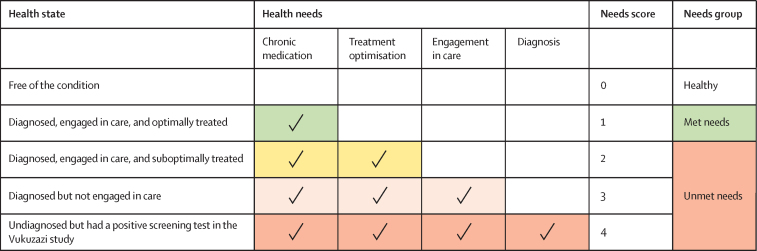
Methods: We analysed data collected between May 25, 2018, and March 13, 2020, from participants of a large, community-based, cross-sectional multimorbidity survey (Vukuzazi) that offered community-based HIV, hypertension, and diabetes screening to all residents aged 15 years or older in a surveillance area in the uMkhanyakude district in KwaZulu-Natal, South Africa. Data from the Vukuzazi survey were linked with data from demographic and health surveillance surveys with a unique identifier common to both studies. Questionnaires were used to assess the diagnosed health conditions, treatment history, general health, and sociodemographic characteristics of an individual. For each condition (ie, HIV, hypertension, and diabetes), individuals were defined as having no health needs (absence of condition), met health needs (condition that is well controlled), or one or more unmet health needs (including diagnosis, engagement in care, or treatment optimisation). We analysed met and unmet health needs for individual and combined conditions and investigated their geospatial distribution.
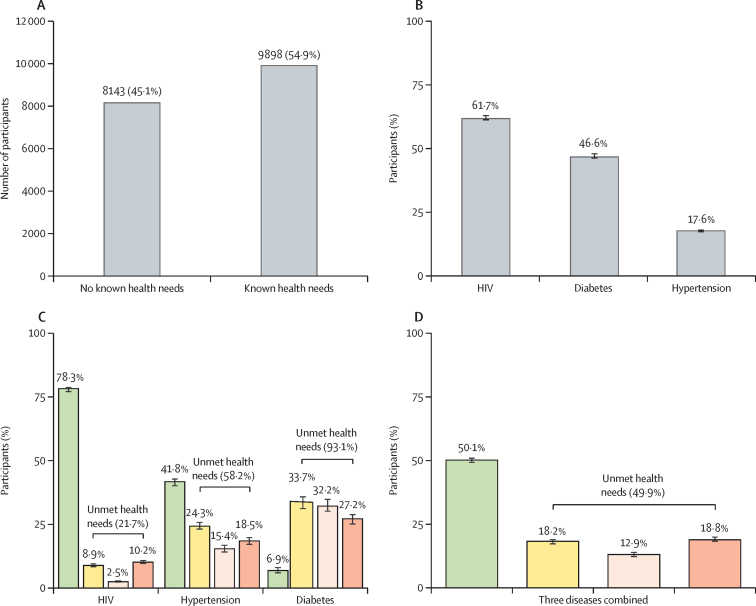
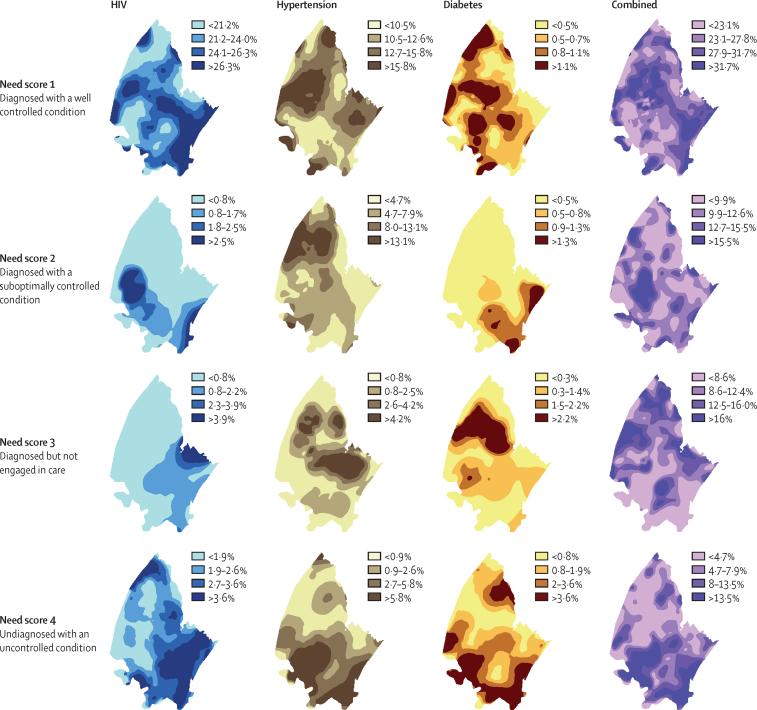
Findings: Of 18 041 participants who completed the survey (12 229 [67·8%] were female and 5812 [32·2%] were male), 9898 (54·9%) had at least one of the three chronic diseases measured. 4942 (49·9%) of these 9898 individuals had at least one unmet health need (1802 [18·2%] of 9898 needed treatment optimisation, 1282 [13·0%] needed engagement in care, and 1858 [18·8%] needed a diagnosis). Unmet health needs varied by disease; 1617 (93·1%) of 1737 people who screened positive for diabetes, 2681 (58·2%) of 4603 people who screened positive for hypertension, and 1321 (21·7%) of 6096 people who screened positive for HIV had unmet health needs. Geospatially, met health needs for HIV were widely distributed and unmet health needs for all three conditions had specific sites of concentration; all three conditions had an overlapping geographical pattern for the need for diagnosis.
Interpretation: Although people living with HIV predominantly have a well controlled condition, there is a high burden of unmet health needs for people living with hypertension and diabetes. In South Africa, adapting current, widely available HIV care services to integrate non-communicable disease care is of high priority.
Funding: Fogarty International Center and the National Institutes of Health, the Bill & Melinda Gates Foundation, the South African Department of Science and Innovation, the South African Medical Research Council, the South African Population Research Infrastructure Network, and the Wellcome Trust.
Translation: For the isiZulu translation of the abstract see Supplementary Materials section.
Copyright © 2023 The Author(s). Published by Elsevier Ltd. This is an Open Access article under the CC BY 4.0 license. Published by Elsevier Ltd.. All rights reserved.
Conflict of interest statement
Declaration of interests We declare no competing interests.
Figures
Update of
-
Quantifying met and unmet health needs for HIV, hypertension and diabetes in rural KwaZulu-Natal, South Africa.Res Sq [Preprint]. 2023 Mar 21:rs.3.rs-2702048. doi: 10.21203/rs.3.rs-2702048/v1. Res Sq. 2023. Update in: Lancet Glob Health. 2023 Sep;11(9):e1372-e1382. doi: 10.1016/S2214-109X(23)00239-5. PMID: 36993494 Free PMC article. Updated. Preprint.
Comment in
-
Access to comprehensive services for HIV and non-communicable diseases in sub-Saharan Africa.Lancet Glob Health. 2023 Sep;11(9):e1317-e1318. doi: 10.1016/S2214-109X(23)00262-0. Lancet Glob Health. 2023. PMID: 37591570 No abstract available.
References
-
- Gouda HN, Charlson F, Sorsdahl K, et al. Burden of non-communicable diseases in sub-Saharan Africa, 1990–2017: results from the Global Burden of Disease Study 2017. Lancet Glob Health. 2019;7:e1375–e1387. - PubMed
Publication types
MeSH terms
Grants and funding
LinkOut - more resources
Full Text Sources
Medical
Miscellaneous
