Randomized Controlled Trial
. 2023 Aug;5(8):1352-1363.
doi: 10.1038/s42255-023-00859-y. Epub 2023 Aug 17.

Liraglutide restores impaired associative learning in individuals with obesity

Affiliations
Randomized Controlled Trial

Liraglutide restores impaired associative learning in individuals with obesity

Ruth Hanssen et al. Nat Metab. 2023 Aug.

Abstract

Survival under selective pressure is driven by the ability of our brain to use sensory information to our advantage to control physiological needs. To that end, neural circuits receive and integrate external environmental cues and internal metabolic signals to form learned sensory associations, consequently motivating and adapting our behaviour. The dopaminergic midbrain plays a crucial role in learning adaptive behaviour and is particularly sensitive to peripheral metabolic signals, including intestinal peptides, such as glucagon-like peptide 1 (GLP-1). In a single-blinded, randomized, controlled, crossover basic human functional magnetic resonance imaging study relying on a computational model of the adaptive learning process underlying behavioural responses, we show that adaptive learning is reduced when metabolic sensing is impaired in obesity, as indexed by reduced insulin sensitivity (participants: N = 30 with normal insulin sensitivity; N = 24 with impaired insulin sensitivity). Treatment with the GLP-1 receptor agonist liraglutide normalizes impaired learning of sensory associations in men and women with obesity. Collectively, our findings reveal that GLP-1 receptor activation modulates associative learning in people with obesity via its central effects within the mesoaccumbens pathway. These findings provide evidence for how metabolic signals can act as neuromodulators to adapt our behaviour to our body's internal state and how GLP-1 receptor agonists work in clinics.


Conflict of interest statement

O.A.C. reports grants or contracts from Amplyx, Basilea, BMBF, Cidara, DZIF, EU-DG RTD (101037867), F2G, Gilead, Matinas, MedPace, MSD, Mundipharma, Octapharma, Pfizer and Scynexis; consulting fees from Abbvie, Amplyx, Biocon, Biosys, Cidara, Da Volterra, Gilead, IQVIA, Janssen, Matinas, MedPace, Menarini, Molecular Partners, MSG-ERC, Noxxon, Octapharma, Pardes, Pfizer, PSI, Scynexis and Seres; honoraria for lectures from Abbott, Abbvie, Al-Jazeera Pharmaceuticals, Astellas, Gilead, Grupo Biotoscana/United Medical/Knight, Hikma, MedScape, MedUpdate, Merck/MSD, Mylan, Noscendo, Pfizer and Shionogi; payment for expert testimony from Cidara; participation on a Data Safety Monitoring Board or Advisory Board from Actelion, Allecra, Cidara, Entasis, IQVIA, Janssen, MedPace, Paratek, PSI, Pulmocide, Shionogi and The Prime Meridian Group; a patent at the German Patent and Trade Mark Office (DE 10 2021 113 007.7); and other interests from DGHO, DGI, ECMM, ISHAM, MSG-ERC and Wiley. All other authors have no competing interests.

Figures
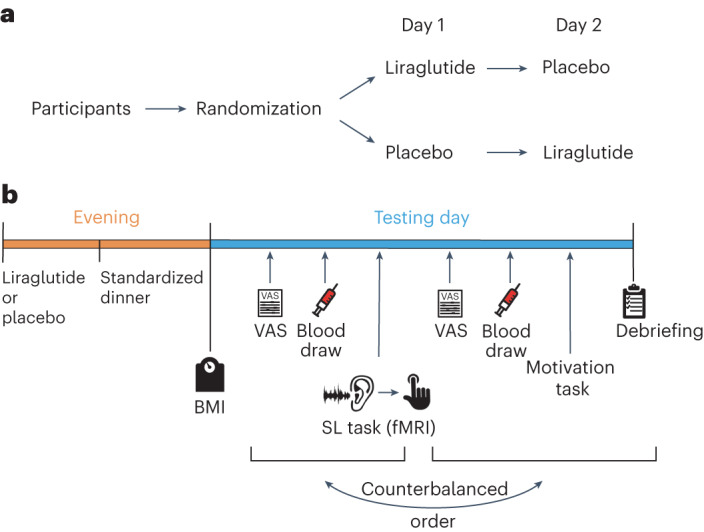
Fig. 1
Fig. 1. Experimental design.
a, Randomization of participants. In this interventional crossover study, all participants underwent a placebo and a liraglutide session. The order of the interventions was counterbalanced across participants. b, Outline of the testing day; BMI, body mass index; VAS, visual analogue scale used for hunger rating; SL task, associative sensory learning task assessing trial-wise learning processes.
Fig. 2
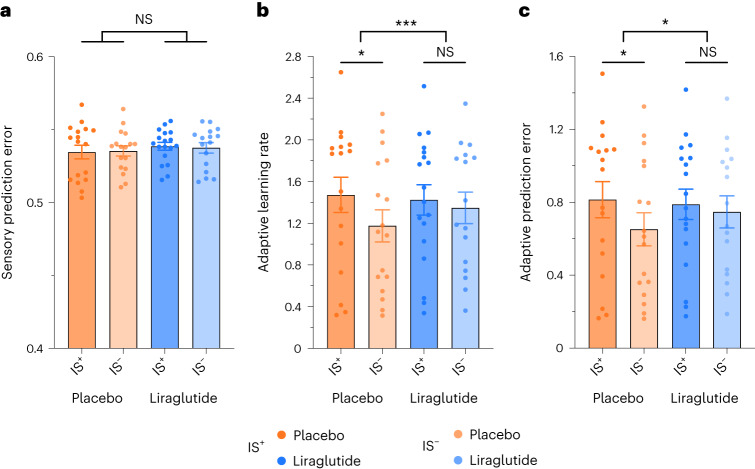
Fig. 2. Differential effect of liraglutide on trial-wise measures of learning.
ac, While leaving sensory prediction errors (a) unchanged, liraglutide normalizes the adaptive learning rate (b) and adaptive prediction error (c) in individuals with impaired insulin sensitivity to the level of insulin-sensitive individuals. Data are presented as mean ± s.e.m. Data were analysed by mixed effect models with post hoc tests using Tukey’s procedure to test for the effects of intervention (placebo versus liraglutide) and group (IS+ versus IS) on the respective learning parameter (IS+: placebo n = 17, liraglutide n = 18; IS: placebo n = 17, liraglutide n = 16); *P < 0.05; ***P < 0.001; NS, not significant. Original P values are provided in Supplementary Table 1a–f. Source data
Fig. 3
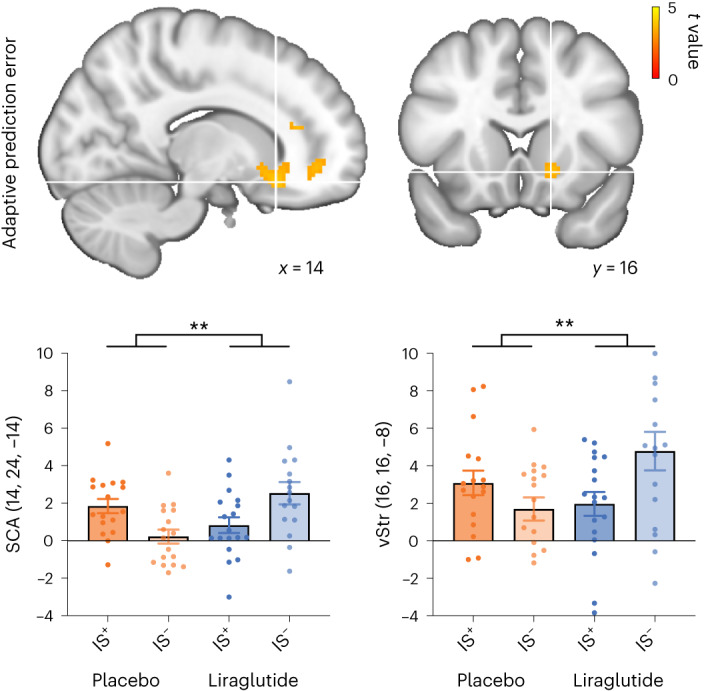
Fig. 3. Liraglutide enhances learning-related brain activity in individuals with impaired insulin sensitivity.
The interaction group × intervention identified brain regions in which the encoding of adaptive prediction errors was more strongly enhanced by liraglutide than placebo in the insulin-resistant group (IS) than in the insulin-sensitive group (IS+). Liraglutide enhanced adaptive prediction error encoding in the IS group in the SCA and the ventral striatum (vStr). Activation maps were overlayed on the standard brain atlas provided by the Montreal Neurological Institute (MNI) (the statistical threshold was P < 0.05, with data family-wise error corrected at the cluster level and with an underlying voxel-level threshold of P < 0.001). Statistical analyses were conducted using Statistical Parametric Mapping version 12 in the framework of a general linear model (GLM) with flexible factorial designs. Bars and error bars correspond to the mean and s.e.m. of the contrast estimates at the peak of the cluster inferred at the group level, reflecting the relationship between trial-wise BOLD responses to visual outcomes and adaptive prediction errors. The corresponding activation peaks are marked with white crosses, with respective anatomical labels and MNI coordinates (x, y and z) indicated in each plot. Data points correspond to the individual contrast estimates at the same voxel (IS+: placebo n = 17, liraglutide n = 18; IS: placebo n = 17, liraglutide n = 16); **P < 0.01. Source data
Extended Data Fig. 1
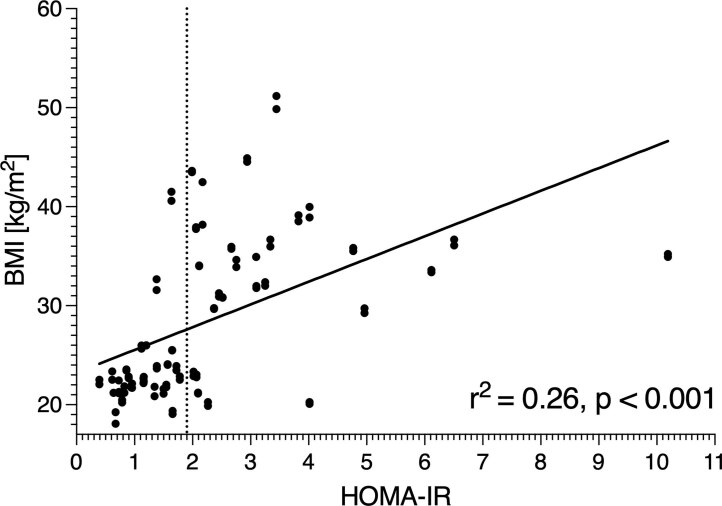
Extended Data Fig. 1. Correlation between BMI and HOMA-IR.
Within the study participants, BMI and HOMA-IR were highly correlated; r2 = 0.26, P < 0.001 based on the Pearson’s correlation test. Source data

References

    1. Pontes AC, Mobley RB, Ofria C, Adami C, Dyer FC. The evolutionary origin of associative learning. Am. Nat. 2020;195:E1–E19. doi: 10.1086/706252. - DOI - PubMed
    1. Hume, D. A Treatise of Human Nature: Being an Attempt to Introduce the Experimental Method of Reasoning Into Moral Subjects (Collins, 1738).
    1. Cisek P. Evolution of behavioural control from chordates to primates. Philos. Trans. R. Soc. Lond. B Biol. Sci. 2022;377:20200522. doi: 10.1098/rstb.2020.0522. - DOI - PMC - PubMed
    1. Waschke L, Kloosterman NA, Obleser J, Garrett DD. Behavior needs neural variability. Neuron. 2021;109:751–766. doi: 10.1016/j.neuron.2021.01.023. - DOI - PubMed
    1. Stern SA, Doerig KR, Azevedo EP, Stoffel E, Friedman JM. Control of non-homeostatic feeding in sated mice using associative learning of contextual food cues. Mol. Psychiatry. 2020;25:666–679. doi: 10.1038/s41380-018-0072-y. - DOI - PMC - PubMed

Publication types