


A six-month low-carbohydrate diet high in fat does not adversely affect endothelial function or markers of low-grade inflammation in patients with type 2 diabetes: an open-label randomized controlled trial
- PMID: 37592243
- PMCID: PMC10436534
- DOI: 10.1186/s12933-023-01956-8
A six-month low-carbohydrate diet high in fat does not adversely affect endothelial function or markers of low-grade inflammation in patients with type 2 diabetes: an open-label randomized controlled trial
Abstract
Background: While a low-carbohydrate diet (LCD) reduces HbA1c in patients with type 2 diabetes (T2D), the associated high intake of fat may adversely affect cardiovascular risk factors. To address this, we examined the effect of a non-calorie-restricted LCD high in fat on endothelial function and markers of low-grade inflammation in T2D over 6 months.
Methods: In an open-label randomized controlled trial, 71 patients with T2D were randomized 2:1 to either a LCD (< 20 E% carbohydrates, 50-60 E% fat) or a control diet (50-60 E% carbohydrates, 20-30 E% fat) for six months. Flow-mediated vasodilation (FMD) and nitroglycerine-induced vasodilation (NID) were assessed by ultrasound in the brachial artery together with plasma interleukin-6 (IL-6) and serum high-sensitivity C-reactive protein (hsCRP) in the participants at baseline (n = 70) and after six months (n = 64).
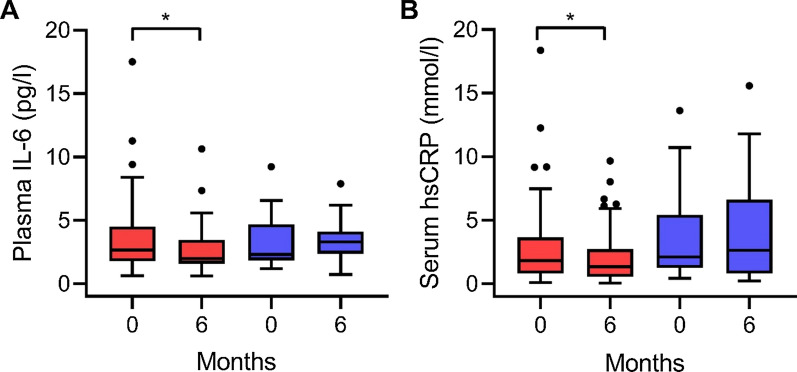
Results: The FMD and NID were unaltered in both groups after six months, and there were no between-group differences in change of either FMD (p = 0.34) or NID (p = 0.53) in response to the interventions. The circulating hsCRP and IL-6 levels decreased only in response to LCD (both p < 0.05). However, comparing changes over time with the control diet, the LCD did not reduce either IL-6 (p = 0.25) or hsCRP (p = 0.07) levels. The lack of changes in FMD and NID in response to LCD persisted after adjustment for cardiovascular risk factors.
Conclusion: A LCD high in fat for six months does not adversely affect endothelial function or selected markers of low-grade inflammation, which suggests that this nutritional approach does not increase the risk of cardiovascular disease. Trial registration ClinicalTrials.gov (NCT03068078).
Keywords: Cardiovascular risk; Endothelial function; Flow-mediated vasodilation; Low-carbohydrate diet; Low-grade inflammation; Type 2 diabetes.
© 2023. BioMed Central Ltd., part of Springer Nature.
Conflict of interest statement
AK reports speaker honorarium from Norgine, Siemens and Nordic Bioscience, outside the submitted work.
Figures

References
-
- International Diabetes Federation (IDF). Diabetes and cardiovascular disease. https://idf.org/our-activities/care-prevention/cardiovascular-disease/cv....
-
- Sattar N, Rawshani A, Franzén S, et al. Age at diagnosis of type 2 diabetes mellitus and associations with cardiovascular and mortality risks. Circulation. 2019;139(19):2228–2237. - PubMed
-
- Disease C, Management R. Standards of medical care in diabetes-2021. Diabetes Care. 2021;44(Suppl 1):S125–S150. - PubMed
-
- Calle MC, Fernandez ML. Inflammation and type 2 diabetes. Diabetes Metab. 2012;38(3):183–191. - PubMed
-
- Halcox JP, Schenke WH, Zalos G, et al. Prognostic value of coronary vascular endothelial dysfunction. Circulation. 2002;106(6):653–658. - PubMed
Publication types
MeSH terms
Substances
Associated data
LinkOut - more resources
Full Text Sources
Medical
Research Materials
