Review
. 2023 Aug 17;16(1):291.
doi: 10.1186/s13071-023-05887-x.

Invasive hematophagous arthropods and associated diseases in a changing world

Affiliations
Review

Invasive hematophagous arthropods and associated diseases in a changing world

Ross N Cuthbert et al. Parasit Vectors. .

Abstract

Biological invasions have increased significantly with the tremendous growth of international trade and transport. Hematophagous arthropods can be vectors of infectious and potentially lethal pathogens and parasites, thus constituting a growing threat to humans-especially when associated with biological invasions. Today, several major vector-borne diseases, currently described as emerging or re-emerging, are expanding in a world dominated by climate change, land-use change and intensive transportation of humans and goods. In this review, we retrace the historical trajectory of these invasions to better understand their ecological, physiological and genetic drivers and their impacts on ecosystems and human health. We also discuss arthropod management strategies to mitigate future risks by harnessing ecology, public health, economics and social-ethnological considerations. Trade and transport of goods and materials, including vertebrate introductions and worn tires, have historically been important introduction pathways for the most prominent invasive hematophagous arthropods, but sources and pathways are likely to diversify with future globalization. Burgeoning urbanization, climate change and the urban heat island effect are likely to interact to favor invasive hematophagous arthropods and the diseases they can vector. To mitigate future invasions of hematophagous arthropods and novel disease outbreaks, stronger preventative monitoring and transboundary surveillance measures are urgently required. Proactive approaches, such as the use of monitoring and increased engagement in citizen science, would reduce epidemiological and ecological risks and could save millions of lives and billions of dollars spent on arthropod control and disease management. Last, our capacities to manage invasive hematophagous arthropods in a sustainable way for worldwide ecosystems can be improved by promoting interactions among experts of the health sector, stakeholders in environmental issues and policymakers (e.g. the One Health approach) while considering wider social perceptions.

Keywords: Anthropogenic activities; Biodiversity homogenization; Biological invasion; Climate change; Global trade; Mosquitoes; Public health; Ticks.


Conflict of interest statement

The authors declare no competing interests.

Figures
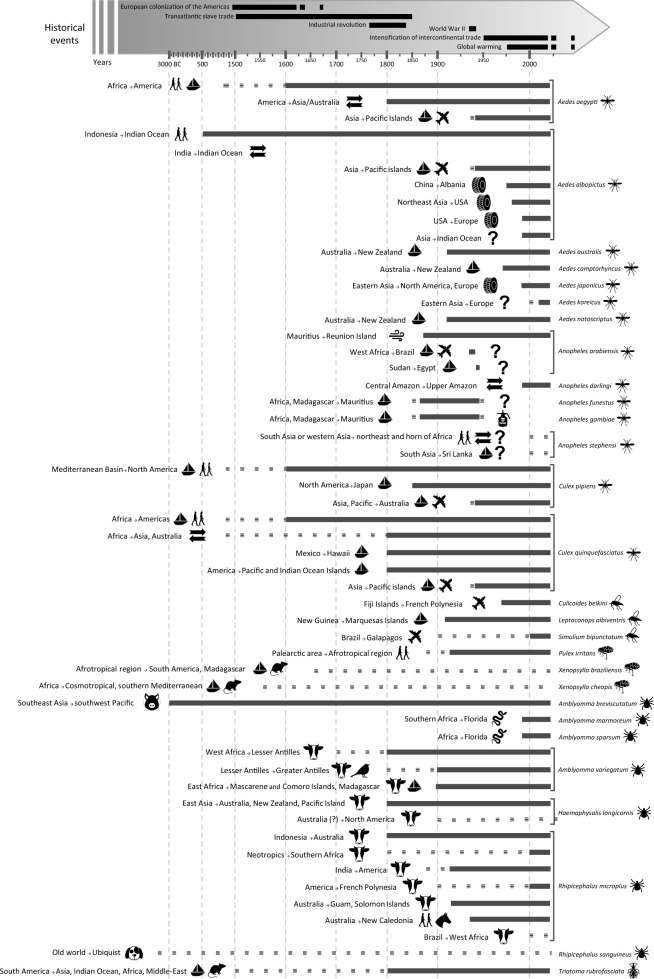
Fig. 1
Fig. 1
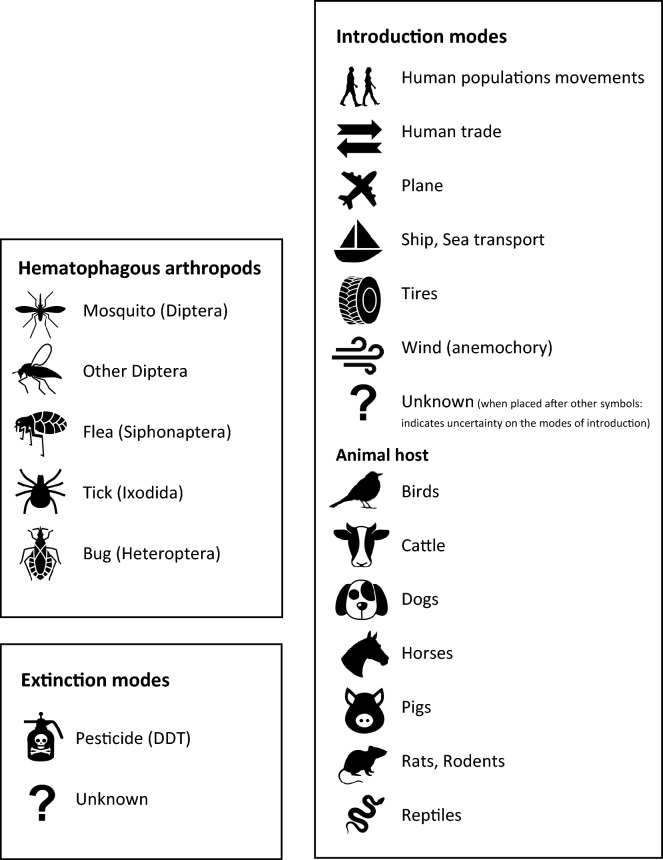
Synthetic representation of the historical trajectory of the different waves of dispersal of hematophagous arthropods. The gray arrow at the top of the figure represents the years from 3000 BC to present time. The solid black lines within the arrow relate to important historical events linked to the dispersion of species (the dotted parts show events either ongoing or with no clear end). Hematophagous arthropod species are identified on the right side of the figure, followed by a symbol representing the taxon (see symbols legend). Each line represents a different wave of dispersal (species with several waves are shown with brackets). For each wave, the geographical details are written following the format “Native Area Alien Area.” Symbols represent the mode of introduction (mechanical and/or via animal hosts) for each wave (see symbols legend). The solid black line represents the time frame of the species’ presence in the alien area. The dotted parts at the end of the lines show either uncertainty in the establishment/extinction dates (particularly when the entire line is dotted) or introduction/extinction occurring during an extended period of time. When the species has become extinct in the alien area, a symbol at the right end of the line represents the mode of extinction (see symbols legend)
Fig. 1
Fig. 1
Synthetic representation of the historical trajectory of the different waves of dispersal of hematophagous arthropods. The gray arrow at the top of the figure represents the years from 3000 BC to present time. The solid black lines within the arrow relate to important historical events linked to the dispersion of species (the dotted parts show events either ongoing or with no clear end). Hematophagous arthropod species are identified on the right side of the figure, followed by a symbol representing the taxon (see symbols legend). Each line represents a different wave of dispersal (species with several waves are shown with brackets). For each wave, the geographical details are written following the format “Native Area Alien Area.” Symbols represent the mode of introduction (mechanical and/or via animal hosts) for each wave (see symbols legend). The solid black line represents the time frame of the species’ presence in the alien area. The dotted parts at the end of the lines show either uncertainty in the establishment/extinction dates (particularly when the entire line is dotted) or introduction/extinction occurring during an extended period of time. When the species has become extinct in the alien area, a symbol at the right end of the line represents the mode of extinction (see symbols legend)

References

    1. Vasilakis N, Tesh RB. Insect-specific viruses and their potential impact on arbovirus transmission. Curr Opin Virol. 2015;15:69–74. - PMC - PubMed
    1. Medlock JM, Hansford KM, Schaffner F, Versteirt V, Hendrickx G, Zeller H, Van Bortel WA. Review of the invasive mosquitoes in Europe: ecology, public health risks, and control options. Vector Borne Zoonotic Dis. 2012;12:435–447. - PMC - PubMed
    1. Bath S, Gething PW, Brady OJ, Messina JP, Farlow AW, Moyes CL, Drake JM, Brownstein JS, Hoen AG, Sankoh O, Myers MF, George DB, Jaenisch T, Wint GRW, Simmons CP, Scott TW, Farrar JJ, Hay SI. The global distribution and burden of dengue. Nature. 2013;496:504–507. - PMC - PubMed
    1. Cuthbert RN, Pattison Z, Taylor NG, Verbrugge L, Diagne C, Ahmed DA, Leroy B, Angulo E, Briski E, Capinha C, Catford JA, Dalu T, Essl F, Gozlan RE, Haubrock PJ, Kourantidou M, Kramer AM, Renault D, Wasserman RJ, Courchamp F. Global economic costs of aquatic invasive alien species. Sci Total Environ. 2021;775:145238. - PubMed
    1. Liu X, Blackburn TM, Song T, Li X, Huang C, Li Y. Risks of biological invasion on the belt and road. Curr Biol. 2019;29:499–505. - PubMed

LinkOut - more resources