The Behaviour Change Technique Ontology: Transforming the Behaviour Change Technique Taxonomy v1
- PMID: 37593567
- PMCID: PMC10427801
- DOI: 10.12688/wellcomeopenres.19363.2
The Behaviour Change Technique Ontology: Transforming the Behaviour Change Technique Taxonomy v1
Abstract
Background: The Behaviour Change Technique Taxonomy v1 (BCTTv1) specifies the potentially active content of behaviour change interventions. Evaluation of BCTTv1 showed the need to extend it into a formal ontology, improve its labels and definitions, add BCTs and subdivide existing BCTs. We aimed to develop a Behaviour Change Technique Ontology (BCTO) that would meet these needs.
Methods: The BCTO was developed by: (1) collating and synthesising feedback from multiple sources; (2) extracting information from published studies and classification systems; (3) multiple iterations of reviewing and refining entities, and their labels, definitions and relationships; (4) refining the ontology via expert stakeholder review of its comprehensiveness and clarity; (5) testing whether researchers could reliably apply the ontology to identify BCTs in intervention reports; and (6) making it available online and creating a computer-readable version.
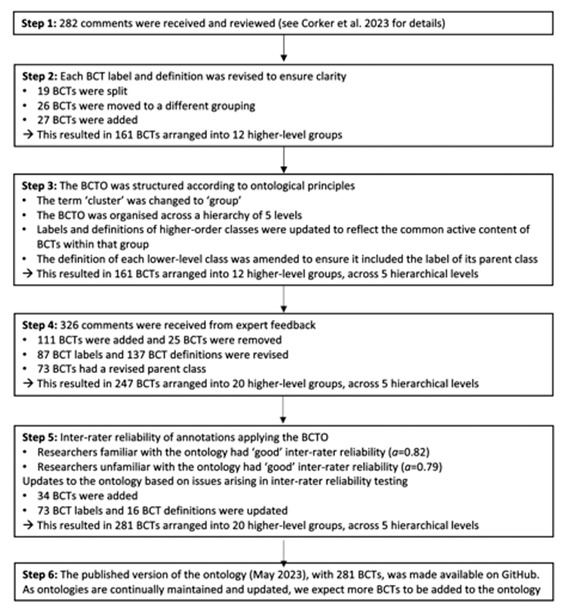
Results: Initially there were 282 proposed changes to BCTTv1. Following first-round review, 19 BCTs were split into two or more BCTs, 27 new BCTs were added and 26 BCTs were moved into a different group, giving 161 BCTs hierarchically organised into 12 logically defined higher-level groups in up to five hierarchical levels. Following expert stakeholder review, the refined ontology had 247 BCTs hierarchically organised into 20 higher-level groups. Independent annotations of intervention evaluation reports by researchers familiar and unfamiliar with the ontology resulted in good levels of inter-rater reliability (0.82 and 0.79, respectively). Following revision informed by this exercise, 34 BCTs were added, resulting in the first published version of the BCTO containing 281 BCTs organised into 20 higher-level groups over five hierarchical levels.
Discussion: The BCTO provides a standard terminology and comprehensive classification system for the content of behaviour change interventions that can be reliably used to describe interventions. The development and maintenance of an ontology is an iterative and ongoing process; no ontology is ever 'finished'. The BCTO will continue to evolve and grow (e.g. new BCTs or improved definitions) as a result of user feedback and new available evidence.
Keywords: behaviour change techniques; intervention reporting; ontology; user feedback.
Copyright: © 2024 Marques MM et al.
Conflict of interest statement
No competing interests were disclosed.
Figures

References
-
- Arp R, Smith B, Spear AD: Building ontologies with basic formal ontology.London, UK: MIT Press,2015. Reference Source - DOI
Grants and funding
LinkOut - more resources
Full Text Sources