. 2023 Nov 2;142(18):1570-1575.
doi: 10.1182/blood.2023021212.

BRAF V600E is associated with higher incidence of second cancers in adults with Langerhans cell histiocytosis

Affiliations

BRAF V600E is associated with higher incidence of second cancers in adults with Langerhans cell histiocytosis

Aldo A Acosta-Medina et al. Blood. .

Abstract

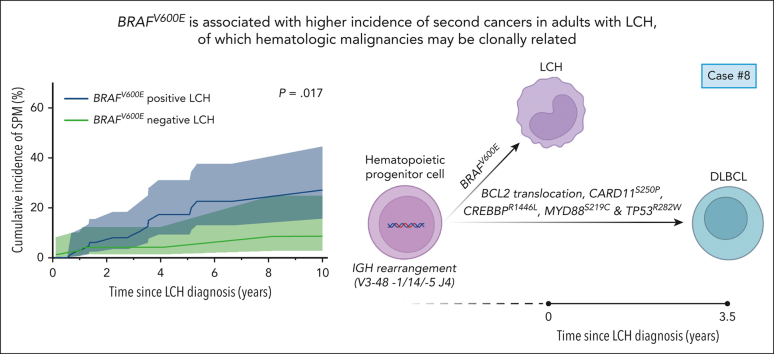
In this retrospective study, BRAF mutation status did not correlate with disease extent or (event-free) survival in 156 adults with Langerhans cell histiocytosis. BRAFV600E was associated with an increased incidence of second malignancies, often comprising hematological cancers, which may be clonally related.


Conflict of interest statement

Conflict-of-interest disclosure: G.G. served on an advisory board for Opna Bio LLC, received royalties from UpToDate, and is a consultant to 2nd.MD. W.O.T. has received research funding from Mallinckrodt Inc, the Center for Multiple Sclerosis and Autoimmune Neurology at Mayo Clinic, and the National Institutes of Health; speaking fees from DKBMed, NeurologyLive, and the American Association for Clinical Chemistry; and publishing royalties from the publication of Mayo Clinic Cases in Neuroimmunology. The remaining authors declare no competing financial interests.

Figures

None
Graphical abstract
Figure 1.
Figure 1.
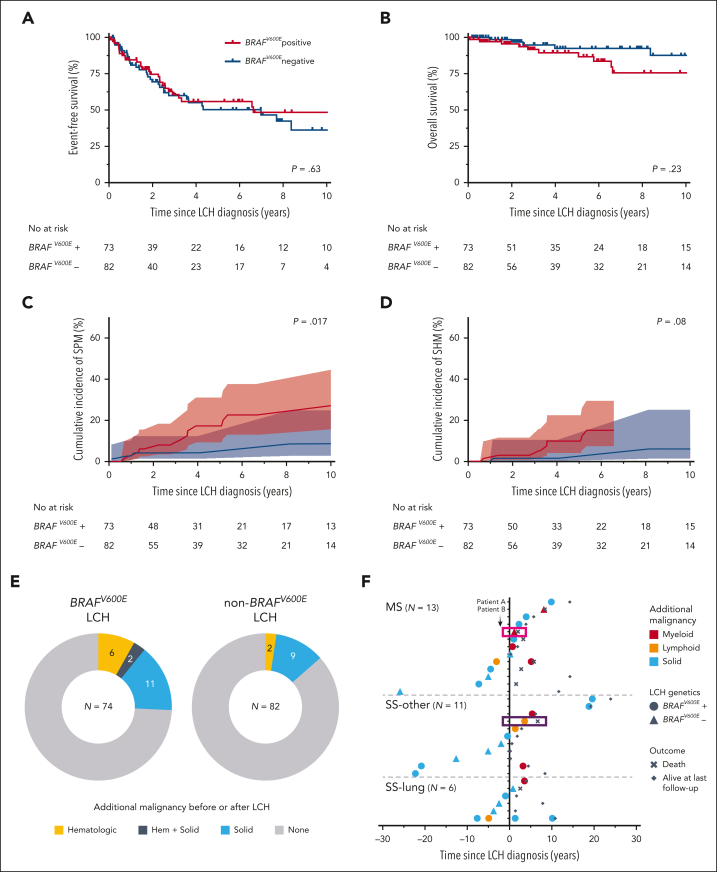
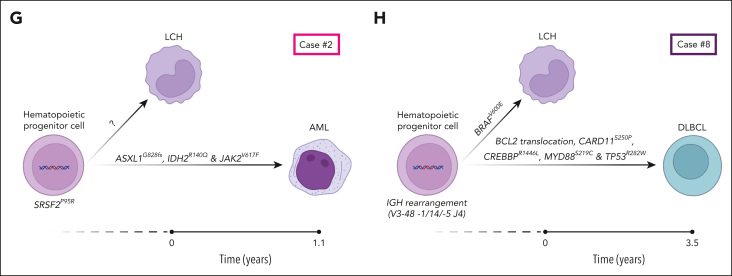
Clinical outcomes according to lesional BRAFV600E status. (A) EFS according to BRAFV600E status. Event was defined as LCH progression, relapse, or death from any cause. (B) Overall survival according to BRAFV600E status. (C) Cumulative incidence of SPMs after LCH diagnosis according to BRAFV600E status, with death as a competing event. Basal cell carcinoma was excluded from analyses of SPMs, given lack of clinical relevance. Colored ribbons indicate 95% confidence intervals. (D) Cumulative incidence of SHMs after LCH diagnosis according to BRAFV600E status, with death as a competing event. Using the etmCIF R function, the curve depicting BRAFV600E-positive patients terminates at 6.57 years, because there are no events (SHMs or death) in this group after this time point. (E) Proportion of patients with ≥1 additional malignancies, irrespective of the occurrence before or after LCH diagnosis, according to LCH lesional BRAFV600E status. (F) Time between diagnosis of LCH and the 35 additional malignancies diagnosed in 30 patients from our cohort. Each virtual horizontal line represents 1 patient. Case 2 is indicated by the pink box; case 8 is indicated by the dark purple box. Patients are grouped by LCH disease extent at diagnosis. (G) Proposed clonal relationship of the LCH and AML in case 2. In separate LCH (time [t] = 0) and AML (t = 1 year) samples, the same SRSF2P95R mutation was identified. The LCH sample was BRAFV600E negative by sequencing and BRAF-VE1 immunohistochemistry; no other MAPK pathway gene alteration was identified. In the AML specimen, additional mutations were detected in ASXL1, IDH2, and JAK2, which were absent in the LCH sample. (H) Proposed clonal relationship of the LCH and DLBCL in case 8. In separate LCH (t = 0) and DLBCL (t = 3.5 years) samples, an identical IGH gene rearrangement was identified by EuroClonality-NGS panels. In addition, BRAFV600E was detected in the LCH sample, but not in the DLBCL sample by BRAF-VE1 immunohistochemistry, allele-specific droplet digital PCR, and NGS. In the DLBCL sample, a BCL2 translocation was observed by fluorescence in situ hybridization, and CARD11S250P (NM_032415: c.T748C), CREBBPR1446L (NM_004380: c.G4337T), MYD88S219C (NM_002468: c.C656G), and TP53R282W (NM_000546: c.C844T) mutations were detected by NGS, which were not present in the LCH sample. Hem, hematologic.
Figure 1.
Figure 1.
Clinical outcomes according to lesional BRAFV600E status. (A) EFS according to BRAFV600E status. Event was defined as LCH progression, relapse, or death from any cause. (B) Overall survival according to BRAFV600E status. (C) Cumulative incidence of SPMs after LCH diagnosis according to BRAFV600E status, with death as a competing event. Basal cell carcinoma was excluded from analyses of SPMs, given lack of clinical relevance. Colored ribbons indicate 95% confidence intervals. (D) Cumulative incidence of SHMs after LCH diagnosis according to BRAFV600E status, with death as a competing event. Using the etmCIF R function, the curve depicting BRAFV600E-positive patients terminates at 6.57 years, because there are no events (SHMs or death) in this group after this time point. (E) Proportion of patients with ≥1 additional malignancies, irrespective of the occurrence before or after LCH diagnosis, according to LCH lesional BRAFV600E status. (F) Time between diagnosis of LCH and the 35 additional malignancies diagnosed in 30 patients from our cohort. Each virtual horizontal line represents 1 patient. Case 2 is indicated by the pink box; case 8 is indicated by the dark purple box. Patients are grouped by LCH disease extent at diagnosis. (G) Proposed clonal relationship of the LCH and AML in case 2. In separate LCH (time [t] = 0) and AML (t = 1 year) samples, the same SRSF2P95R mutation was identified. The LCH sample was BRAFV600E negative by sequencing and BRAF-VE1 immunohistochemistry; no other MAPK pathway gene alteration was identified. In the AML specimen, additional mutations were detected in ASXL1, IDH2, and JAK2, which were absent in the LCH sample. (H) Proposed clonal relationship of the LCH and DLBCL in case 8. In separate LCH (t = 0) and DLBCL (t = 3.5 years) samples, an identical IGH gene rearrangement was identified by EuroClonality-NGS panels. In addition, BRAFV600E was detected in the LCH sample, but not in the DLBCL sample by BRAF-VE1 immunohistochemistry, allele-specific droplet digital PCR, and NGS. In the DLBCL sample, a BCL2 translocation was observed by fluorescence in situ hybridization, and CARD11S250P (NM_032415: c.T748C), CREBBPR1446L (NM_004380: c.G4337T), MYD88S219C (NM_002468: c.C656G), and TP53R282W (NM_000546: c.C844T) mutations were detected by NGS, which were not present in the LCH sample. Hem, hematologic.

References

    1. Goyal G, Tazi A, Go RS, et al. International expert consensus recommendations for the diagnosis and treatment of Langerhans cell histiocytosis in adults. Blood. 2022;139(17):2601–2621. - PubMed
    1. Allen CE, Beverley PCL, Collin M, et al. The coming of age of Langerhans cell histiocytosis. Nat Immunol. 2020;21(1):1–7. - PubMed
    1. Héritier S, Emile J-F, Barkaoui M-A, et al. BRAF mutation correlates with high-risk Langerhans cell histiocytosis and increased resistance to first-line therapy. J Clin Oncol. 2016;34(25):3023–3030. - PMC - PubMed
    1. Kemps PG, Zondag TCE, Arnardóttir HB, et al. Clinicogenomic associations in childhood Langerhans cell histiocytosis: an international cohort study. Blood Adv. 2023;7(4):664–679. - PMC - PubMed
    1. Xiao Y, van Halteren AGS, Lei X, et al. Bone marrow–derived myeloid progenitors as driver mutation carriers in high- and low-risk Langerhans cell histiocytosis. Blood. 2020;136(19):2188–2199. - PubMed

Publication types

MeSH terms

Substances