Review
. 2023 Aug 18;8(1):315.
doi: 10.1038/s41392-023-01559-5.

Hedgehog signaling in tissue homeostasis, cancers, and targeted therapies

Affiliations
Review

Hedgehog signaling in tissue homeostasis, cancers, and targeted therapies

Junjun Jing et al. Signal Transduct Target Ther. .

Abstract

The past decade has seen significant advances in our understanding of Hedgehog (HH) signaling pathway in various biological events. HH signaling pathway exerts its biological effects through a complex signaling cascade involved with primary cilium. HH signaling pathway has important functions in embryonic development and tissue homeostasis. It plays a central role in the regulation of the proliferation and differentiation of adult stem cells. Importantly, it has become increasingly clear that HH signaling pathway is associated with increased cancer prevalence, malignant progression, poor prognosis and even increased mortality. Understanding the integrative nature of HH signaling pathway has opened up the potential for new therapeutic targets for cancer. A variety of drugs have been developed, including small molecule inhibitors, natural compounds, and long non-coding RNA (LncRNA), some of which are approved for clinical use. This review outlines recent discoveries of HH signaling in tissue homeostasis and cancer and discusses how these advances are paving the way for the development of new biologically based therapies for cancer. Furthermore, we address status quo and limitations of targeted therapies of HH signaling pathway. Insights from this review will help readers understand the function of HH signaling in homeostasis and cancer, as well as opportunities and challenges of therapeutic targets for cancer.


Conflict of interest statement

The authors declare no competing interests. C.Z., who is a member of the editorial board of Signal Transduction and Targeted Therapy, was not involved in the handling process of this manuscript.

Figures
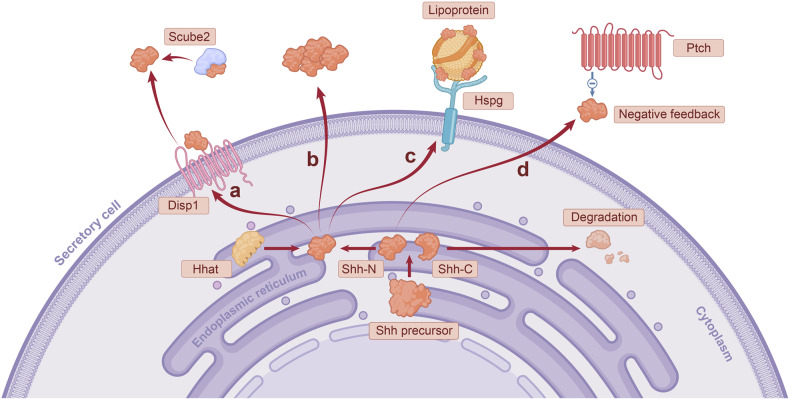
Fig. 1
Fig. 1
Activation and spread of hedgehog ligands in secretory cells. The three vertebrate hedgehog ligands Shh, Dhh and Ihh have similar secretion processes, differing slightly in the tissue distribution of the three. The figure shows the secretion of Shh as an example of the secretion process of hedgehog ligands. Activation of Shh occurs in the endoplasmic reticulum (ER). The Shh precursor is first processed into two parts, Shh-N and Shh-C. The carboxyl terminus of Shh-N is bound to cholesterol by a protein hydrolytic cleavage process, while the amino terminus of Shh-N is bound to palmitic acid mediated by Hhat. In contrast, Shh-C is degraded after being transported out of the ER. There are several mechanisms for the diffusion of Shh-N out of secretory cells after activation: a Shh-N is mainly transported out of secretory cells by the synergistic action of Disp1 and Scube2. b The polymerization of monomer-activated Shh-N into multimolecules facilitates the diffusion of ligands. c Hspg is localized to the secretory cell membrane, which recruits lipoprotein. Shh-N is loaded on the lipoprotein as a "passenger" for long-distance transportation. d Ptch1 on the surface of the receiving cells has a negative feedback regulation on the release of Shh-N
Fig. 2
Fig. 2
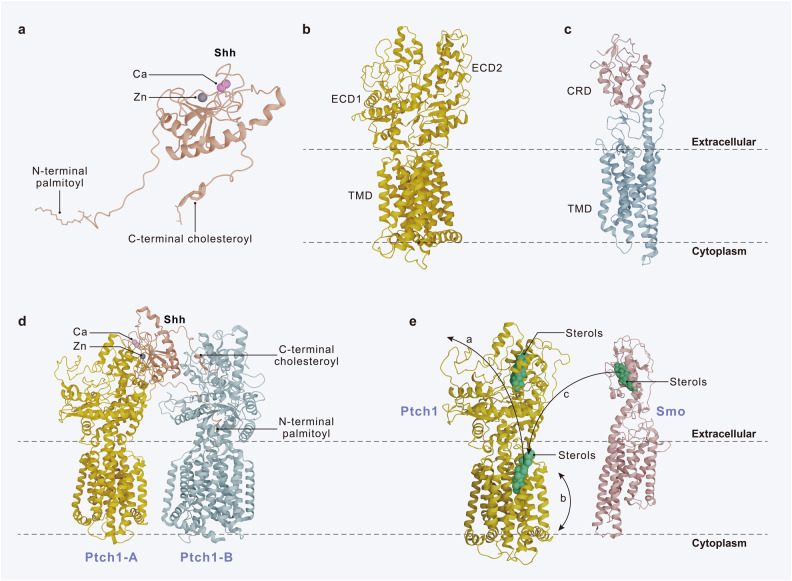
Three-dimensional structure of Shh, Ptch1 and Smo. a The structure of the activated Shh. b The structure of Ptch1. c The structure of Smo. d The structure of the 1Shh:2 Ptch1 complex. Ptch1-A binds to Shh at the interface of its calcium and zinc binding sites, which drives Ptch1 degradation. Ptch1-B binds to the N-terminal palmitoyl and C-terminal cholesterol modifications of Shh and anchors to the core of Ptch1 protein, which decreases the protein activity of Ptch1. e Mechanism of Smo inhibition by Ptch1. Ptch1 regulates the binding of sterols to Smo, and hence inhibits the activity of Smo. Three possible mechanisms are shown by the black arrows. a Sterols move from the outer leaflet of the membrane to ECD1 via Ptch1, which depletes the sterols inside the membrane. b Ptchl inhibits Smo activity by decreasing its accessibility to sterols from the inner leaflet of the membrane. c Ptch1 accepts sterols from CRD and transports them to the membrane, thereby inhibiting Smo activity
Fig. 3
Fig. 3
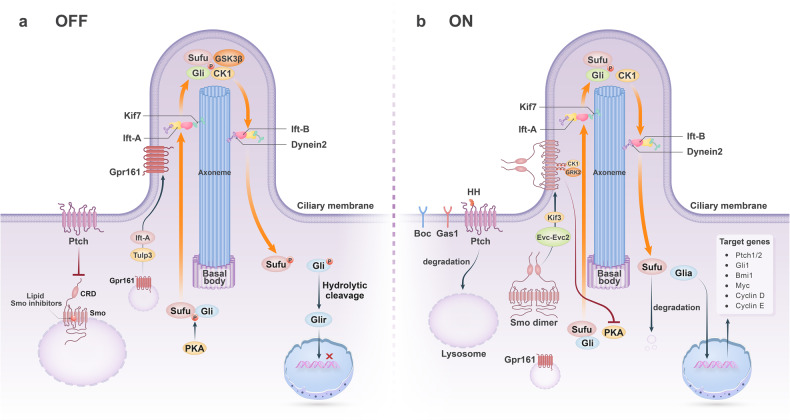
Primary cilia play a key role in HH signaling pathway. Primary cilia are composed of ciliary membrane, axoneme and basal body. The proper functioning of HH signaling relies on the Ift mechanism. Ift-B complex protein and Ift-A complex protein together constitute Ift trains that carry motors with HH signaling components sliding on the axoneme. Kinesin mediates transport from the base to the tip of the cilium, while dynein2 mediates transport from the tip to the base of the cilium. a Receptor cells are closed to signal transduction. In the absence of hedgehog ligand, Ptch1 inhibits Smo. Lipid Smo inhibitors bind to the TMD region of Smo, inhibit Smo activity, and constrain Smo to the cytoplasm. Gpr161 localizes to the cilia in the presence of Ift-A and Tulp3. Gpr161 induces PKA activity, and PKA phosphorylates the Sufu/Gli complex. Kinesin Kif7 then transports the complex to the cilia tip. Sufu is further phosphorylated by GSK3β; Gli is further phosphorylated by CK1 and GSK3β. The complex then dissociates and Gli is processed by protein hydrolytic cleavage to Glir, which subsequently enters the nucleus to repress target gene transcription. b Receptor cells are open to signal transduction. In the presence of Hedgehog ligand, the inhibition of Smo by Ptch is released and Ptch is transported to the lysosome for degradation. The co-receptors Boc and Gas1 can interact with Ptch1 and Ptch2 to form a receptor complex respectively, thereby promoting or inhibiting signal transduction. The concentration of intracellular lipid Smo inhibitor ligands decreases and Smo forms an activated dimeric form that is transported by Kinesin Kif3 and Evc-Evc2 proteins to the cilia membrane near the basolateral. The Smo carboxyl terminus is then fully activated by phosphorylation of CK1 and GRK2. After Smo activation, Gpr161 returns to the cytoplasm. Meanwhile, activated Smo inhibits PKA activity and is not sufficient to phosphorylate the Sufu/Gli complex. The unphosphorylated complex is transported to the cilia tip by Kinesin Kif7. The unphosphorylated Sufu is degraded by ubiquitination; Gli is phosphorylated by CK1 to form Glia. Glia enters the nucleus to promote the transcription of related target genes, such as Ptch1/2, which acts as a negative regulator of signal transduction, Gli1, which amplifies signals, Bmi1, which encodes a transcriptional repressor, and Myc, Cyclin D, and Cyclin E, which encode cell cycle regulators
Fig. 4
Fig. 4
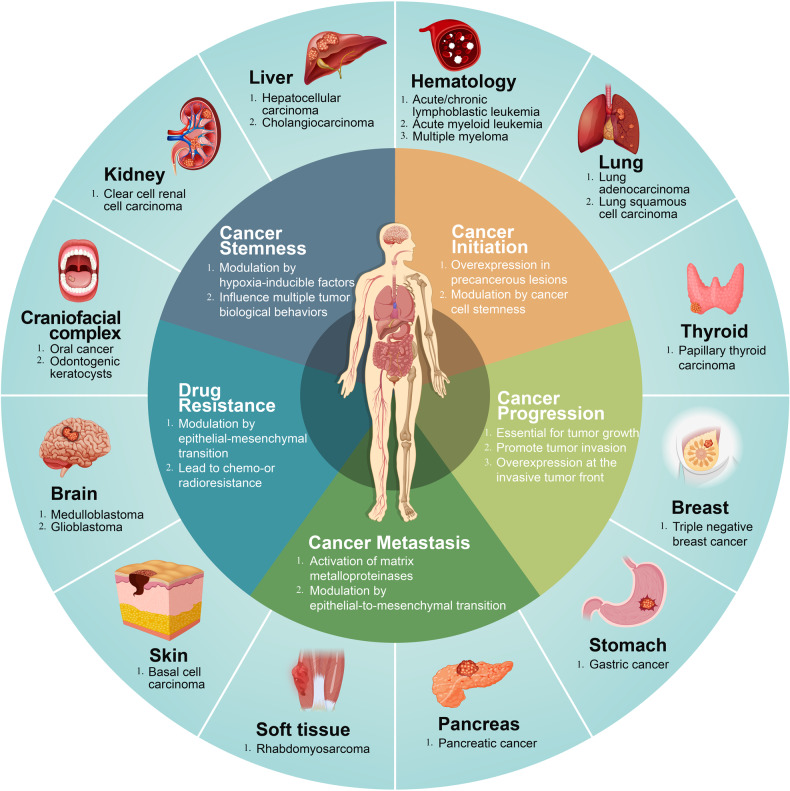
Summary of types of cancer caused by dysregulation of HH signaling pathway. The inner circle present five aspects of tumor biological behavior which are influenced by HH signaling pathway. The outer circle shows the representative cancers discussed in the review. The online resources in the picture were obtained from the website: www.699pic.com and www.vecteezy.com
Fig. 5
Fig. 5
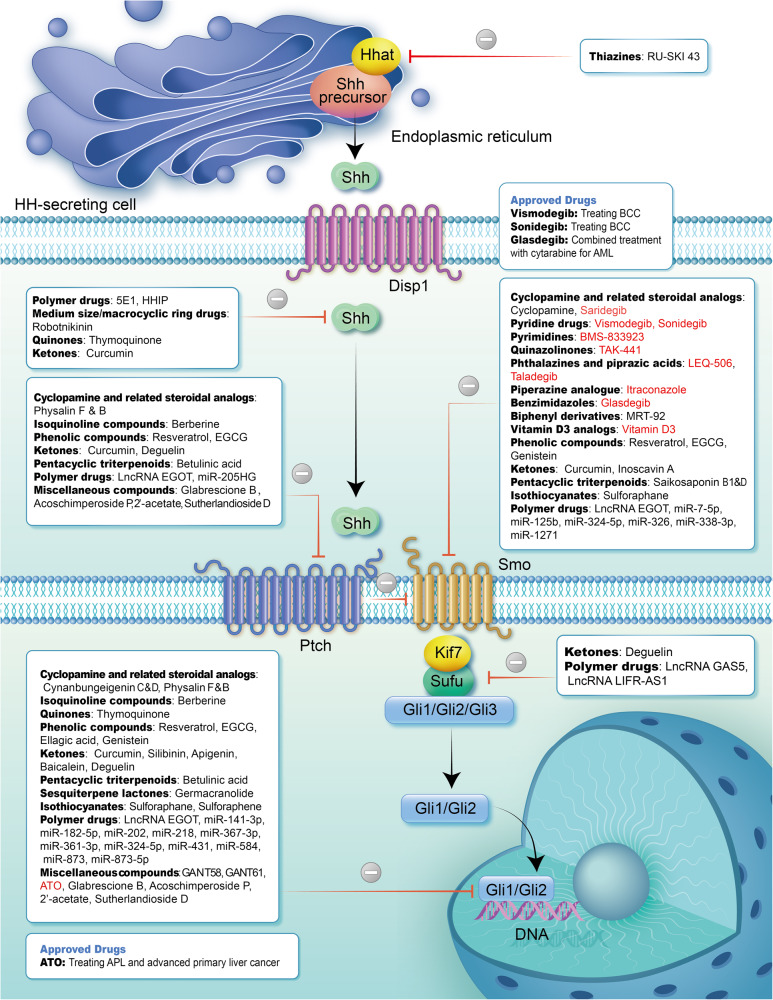
Inhibitors targeting HH signaling pathway. In this figure, we mainly show the inhibitors targeting HH signaling pathway, classified according to the properties of the compounds, and the inhibitors in ongoing or completed clinical trials are shown in red. Approved drugs are individually identified, including their indications. BCC basal cell carcinomas, AML acute myeloid leukemia, APL acute promyelocytic leukemia

References

    1. Cavodeassi, F., Creuzet, S. & Etchevers, H. The hedgehog pathway and ocular developmental anomalies. Hum. Genet.138, 917–936 (2019). - PMC - PubMed
    1. Ingham, P. Drosophila segment polarity mutants and the rediscovery of the hedgehog pathway genes. Curr. Top. Dev. Biol.116, 477–488 (2016). - PubMed
    1. Ingham, P. Hedgehog signaling. Curr. Top. Dev. Biol.149, 1–58 (2022). - PubMed
    1. Gonzalez, D. & Medici, D. Signaling mechanisms of the epithelial-mesenchymal transition. Sci. Signal7, re8 (2014). - PMC - PubMed
    1. Briscoe, J. & Thérond, P. The mechanisms of Hedgehog signalling and its roles in development and disease. Nat. Rev. Mol. Cell Biol.14, 416–429 (2013). - PubMed

Publication types

Substances