Review
. 2023 Dec;37(12):607-656.
doi: 10.1007/s10822-023-00513-5. Epub 2023 Aug 19.

Conformational energies of reference organic molecules: benchmarking of common efficient computational methods against coupled cluster theory

Affiliations
Review

Conformational energies of reference organic molecules: benchmarking of common efficient computational methods against coupled cluster theory

Ioannis Stylianakis et al. J Comput Aided Mol Des. 2023 Dec.

Erratum in

Abstract

We selected 145 reference organic molecules that include model fragments used in computer-aided drug design. We calculated 158 conformational energies and barriers using force fields, with wide applicability in commercial and free softwares and extensive application on the calculation of conformational energies of organic molecules, e.g. the UFF and DREIDING force fields, the Allinger's force fields MM3-96, MM3-00, MM4-8, the MM2-91 clones MMX and MM+, the MMFF94 force field, MM4, ab initio Hartree-Fock (HF) theory with different basis sets, the standard density functional theory B3LYP, the second-order post-HF MP2 theory and the Domain-based Local Pair Natural Orbital Coupled Cluster DLPNO-CCSD(T) theory, with the latter used for accurate reference values. The data set of the organic molecules includes hydrocarbons, haloalkanes, conjugated compounds, and oxygen-, nitrogen-, phosphorus- and sulphur-containing compounds. We reviewed in detail the conformational aspects of these model organic molecules providing the current understanding of the steric and electronic factors that determine the stability of low energy conformers and the literature including previous experimental observations and calculated findings. While progress on the computer hardware allows the calculations of thousands of conformations for later use in drug design projects, this study is an update from previous classical studies that used, as reference values, experimental ones using a variety of methods and different environments. The lowest mean error against the DLPNO-CCSD(T) reference was calculated for MP2 (0.35 kcal mol-1), followed by B3LYP (0.69 kcal mol-1) and the HF theories (0.81-1.0 kcal mol-1). As regards the force fields, the lowest errors were observed for the Allinger's force fields MM3-00 (1.28 kcal mol-1), ΜΜ3-96 (1.40 kcal mol-1) and the Halgren's MMFF94 force field (1.30 kcal mol-1) and then for the MM2-91 clones MMX (1.77 kcal mol-1) and MM+ (2.01 kcal mol-1) and MM4 (2.05 kcal mol-1). The DREIDING (3.63 kcal mol-1) and UFF (3.77 kcal mol-1) force fields have the lowest performance. These model organic molecules we used are often present as fragments in drug-like molecules. The values calculated using DLPNO-CCSD(T) make up a valuable data set for further comparisons and for improved force field parameterization.

Keywords: B3LYP; Conformational energies; DLPNO-CCSD(T); Force fields; Organic molecules.


Conflict of interest statement

The authors declare no competing financial interest.

Figures
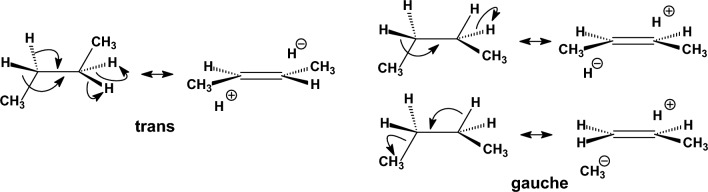
Fig. 1
Fig. 1
Hyperconjugative interactions in trans and gauche n-butane. There are four hyperconjugative σC-Η → σ*C-H interactions in trans conformation but two σC-H → σ*C-Η and two σC-Η → σ*C-C in gauche conformation
Fig. 2
Fig. 2
The stabilisation of staggered configuration with respect to eclipsed in ethane comes from the hyperconjugative orbital interactions σC-H → σ*C-H
Fig. 3
Fig. 3
1,1,2,2-Tetrasubstituted ethane conformations. The opening up of bond angles R-C-R caused by steric crowding of methyl groups does not lead to additional unfavourable interactions in gauche conformation (F → H) but it causes stereochemical tension in anti conformation (E → G)
Fig. 4
Fig. 4
Conformations of 1-butene
Fig. 5
Fig. 5
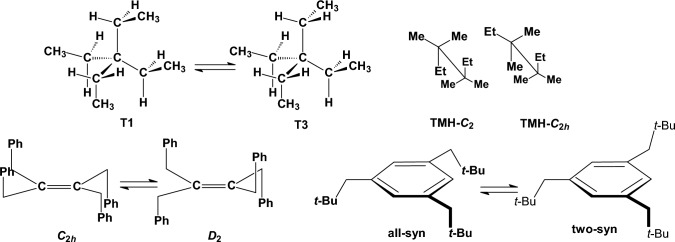
Low energy conformations for tetraethylmethane, tetramethylhexane, tetrabenzylethene and tri-(neopentyl)benzene
Fig. 6
Fig. 6
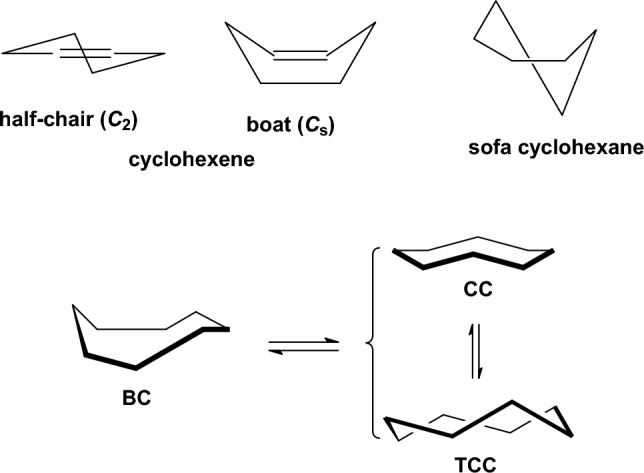
Conformers of cyclohexane, cyclohexene and cyclooctane
Fig. 7
Fig. 7
A Shows the stabilization of the gauche conformation by rotation about C2-C3 bond in 1-fluoropropane through attractive electrostatic interactions (left) and/or via hyperconjugative interaction (right). B Shows destabilisation of the anti conformer because of shaping bended bond C-C (left) and stabilisation of gauche conformation in 1,2-difluoroethane via hyperconjugative phenomenon (right). C Shows the conformarions of 1,3-dichloropropane
Fig. 8
Fig. 8
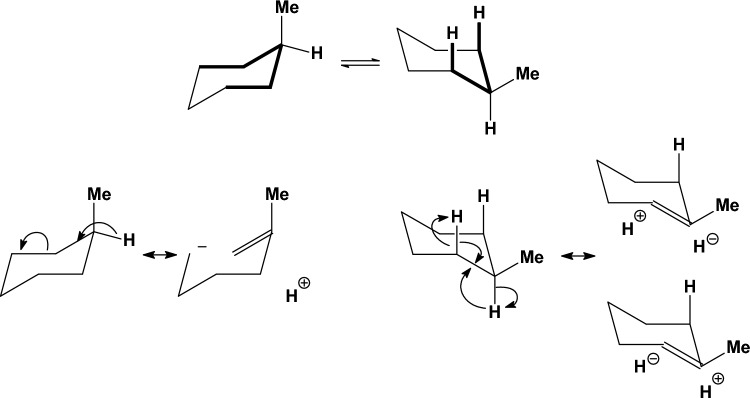
Top: equilibrium between low energy conformers in methylcyclohexane and the C-H bonds which participated (in bold) in the most important hyperconjugative interactions. Bottom: C-H bond participates in two hyperconjugative interactions in axial methylcyclohexane and in four hyperconjugative interactions in equatorial conformer
Fig. 9
Fig. 9
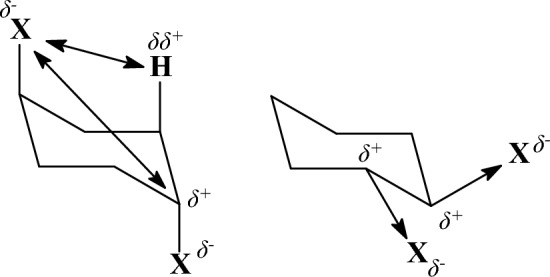
Diaxial conformations of 1,4-dihalo cyclohexane (left) and di-equatorial conformation in 1,2-dihalo cyclohexane (right)
Fig. 10
Fig. 10
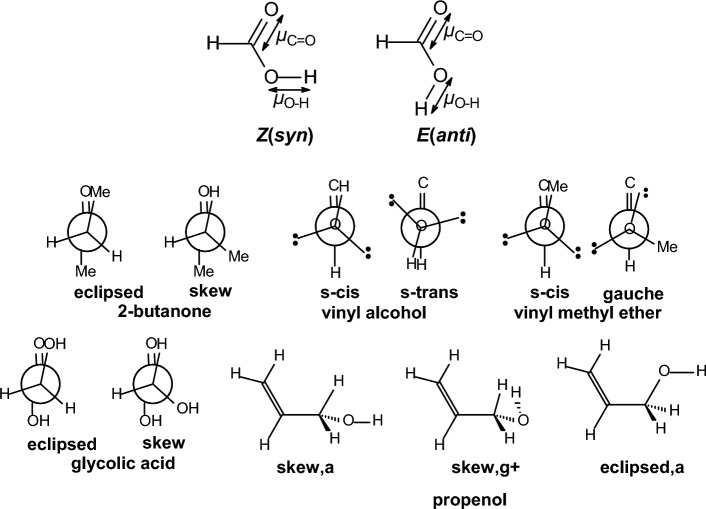
Low energy conformers of 2-butanone, vinyl alcohol, vinyl methyl ether, glycolic acid and propenol
Fig. 11
Fig. 11
Conformations of cyclodecanone
Fig. 12
Fig. 12
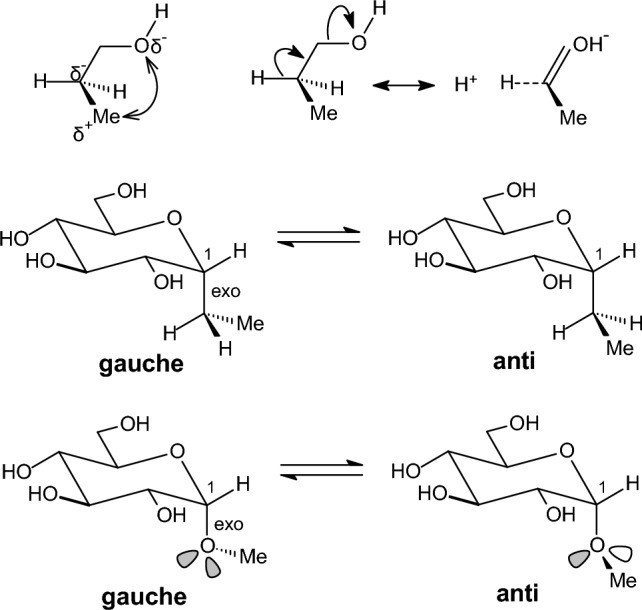
Top: stabilization of gauche conformation of 1-propanol over anti conformation by rotation of C2-C3 bond is likely due to electrostatical interactions (left) and hyperconjugative interactions (right). Middle and bottom: the same conformational preferences are observed for the O-C1-Cexo-C dihedral in C- and O-glycosides
Fig. 13
Fig. 13
The buttressing effect of methyl groups forces the O-Me group in cis-2,6-dimethyl-1-methoxycyclohexane eclipsing tertiary C-H bond
Fig. 14
Fig. 14
Conformations around central C-O bonds in acetals R1CH(OR2)(OR3)
Fig. 15
Fig. 15
Conformations of 1,2-ethanediol and description of the conformarional space of trehalose by rotation around dihedral angles φ and φ
Fig. 16
Fig. 16
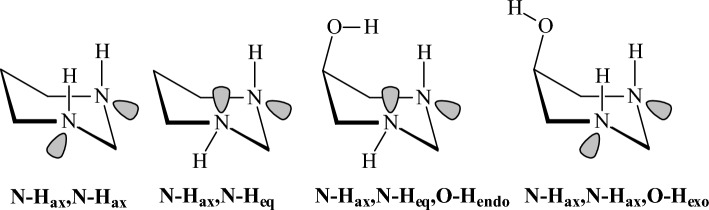
Conformations of hexahydropyrimidine and of its 3-OH analogue
Fig. 17
Fig. 17
Conformations of diamines H2N(CH2)xNH2 (x = 2–4) around N-C-C-N (G or T) and lp-N-C-C (g or g+ and g' or g−) dihedral angles
Fig. 18
Fig. 18
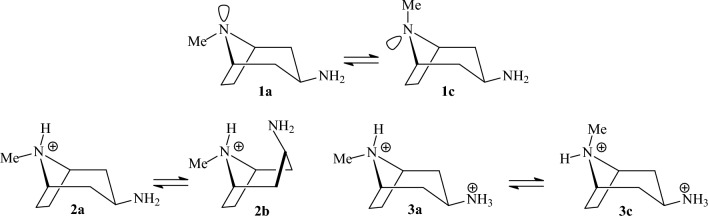
Low energy conformers of β-aminotropane and its cations
Fig. 19
Fig. 19
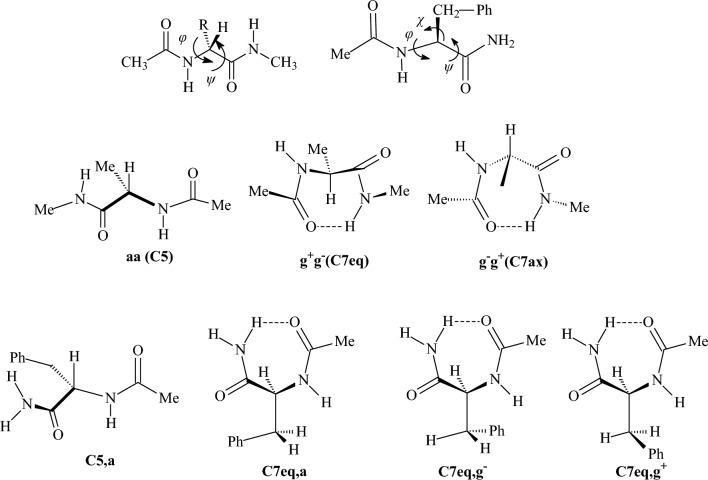
Low energy conformers of N-acetylalanine-N-methylamide and of N-acetylphenylalaninyl-amide (NAPA) by rotation around φ (OC-N-C-CO), ψ (N-C-CO-N) and χ (N-C-C-Cipso) dihedral angles; Ramachandran and IUPAC definitions are used
Fig. 20
Fig. 20
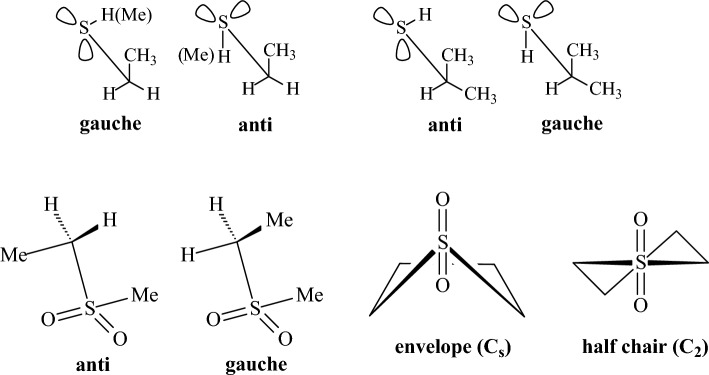
Low energy conformers of EtSH, MeSEt, i-PrSH and of the sulfones MeSO2Et and cyclopentanesulfone (sulfolane)
Fig. 21
Fig. 21
Conformations of ethyldimethylphosphine and trimethoxyphosphate
Fig. 22
Fig. 22
Possible structures for the transition state by rotation around CO-N bond
Fig. 23
Fig. 23
Ring inversion transition states for cyclohexane, cyclohexene and N-methylpiperidine
Fig. 24
Fig. 24
Comparative performance (mean error in kcal mol−1) of different theories using 158 conformational energies and barriers from 145 standard organic molecules compared to the DLPNO-CCSD(T)/cc-pVTZ calculated values

References

    1. Kitchen DB, Decornez H, Furr JR, Bajorath J. Docking and scoring in virtual screening for drug discovery: methods and applications. Nat Rev Drug Discov. 2004;3:935–949. doi: 10.1038/nrd1549. - DOI - PubMed
    1. Mohamadi F, Richards NGJ, Guida WC, et al. Macromodel? An integrated software system for modeling organic and bioorganic molecules using molecular mechanics. J Comput Chem. 1990;11(4):440–467. doi: 10.1002/jcc.540110405. - DOI
    1. Taylor RD, Jewsbury PJ, Essex JW. A review of protein-small molecule docking methods. J Comput Aided Mol Des. 2002;16:151–166. doi: 10.1023/A:1020155510718. - DOI - PubMed
    1. Song CM, Lim SJ, Tong JC. Recent advances in computer-aided drug design. Brief Bioinform. 2009;10:579–591. doi: 10.1093/bib/bbp023. - DOI - PubMed
    1. Ferreira LG, Dos Santos RN, Oliva G, Andricopulo AD. Molecular docking and structure-based drug design strategies. Molecules. 2015;20:13384–13421. doi: 10.3390/molecules200713384. - DOI - PMC - PubMed

Publication types