. 2023 Oct:66:102852.
doi: 10.1016/j.redox.2023.102852. Epub 2023 Aug 16.

Remote ischemic conditioning attenuates oxidative stress and inflammation via the Nrf2/HO-1 pathway in MCAO mice

Affiliations

Remote ischemic conditioning attenuates oxidative stress and inflammation via the Nrf2/HO-1 pathway in MCAO mice

Ying-Ying Sun et al. Redox Biol. 2023 Oct.

Abstract

The protective effects of remote ischemic conditioning (RIC) on acute ischemic stroke have been reported. However, the protective mechanisms of RIC have not been fully elucidated. This study aimed to investigate whether RIC could reduce oxidative stress and inflammatory responses in middle cerebral artery occlusion (MCAO)-reperfusion mice via the nuclear factor-E2-related factor 2 (Nrf2)/heme oxygenase-1 (HO-1) pathway. C57BL/6 mice were subjected to MCAO and underwent RIC twice daily at 1, 3, and 7 days after MCAO. ML385 was used to specifically inhibit Nrf2 in MCAO mice. Neurological deficit scores, infarct volume, and hematoxylin-eosin (HE) staining were assessed. Oxidative stress levels were assessed based on total antioxidant capacity (TAC), malonaldehyde (MDA), superoxide dismutase (SOD), and glutathione/glutathione disulfide (GSH/GSSG). mRNA levels were detected using real-time polymerase chain reaction (PCR), and protein levels were detected using western blotting and enzyme-linked immunosorbent assay (ELISA). Protein localization was investigated using immunofluorescence staining. RIC significantly reduced infarct volume and improved neurological function and histological changes after MCAO. RIC significantly increased TAC, SOD, and GSH/GSSG levels and decreased MDA levels. RIC significantly increased Nrf2 and HO-1 mRNA levels and decreased Keap1, NLRP3, and Cleaved Caspase-1 mRNA levels. RIC significantly increased Nrf2, HO-1, and NQO1 protein expression and decreased Keap1, NLRP3, Cleaved Caspase-1, Cleaved IL-1β, IL-6, and TNF-α protein expression. RIC promoted the activation and translocation of Nrf2 into the nucleus. The protective effects of RIC were abolished by ML385 treatment. In conclusion, our findings suggest that RIC alleviates oxidative stress and inflammatory responses via the Nrf2/HO-1 pathway, which in turn improves neurobehavioral function. RIC may provide novel therapeutic options for acute ischemic stroke.

Keywords: Inflammation; MCAO; Nrf2/HO-1 pathway; Oxidative stress; Remote ischemic conditioning.


Conflict of interest statement

Declaration of competing interest The authors declare that they have no known competing financial interests or personal relationships that could have appeared to influence the work reported in this paper.

Figures

Image 1
Graphical abstract
Fig. 1
Fig. 1
RIC improved neurological function in MCAO mice. (A) Study flow chart. (B) Femoral artery blood flow before, during, and after RIC. (C–E) Neurological deficit scores based on Zea Longa, Bederson, and modified Garcia scores at 1, 3, and 7 days after MCAO. *P < 0.05, **P < 0.01, ***P < 0.001.
Fig. 2
Fig. 2
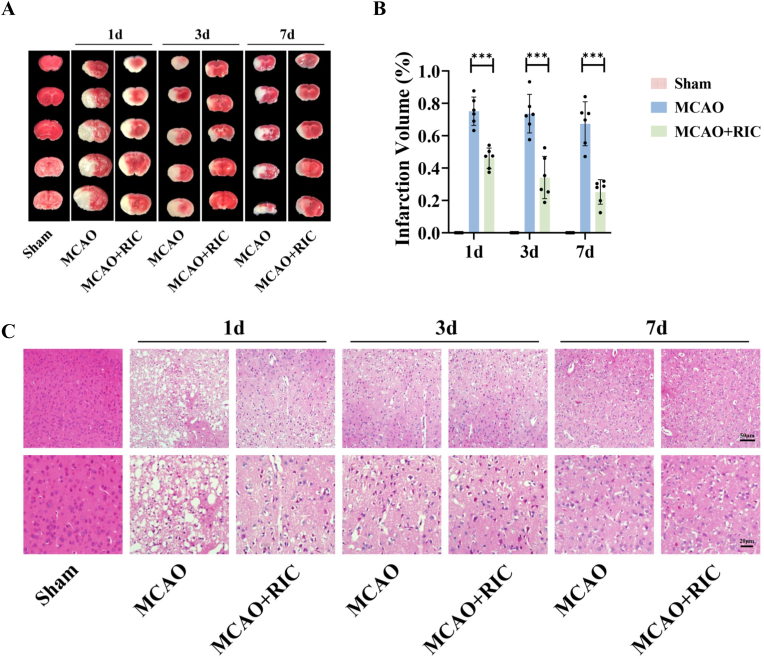
RIC reduced infarct volume and improved histological changes in the infarcted cortex. (A–B) TTC staining and analysis of infarct volume at 1, 3, and 7 days after MCAO. (C) HE staining at 1, 3, and 7 days after MCAO. ***P < 0.001.
Fig. 3
Fig. 3
RIC increased Nrf2 and HO-1 protein levels and decreased NLRP3 and Cleaved Caspase-1 protein levels. (A) Western blotting of Nrf2, HO-1, NLRP3, Cleaved Caspase-1, and β-actin at 1, 3, and 7 days after MCAO. (B–E) Analysis of Nrf2, HO-1, NLRP3, and Cleaved Caspase-1 protein levels at 1, 3, and 7 days after MCAO. *P < 0.05, **P < 0.01, ***P < 0.001.
Fig. 4
Fig. 4
RIC improved neurological function and reduced infarct volume by attenuating oxidative stress levels. (A–C) Neurological deficit scores based on Zea Longa, Bederson, and modified Garcia scores at 3 days after MCAO. (D–E) TTC staining and analysis of infarct volume at 3 days after MCAO. (F–I) TAC, MDA, SOD, and GSH/GSSG levels at 3 days after MCAO. *P < 0.05, **P < 0.01, ***P < 0.001.
Fig. 5
Fig. 5
RIC attenuated oxidative stress and inflammatory responses via the Nrf2/HO-1 pathway. (A–E) Analysis of mRNA levels of Nrf2, Keap1, HO-1, NLRP3, and Cleaved Caspase-1 at 3 days after MCAO. (F) Western blotting of Nrf2, Keap1, HO-1, NQO1, NLRP3, Cleaved Caspase-1, Cleaved IL-1β, and β-actin at 3 days after MCAO. (G–M) Analysis of protein levels of Nrf2, Keap1, HO-1, NQO1, NLRP3, Cleaved Caspase-1, and Cleaved IL-1β at 3 days after MCAO. *P < 0.05, **P < 0.01, ***P < 0.001.
Fig. 6
Fig. 6
Immunofluorescence staining of Nrf2 and Keap1 localization and the protein levels by ELISA. (A) The results demonstrated that Nrf2 was activated and translocated to the nucleus, and Keap1 expression was reduced in the MCAO + RIC group than in the MCAO group. Nrf2 expression was significantly suppressed, and Keap1 expression was significantly increased in the MCAO + RIC + ML385 group than in the MCAO + RIC and MCAO + RIC + Vehicle groups. (B–D) The protein levels of Cleaved IL-1β, IL-6, and TNF-α by ELISA at 3 days after MCAO. *P < 0.05, **P < 0.01, ***P < 0.001.

References

    1. Collaborators G.B.D.S. Global, regional, and national burden of stroke and its risk factors, 1990-2019: a systematic analysis for the global burden of disease study 2019. Lancet Neurol. 2021;20(10):795–820. doi: 10.1016/S1474-4422(21)00252-0. - DOI - PMC - PubMed
    1. Chen H., He Y., Chen S., Qi S., Shen J. Therapeutic targets of oxidative/nitrosative stress and neuroinflammation in ischemic stroke: applications for natural product efficacy with omics and systemic biology. Pharmacol. Res. 2020;158 doi: 10.1016/j.phrs.2020.104877. - DOI - PubMed
    1. Kopacz A., Kloska D., Forman H.J., Jozkowicz A., Grochot-Przeczek A. Beyond repression of Nrf2: an update on Keap1. Free Radic. Biol. Med. 2020;157:63–74. doi: 10.1016/j.freeradbiomed.2020.03.023. - DOI - PMC - PubMed
    1. Yamamoto M., Kensler T.W., Motohashi H. The KEAP1-NRF2 system: a thiol-based sensor-effector apparatus for maintaining redox homeostasis. Physiol. Rev. 2018;98(3):1169–1203. doi: 10.1152/physrev.00023.2017. - DOI - PMC - PubMed
    1. Loboda A., Damulewicz M., Pyza E., Jozkowicz A., Dulak J. Role of Nrf2/HO-1 system in development, oxidative stress response and diseases: an evolutionarily conserved mechanism. Cell. Mol. Life Sci. 2016;73(17):3221–3247. doi: 10.1007/s00018-016-2223-0. - DOI - PMC - PubMed

Publication types