


Therapy by physician-pharmacist combination and economic returns for cancer pain management in China: a cost-effectiveness analysis
- PMID: 37601047
- PMCID: PMC10436594
- DOI: 10.3389/fphar.2023.1073939
Therapy by physician-pharmacist combination and economic returns for cancer pain management in China: a cost-effectiveness analysis
Erratum in
-
Corrigendum: Therapy by physician-pharmacist combination and economic returns for cancer pain management in China: a cost-effectiveness analysis.Front Pharmacol. 2023 Nov 17;14:1327256. doi: 10.3389/fphar.2023.1327256. eCollection 2023. Front Pharmacol. 2023. PMID: 38044935 Free PMC article.
Abstract
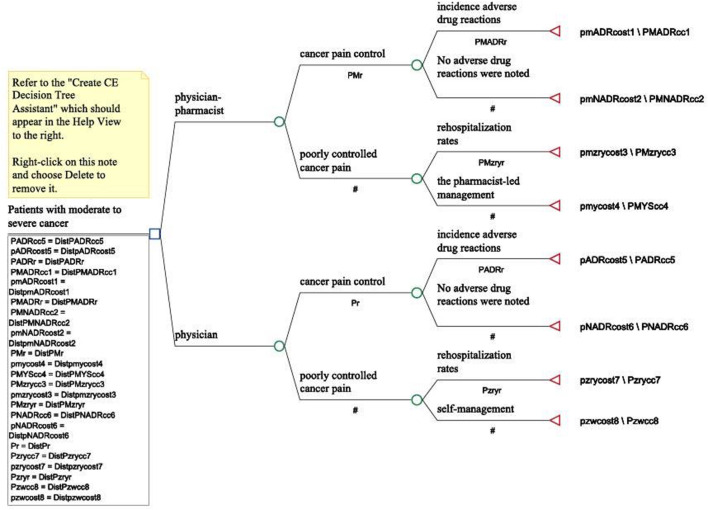
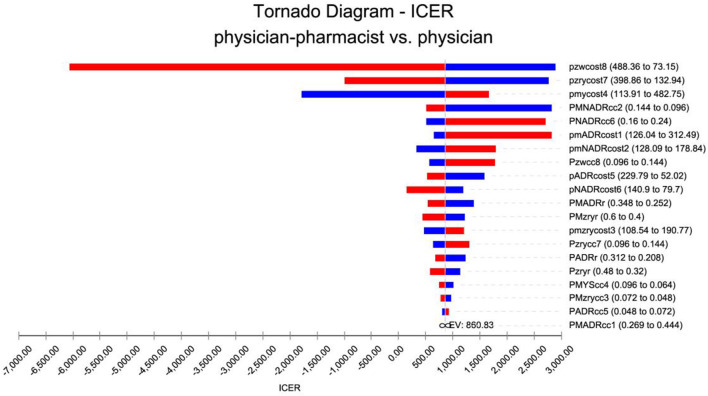
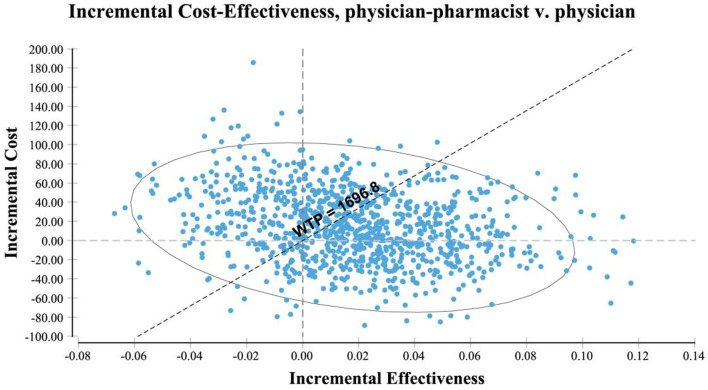
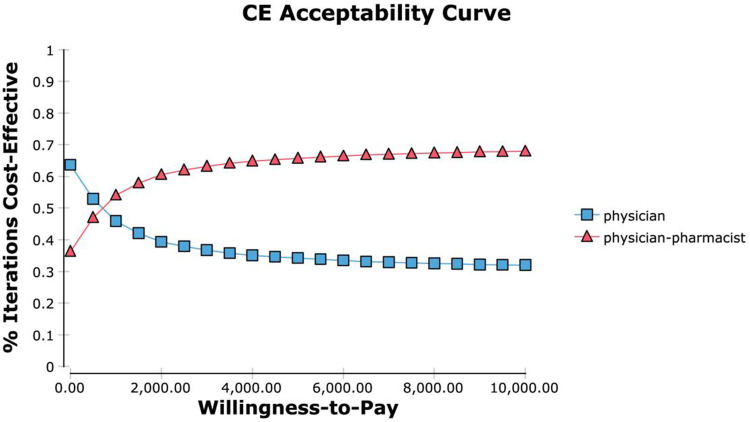
Objective: To examine whether joint management of cancer pain by physicians and pharmacists in clinics provides economic advantages from the perspective of the Chinese healthcare system. Methods: From February 2018 to March 2020, 100 patients who visited the joint cancer pain clinic at the Xiangya Hospital of Central South University were included. These patients were randomly assigned to either the control or intervention groups. The control group received regular outpatient services from a physician, while the intervention group received regular outpatient services from a physician and medication education provided by a pharmacist. The study considered various direct costs, including drug expenses, physician-pharmacist outpatient services, adverse event management, consultations, examinations, and readmissions. The outcome indicators considered were the cancer pain control rate and the reduction in pain scores. Decision tree modeling, single-factor sensitivity analysis, and probabilistic sensitivity analysis were performed to evaluate the cost-effectiveness of joint physician-pharmacist outpatient services compared to physician-alone outpatient services. Results: The intervention group showed a significantly higher cancer pain control rate than the control group (0.69 vs. 0.39, p = 0.03). In the decision tree model, the intervention group had a significantly lower pain score than the control group (0.23 vs. 0.14). The cost per person in the intervention group was $165.39, while it was $191.1 per person in the control group. The univariate sensitivity analysis showed that the cost of self-management for patients in the control group was identified as the primary sensitivity factor. Probabilistic sensitivity analysis indicated that the joint clinic group had a favorable incremental cost-effectiveness compared to the physician clinic group. In addition, the probabilistic sensitivity analysis demonstrated an absolute advantage in the incremental cost-effectiveness of the joint clinic group over the outpatient physician group. Conclusion: The participation of pharmacists in joint cancer pain clinic services led to improved pain management for patients, demonstrating a clear advantage in terms of cost-effectiveness.
Keywords: cancer pain; cost-effectiveness analysis; decision trees; economics; physician-pharmacist.
Copyright © 2023 Lu, Zhang, Huang, Wu, Wang, Huang, Li, Yu, Zhang and Xiao.
Conflict of interest statement
The authors declare that the research was conducted in the absence of any commercial or financial relationships that could be construed as a potential conflict of interest.
Figures
References
-
- Copenhaver D. J., Huang M., Singh J., Fishman S. M. (2021). History and epidemiology of cancer pain. Berlin, Germany: Springer International Publishing, 3–15. - PubMed
-
- Feng W., Wang Y., Ran F., Mao Y., Zhang H., Wang Q., et al. (2022). The effectiveness and safety of the rapid titration strategy of background controlled-release oxycodone hydrochloride for patients with moderate-to-severe cancer pain: A retrospective cohort study. Front. Med. (Lausanne) 9, 918468. 10.3389/fmed.2022.918468 - DOI - PMC - PubMed
-
- Liu K. (2019). Application of intelligent pharmaceutical service platform for the treatment of cancer pain in outpatient. Berlin, Germany: Springer.
LinkOut - more resources
Full Text Sources
