


Bilingual resuscitation training does not affect adherence to resuscitation guidelines but reduces leadership skills and overall team performance. An observational study with cross-border German-Polish training
- PMID: 37601413
- PMCID: PMC10436166
- DOI: 10.1016/j.resplu.2023.100436
Bilingual resuscitation training does not affect adherence to resuscitation guidelines but reduces leadership skills and overall team performance. An observational study with cross-border German-Polish training
Abstract
Aim of study: This study aims to investigate feasibility and quality of a bilingual cardiopulmonary resuscitation training with interprofessional emergency teams from Germany and Poland.
Methods: As part of a cross-border European Territorial Cooperation (Interreg-VA) funded project a combined communication and simulation training was organised. Teams of German and Polish emergency medicine personnel jointly practised resuscitation. The course was held in both languages with consecutive translation.Quality of chest compression was assessed using a simulator with feedback application. Learning objectives (quality of cardiopulmonary resuscitation, adherence to guidelines, closed loop communication), and team performance were assessed by an external observer. Coopeŕs Team Emergency Assessment Measure questionnaire was used.
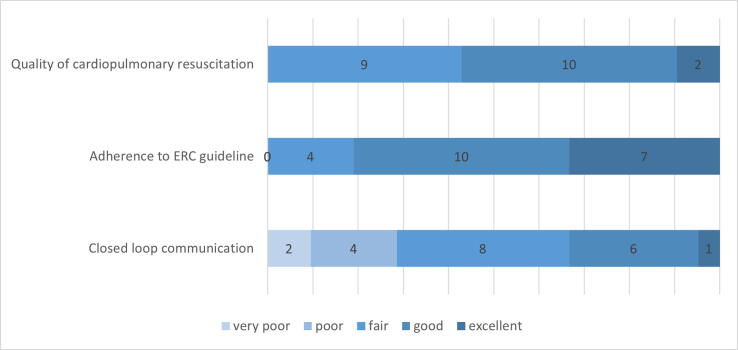
Results: Twenty-one scenarios with 17 participants were analysed. In all scenarios, defibrillation and medication were delivered with correct dosage and at the right time. Mean fraction of correct hand position was 85.7% ± 25.7 [95%-CI 74.0; 97.4], mean fraction of compression depth 75.1% ± 21.0 [95%-CI 65.6; 84.7], compression rate 117.7 min-1 ± 7.1 [95%-CI 114.4; 120.9], and chest compression fraction 83.3% ± 3.8 [95%-CI 81.6; 85.0].Quality of cardiopulmonary resuscitation was rated as "fair" to "good", adherence to guidelines as "good", and closed loop communication as "fair". Bilingual teams demonstrated good situational awareness, but lack of leadership and suboptimal overall team performance.
Conclusion: Bilingual and interprofessional cross-border resuscitation training in German and Polish tandem teams is feasible. It does not affect quality of technical skills such as high-quality chest compression but does affect performance of non-technical skills (e.g. closed loop communication and leadership).
Keywords: Advanced life support; Bilingual; Cross-border; Interprofessional; Resuscitation training; Simulation training.
© 2023 The Authors.
Conflict of interest statement
The authors declare the following financial interests/personal relationships which may be considered as potential competing interests: The simulation training we are reporting about was funded by the European Union with-in the scope of Interreg VA -Mecklenburg-Vorpommern/Brandenburg/Pomerania.
Figures
References
-
- Perkins G.D., Graesner J.-T., Semeraro F., et al. European Resuscitation Council Guidelines 2021: executive summary. Resuscitation. 2021;161:1–60. - PubMed
-
- Olasveengen T.M., Semeraro F., Ristagno G., et al. European Resuscitation Council Guidelines 2021: basic life support. Resuscitation. 2021;161:98–114. - PubMed
-
- Gräsner J.-T., Herlitz J., Tjelmeland I.B.M., et al. European Resuscitation Council Guidelines 2021: epidemiology of cardiac arrest in Europe. Resuscitation. 2021;161:61–79. - PubMed
-
- Fleßa S. In: Sektoren- und grenzüberschreitende Gesundheitsversorgung: Risiken und Chancen. Zygmunt M., editor. Med. Wiss. Verl.-Ges; Berlin: 2013. Wirtschaftliche Grundlagen der grenzüberschreitenden Versorgung; pp. 11–21.
-
- Schwarzenberg T. Negotiating invisible lines: Cross-border emergency care in the rural north of Scandinavia. Nor Geogr Tidsskr – Norwegian J Geography. 2019;73:139–155.
LinkOut - more resources
Full Text Sources
Research Materials
Miscellaneous
