Screen Time at Age 1 Year and Communication and Problem-Solving Developmental Delay at 2 and 4 Years
- PMID: 37603356
- PMCID: PMC10442786
- DOI: 10.1001/jamapediatrics.2023.3057
Screen Time at Age 1 Year and Communication and Problem-Solving Developmental Delay at 2 and 4 Years
Abstract
Importance: Whether some domains of child development are specifically associated with screen time and whether the association continues with age remain unknown.
Objective: To examine the association between screen time exposure among children aged 1 year and 5 domains of developmental delay (communication, gross motor, fine motor, problem-solving, and personal and social skills) at age 2 and 4 years.
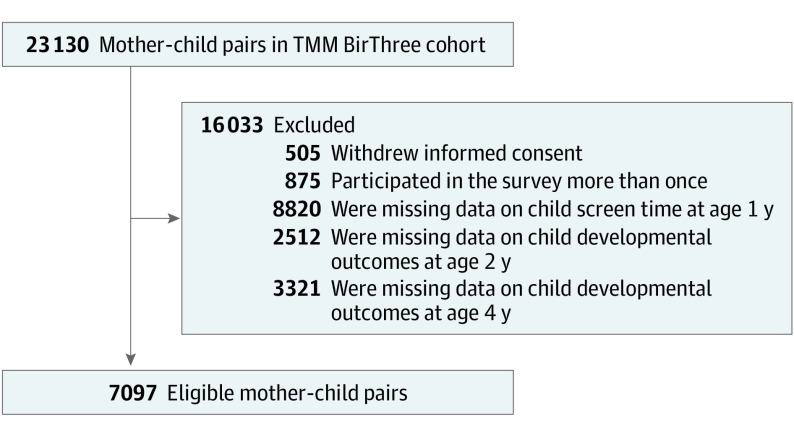
Design, participants, and setting: This cohort study was conducted under the Tohoku Medical Megabank Project Birth and Three-Generation Cohort Study. Pregnant women at 50 obstetric clinics and hospitals in the Miyagi and Iwate prefectures in Japan were recruited into the study between July 2013 and March 2017. The information was collected prospectively, and 7097 mother-child pairs were included in the analysis. Data analysis was performed on March 20, 2023.
Exposure: Four categories of screen time exposure were identified for children aged 1 year (<1, 1 to <2, 2 to <4, or ≥4 h/d).
Main outcomes and measures: Developmental delays in the 5 domains for children aged 2 and 4 years were assessed using the Japanese version of the Ages & Stages Questionnaires, Third Edition. Each domain ranged from 0 to 60 points. Developmental delay was defined if the total score for each domain was less than 2 SDs from its mean score.
Results: Of the 7097 children in this study, 3674 were boys (51.8%) and 3423 were girls (48.2%). With regard to screen time exposure per day, 3440 children (48.5%) had less than 1 hour, 2095 (29.5%) had 1 to less than 2 hours, 1272 (17.9%) had 2 to less than 4 hours, and 290 (4.1%) had 4 or more hours. Children's screen time was associated with a higher risk of developmental delay at age 2 years in the communication (odds ratio [OR], 1.61 [95% CI, 1.23-2.10] for 1 to <2 h/d; 2.04 [1.52-2.74] for 2 to <4 h/d; 4.78 [3.24-7.06] for ≥4 vs <1 h/d), fine motor (1.74 [1.09-2.79] for ≥4 vs <1 h/d), problem-solving (1.40 [1.02-1.92] for 2 to <4 h/d; 2.67 [1.72-4.14] for ≥4 vs <1 h/d), and personal and social skills (2.10 [1.39-3.18] for ≥4 vs <1 h/d) domains. Regarding risk of developmental delay at age 4 years, associations were identified in the communication (OR, 1.64 [95% CI, 1.20-2.25] for 2 to <4 h/d; 2.68 [1.68-4.27] for ≥4 vs <1 h/d) and problem-solving (1.91 [1.17-3.14] for ≥4 vs <1 h/d) domains.
Conclusions and relevance: In this study, greater screen time for children aged 1 year was associated with developmental delays in communication and problem-solving at ages 2 and 4 years. These findings suggest that domains of developmental delay should be considered separately in future discussions on screen time and child development.
Conflict of interest statement
Figures
References
-
- World Health Organization . Guidelines on physical activity, sedentary behaviour and sleep for children under 5 years of age. 2019. Accessed June 11, 2022. https://apps.who.int/iris/handle/10665/311664 - PubMed
-
- Aguilar-Farias N, Toledo-Vargas M, Miranda-Marquez S, et al. . Sociodemographic predictors of changes in physical activity, screen time, and sleep among toddlers and preschoolers in Chile during the COVID-19 pandemic. Int J Environ Res Public Health. 2020;18(1):176. doi:10.3390/ijerph18010176 - DOI - PMC - PubMed